How to Choose A Customizable Compliance Training Platform: Buyer's Guide



Not all customizable compliance training is created equal—learn how to evaluate platforms on depth, self-serve workflows, and audit-ready reporting.

Not all customizable compliance training is created equal—learn how to evaluate platforms on depth, self-serve workflows, and audit-ready reporting.
- Why generic compliance training falls short
- What customizable training actually means (and how it addresses compliance gaps)
- What to evaluate when comparing customizable compliance training platforms
- Hidden costs and questions to ask every vendor
- How to launch customized training without building courses from scratch
- Choose a compliance training platform built for real customization
Test Your Compliance
Find out if your company is compliant in two minutes with our free Compliance Grader.
Get Your Free ReportEvery compliance training vendor claims their platform is "customizable." But when you dig in, "customizable" can mean anything from swapping a logo to building entire courses from scratch.
For HR and compliance leaders, this gap between marketing claims and actual capabilities can create wasted budget and slow rollouts, while training that still doesn't reflect your company's policies adds to the risk.
In this guide, you'll learn what customization actually means across three distinct levels and how to evaluate vendors with a practical checklist. You'll also discover where hidden costs show up and how to move from policy document to live training without a months-long project.
Why generic compliance training falls short
Off-the-shelf compliance training delivers identical content to every employee, regardless of role, department, or location. A warehouse worker in California and a remote software engineer in New York receive the same harassment prevention training, with the same examples and the same policy references.
The consequences are pretty predictable. Employees tune out when training doesn't match their day-to-day work, and completion rates drop when content feels irrelevant. So when training doesn't reflect your actual policies or local regulations, it creates compliance gaps that surface during audits or during an incident investigation.
Generic training also misses the mark on state-specific requirements. For example, California, New York, and Illinois each have distinct harassment prevention training mandates. A single generic course can't address these differences, leaving your organization exposed to regulatory risk in the states that matter most.
What customizable training actually means (and how it addresses compliance gaps)
Customizable compliance training is training that can be tailored to reflect your company's specific policies, procedures, and workplace examples. But not every platform means the same thing when they say "customizable."
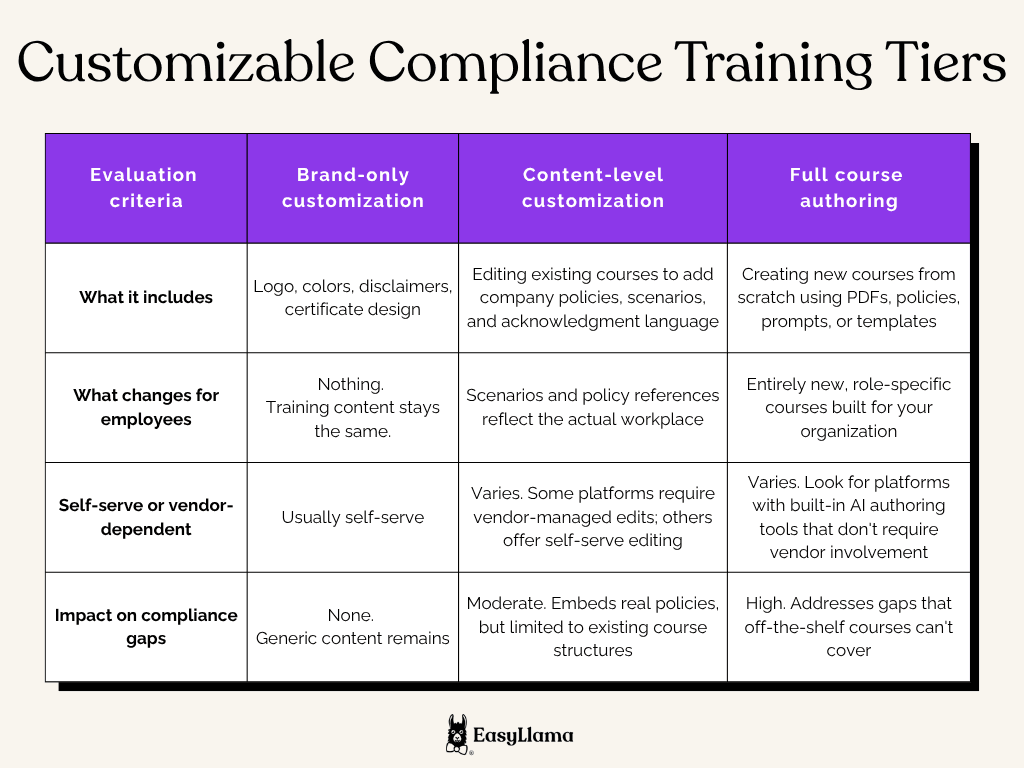
Here's how to evaluate vendor claims by understanding three distinct levels of customization:
Brand-only customization
This is the most basic level. It includes adding your logo, adjusting brand colors, and customizing certificate designs. Brand-only customization is table stakes. It doesn't change the training content employees actually receive, and it won't address compliance gaps tied to your specific policies or state requirements.
Content-level customization
Content-level customization means editing existing courses to embed your company's policies, internal resources, and workplace-specific scenarios. This is where relevance starts to improve.
However, some platforms lock content editing behind vendor-managed services. You submit a request and wait days or weeks for changes. Others offer self-serve editing so your team can make updates directly.
Full course authoring
Full course authoring means creating entirely new courses from scratch or from existing materials like PDFs, slide decks, or internal policy documents. EasyLlama's Course Authoring Tool, for example, enables HR teams to turn policies or a simple prompt into structured, role-specific courses using AI.
Customization at the content and authoring levels improves training relevance, which directly boosts engagement and retention. When employees see scenarios that mirror their actual workplace, they pay attention. Interactive, scenario-based training helps learners practice applying policies instead of passively reading them.
The most effective approach is often a hybrid one. Start with expert-built compliance courses for core topics, then layer on custom content for company-specific needs.
What to evaluate when comparing customizable compliance training platforms
The checklist below maps directly to the capabilities HR teams need most when evaluating customizable compliance training solutions. Use these questions during vendor demos and trials to understand what "customizable" actually means for each platform.
Content and course creation capabilities
Start by understanding how each platform handles content creation and editing. Ask yourself these questions about any platform you're evaluating:
- Can you edit existing courses, or can you only build from scratch?
- Can you create courses from internal documents like PDFs and policies?
- Does the platform offer interactive templates and scenario-based formats?
- How quickly can a non-technical admin create and publish a new course?
Self-serve course creation matters because vendor-dependent customization creates bottlenecks. When every change requires a support ticket and a two-week turnaround, your training can't keep pace with policy changes or new regulatory requirements.
EasyLlama, for example, offers both: a library of 450+ expert-designed courses that can be customized, plus a full AI-powered Course Authoring Tool for building new courses from scratch. Everything is self-serve, with no vendor involvement required.
Administration, automation, and integrations
Smooth administration keeps training on track after launch. Ask yourself these questions about platform administration:
- Does the platform integrate with your HRIS and payroll systems?
- Can training be automatically assigned based on role, department, or hire date?
- Does it support automated reminders across multiple channels like email, SMS, and Slack?
- Do you need vendor involvement to customize assignment rules?
Integration depth determines how much manual work your team carries after launch. Look for platforms that connect to your existing HRIS and payroll systems so employee records and training assignments update automatically as your workforce changes. Automated reminders sent through the channels your team already uses reduce the follow-up burden on HR.
Reporting, audit documentation, and compliance tracking
Strong reporting protects your organization when auditors come calling. Ask yourself these questions about reporting and audit readiness:
- Can you generate custom reports by department, location, and role without IT support?
- Does the platform automatically generate completion certificates and signature records?
- Can you export audit-ready documentation on demand? Does reporting update in real time?
Audit readiness is a key evaluation criterion. Scattered tracking across spreadsheets and multiple systems creates gaps that surface during audits and investigations. When your completion records live in one place with real-time updates, you can respond to auditors in minutes instead of scrambling for days.
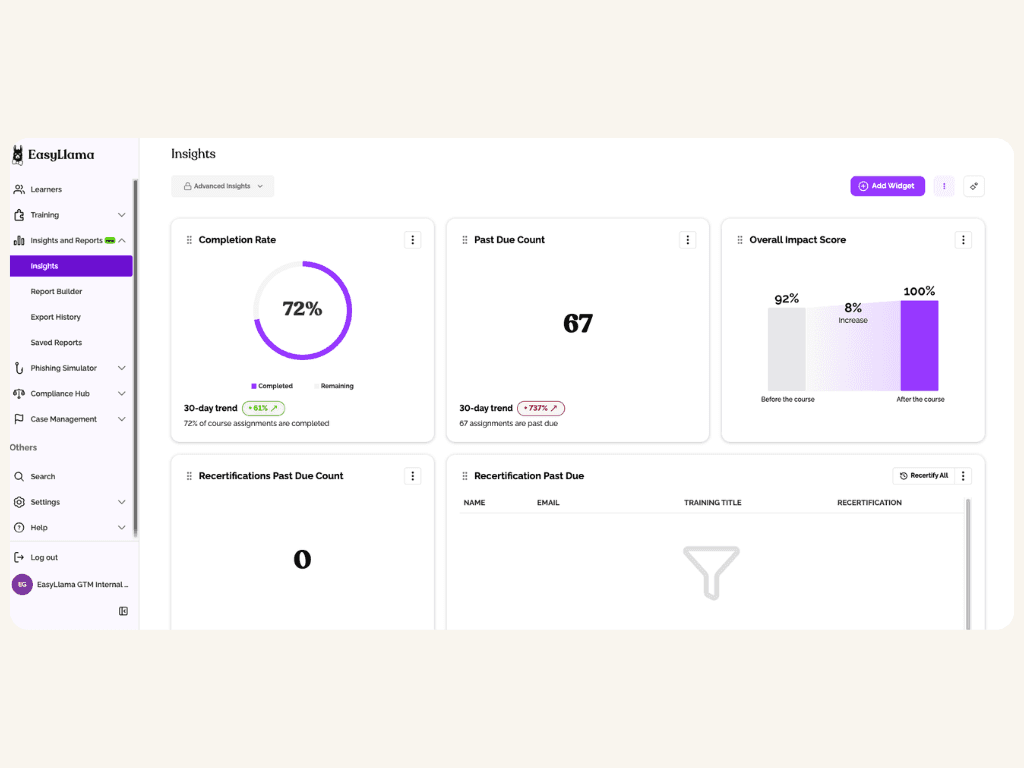
The best platforms let HR create custom dashboards by department, state, and role without IT support. Look for automatically generated completion certificates and signature records, plus export-ready documentation for immediate audit response. EasyLlama's Custom Report Builder, for instance, handles all of this in one place. For a deeper look at what to track, see this guide to effective LMS reporting.
Regulatory updates and content maintenance
Keeping training current protects your organization from evolving legal risk. Ask yourself these questions about content maintenance:
- How does the platform handle changes in regulations?
- Are courses updated automatically when laws change?
- Can you edit and republish custom courses after launch without starting over?
Compliance training that doesn't keep pace with regulatory changes exposes your organization to legal risk. When a state updates its harassment prevention requirements or a federal agency issues new guidance, your training needs to reflect those changes quickly.
Look for platforms where courses are continuously updated by legal and compliance experts to reflect changing laws. Custom courses should also be editable and republishable at any time, so you're never locked into outdated content.
Hidden costs and questions to ask every vendor
"Customizable" claims often come with hidden costs that only surface after you've signed a contract. Watch for content services fees when vendors charge extra for managed edits. Per-course charges for custom content can add up fast. Long lead times when customization requests sit in a queue slow your rollout. Limited admin seats restrict who can manage training day-to-day.
Before purchasing, ask every vendor these direct questions:
- Is customization self-serve, or does it require vendor involvement?
- Are there additional fees for custom content creation or course editing?
- What is the typical lead time from request to published course?
- Can you customize training for specific states and regulations? For example, California-specific harassment prevention training.
- Are there limits on the number of admin users or custom courses?
- What does pricing look like? Is it published and transparent, or quote-only?
Some vendors, like EasyLlama, publish pricing openly with no setup fees or admin seat limits. If a vendor won't share pricing without a sales call, treat that as a signal worth noting.
How to launch customized training without building courses from scratch
The real pain point most HR teams face is actually finding the time to build what they need. Between onboarding cycles, policy updates, and day-to-day operations, creating customized compliance training from scratch might feel impossible.
Here's the practical workflow that eliminates the false choice between "use generic training" and "spend weeks building custom courses":
- Start with expert-built compliance content for core topics like harassment prevention and workplace safety.
- Upload your internal policies or procedures directly into the platform.
- Use AI to tailor content by audience and role. A good course authoring tool can generate structured courses from a PDF, a policy document, or a simple prompt.
- Publish and assign. Automated rules handle distribution by role, department, and hire date.
You're not starting from a blank page with this approach. You're building on a foundation of expert-vetted content and layering your organization's specific context on top.
Microlearning formats (5-to-10-minute modules) also let employees complete training in short breaks instead of sitting through hour-long sessions. This reduces workflow disruption and makes completion more manageable for distributed teams.
With the right platform, this process can move fast. Most EasyLlama clients, for instance, implement in less than a day, and some in less than an hour.
Choose a compliance training platform built for real customization
When you evaluate customizable compliance training platforms, focus on how deeply the platform supports customization, from surface-level branding through full course authoring. Self-serve workflows, integration capabilities, audit-ready reporting, and transparent pricing all matter equally.
The right customizable compliance training platform reduces implementation time and improves employee engagement. It also produces the audit-ready records HR teams need to stay legally protected.
EasyLlama delivers all three levels of customization, from branded certificates to full AI-powered course authoring, with the integrations, automation, and reporting to support training at scale.
Book a demo to see how EasyLlama helps HR teams launch customized compliance training faster.
Share this


 Articles
Read More Blogs
Explore what others in your field are learning

What Is Compliance Reporting? A Practical Guide for HR Teams
Learn how HR teams should be tracking and documenting training completions, policy acknowledgments, and certifications to prove your organization meets its legal and regulatory obligations
Sarah Hamilton

How to Automate Compliance Reporting (Without Spreadsheets)
Learn how to automate compliance reporting for your HR team with real-time dashboards, automated alerts, and audit-ready evidence you can pull in minutes.

Alicia Falcon

How to Customize Harassment Prevention Training Without Breaking Compliance
Learn how to customize your Harassment Prevention training without breaking compliance. Tailor course to your employees, company policies, and more to maximize knowledge retention and training impact.
Alicia Falcon
Start Modernizing Workplace Compliance
It’s easy to get started with EasyLlama. Speak with one of our compliance experts and get a demo tailored to your business’s needs.