What Is Compliance Reporting? A Practical Guide for HR Teams



Learn how HR teams should be tracking and documenting training completions, policy acknowledgments, and certifications to prove your organization meets its legal and regulatory obligations

Learn how HR teams should be tracking and documenting training completions, policy acknowledgments, and certifications to prove your organization meets its legal and regulatory obligations
- What is compliance reporting?
- Why compliance reporting matters for HR teams
- What a compliance report should include
- Supporting documentation
- Essential HR compliance reports every team should maintain
- Compliance metrics HR teams should track
- How to move from reactive to proactive compliance reporting
- Build a compliance reporting process your team can trust
Test Your Compliance
Find out if your company is compliant in two minutes with our free Compliance Grader.
Get Your Free ReportWhen an auditor asks for proof that every employee completed harassment prevention training last year, the answer should take minutes. Not days. Not a frantic search through spreadsheets, email threads, and vendor portals.
But for many HR teams, that scramble is probably the norm, which creates a compliance reporting process that only works when someone is actively chasing it down. But it doesn't have to be this way. Compliance reporting can become an always-on system that protects your organization and gives HR teams the proof they need on demand.
This guide breaks down what compliance reporting includes for HR, the reports every team should maintain, the metrics worth tracking, and how to shift from reactive to proactive.
What is compliance reporting?
At its core, compliance reporting is the process of documenting and producing records that prove your organization meets its legal and regulatory obligations. For HR teams specifically, this means tracking training completions and policy acknowledgments. It also means maintaining the evidence that employees received the required education on time.
Most folks define compliance reporting in terms of financial regulations like SOX or security frameworks like PCI-DSS. Those are valid, but they miss the HR side of the picture. HR compliance reporting centers on the workforce: who was assigned what training, who completed it, when they finished, and whether the records hold up under scrutiny.
Why compliance reporting matters for HR teams
Compliance reporting should go beyond checking a box. It's the evidence trail that protects your organization when audits, investigations, or legal reviews happen. Without it, HR teams are left trying to reconstruct records after the fact, often under pressure and with incomplete information.
Here's what strong compliance reporting gives you:
- Audit readiness: Produce proof of training completion in minutes instead of scrambling across systems.
- Legal protection: Maintain defensible records that demonstrate your organization met its obligations.
- Risk reduction: Identify gaps in training coverage before they become violations or incidents.
- Accountability: Give leadership and legal counsel clear visibility into who completed what and when.
- Stakeholder confidence: Show board members, regulators, and insurers that compliance is an active priority.
There are significant consequences to think about if you don't manage to maintain compliance.
Consider a harassment complaint where the organization cannot prove the employee received harassment prevention training. Without a timestamped completion record, the company has no defensible position. Courts have consistently held that employers who cannot demonstrate adequate training programs have a weaker defense in discrimination and harassment claims, particularly under the Faragher-Ellerth affirmative defense standard.
These challenges grow for distributed teams managing multiple locations, roles, and jurisdictions. Each state or region may have different training requirements, and keeping track of who needs what becomes exponentially harder without a centralized system.
What a compliance report should include
An audit-ready HR compliance report is more than a list of names and dates. It needs specific data points and supporting documentation that hold up under scrutiny. The following sections break down what every HR compliance report should contain.
Essential data fields
Every HR compliance report should capture a consistent set of data points. These fields form the backbone of any defensible record:
- Employee name, role, department, and location
- Assigned training or policy
- Completion status and completion date with timestamp
- Renewal or recertification date
- Certificate of completion
- Follow-up actions or exceptions
Timestamps matter more than most teams realize: A completion record dated before an incident proves the employee received training proactively, whereas a record without a timestamp leaves room for doubt.
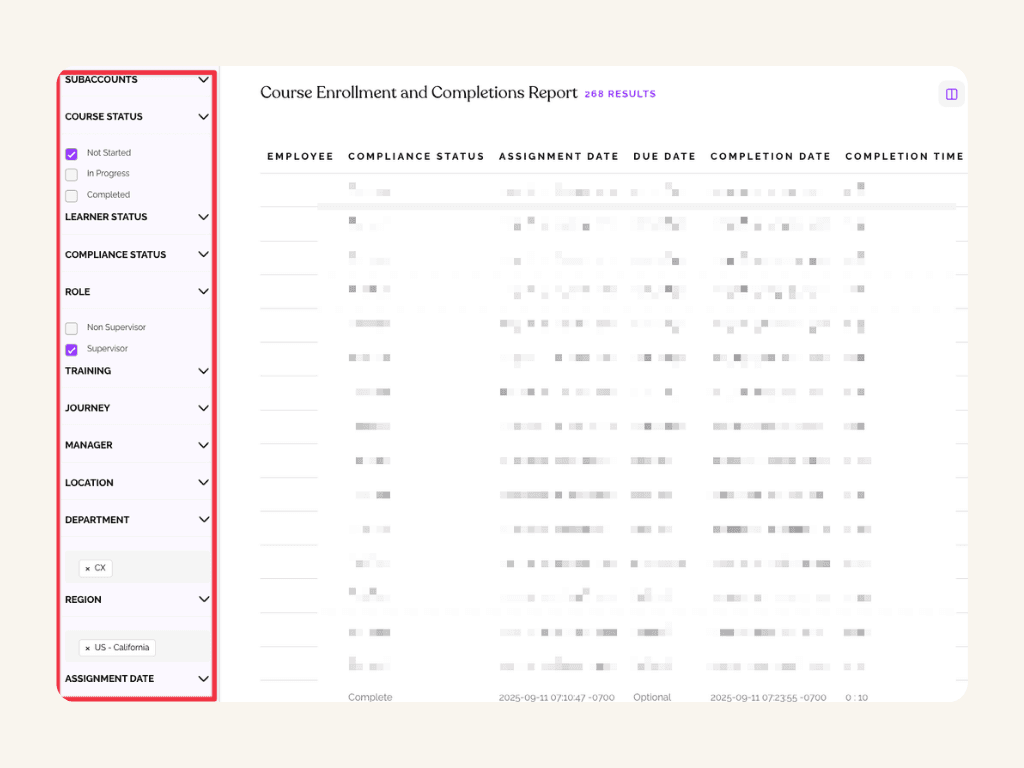
Reports should also capture quiz or assessment results, e-signatures on policy acknowledgments, and audit log entries showing when records were accessed or exported. These details turn a basic report into a defensible one.
Supporting documentation
Data fields tell part of the story, while supporting documentation tells the rest. Strong compliance reports pair those fields with completion certificates and signed policy acknowledgments. Assessment scores and version-controlled training content records also add another layer of defensibility.
Bulk-exportable certificates give HR teams one-click access to proof across the entire workforce. With EasyLlama, admins can download certificates in bulk, so handing auditors a complete file does not require pulling records from multiple systems.
Essential HR compliance reports every team should maintain
Not all compliance reports serve the same purpose. HR teams should maintain several distinct report types, each tracking different aspects of compliance health. Here are the ones that matter most.
Training completion reports
This is the foundational report: a real-time view of who has completed required training and who hasn't. It should be filterable by department, location, role, or training topic so you can quickly identify gaps.
The report should update automatically as employees finish courses, not require manual data entry. Some auditors also want to see assignment records separately from completion records, which proves who was assigned which training and when, not just who completed it. Assignment timing is especially important for new hires and role changes, where reassignment should be triggered automatically.
Overdue and incomplete assignment reports
Every day a required course goes incomplete is a day of unmitigated risk. Overdue assignment reports surface these gaps so HR can intervene before they become audit findings.
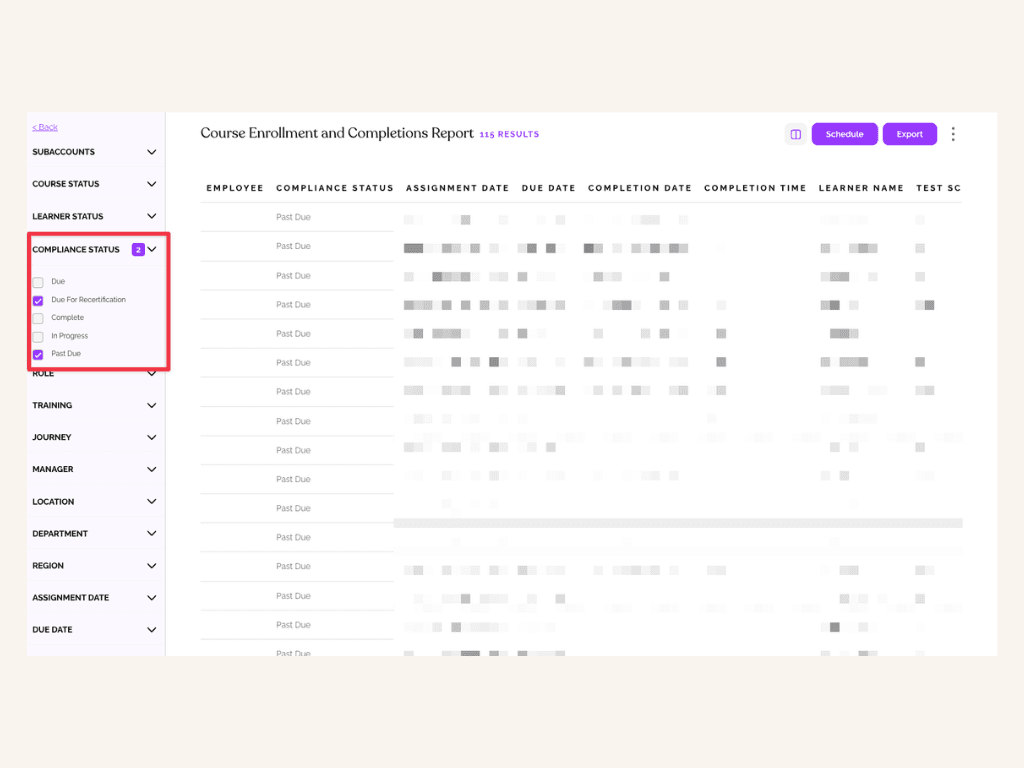
EasyLlama's Insights Dashboard flags exactly who is overdue and which renewals are expiring. This helps teams intervene earlier and avoid the elevated penalties associated with weak compliance programs. According to the U.S. Sentencing Commission Guidelines, organizations with effective compliance programs receive significantly lower penalties than those without documented efforts.
Expiring certification and renewal reports
Letting certifications lapse is a common and preventable risk, especially for roles with legally mandated recertification cycles. HIPAA training, harassment prevention in states like California and New York, and workplace safety certifications all have recurring deadlines.
Automated renewal tracking eliminates the manual calendar-watching most HR teams rely on. When renewals trigger automatically and reminders go out via email and SMS, teams stay current without anyone having to remember a date.
Policy acknowledgment and sign-off reports
Training completion alone may not satisfy every compliance requirement. Many regulations also require documented proof that employees have read and acknowledged specific policies.
E-signature capture with timestamps and version tracking creates the strongest defensible record. EasyLlama's Document Management & Document Signature supports bulk policy assignment with e-signature tracking, so HR teams can roll out new policies across the organization and have proof of acknowledgment in one place.
Audit trail and history reports
Auditors often want to see more than the current status. They want the history: when training was assigned, when it was completed, when certificates were issued, and who accessed the records.
Timestamped records maintained automatically by a compliance platform give HR a defensible audit trail without manual reconstruction. EasyLlama automatically maintains a time-stamped record of every completed training and policy acknowledgment by employee. This creates consistent proof that can be reused for recurring audits.
Incident reports and case records
Audit-ready compliance reporting also extends beyond training data. Auditors and investigators also look for documented channels where employees can raise concerns. They expect timestamped case records and resolution evidence to back up those channels.
Organizations relying on informal reporting, like manager conversations or scattered emails, leave no audit trail. They also cannot demonstrate that employees had a working channel to raise issues.
EasyLlama's Anonymous Reporting & Case Management captures these records through confidential employee submissions with two-way anonymous chat logs, case assignment, and resolution tracking. This gives HR teams documented evidence that reporting channels exist and are being used.
Compliance metrics HR teams should track
Reports are only useful if HR knows which numbers to watch. These are the key compliance health indicators that separate teams who are prepared from teams who are guessing:
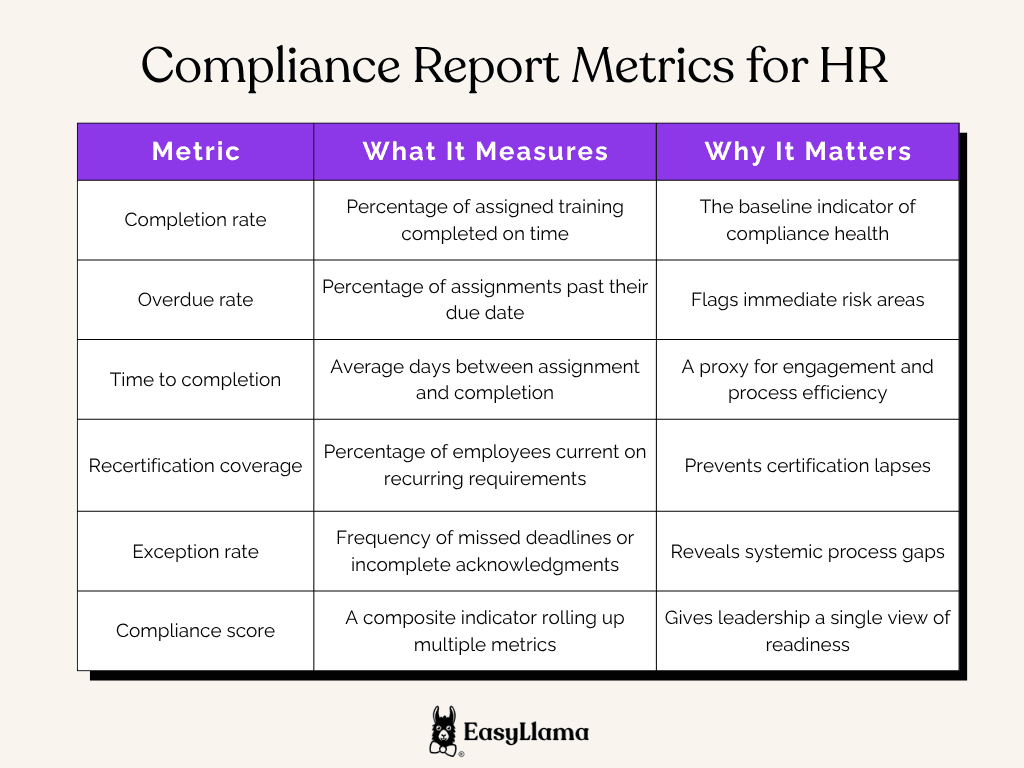
Tracking these metrics over time helps HR shift from reactive to proactive. Instead of scrambling before audits, teams can identify gaps as they appear and close them in real time. EasyLlama's real-time dashboards surface these metrics at a glance, broken down however your team needs to see them.
How to move from reactive to proactive compliance reporting
Most HR teams operate reactively. They pull reports only when an audit is announced or an incident occurs. That approach creates risk, wastes time, and turns compliance into a fire drill instead of a routine process.
The shift to proactive reporting comes down to four practical changes:
- Centralize all compliance records in one platform instead of tracking across spreadsheets, email, and multiple vendor portals.
- Automate course assignments and reminders so completions happen on schedule without manual follow-up.
- Use real-time dashboards that surface gaps as they appear, not after the fact.
- Build custom reports that match the specific views your team needs, filtered by role, location, framework, or deadline, without depending on IT.
If you're not sure where to start, EasyLlama's Compliance Grader gives HR teams a personalized report of required training based on their industry, roles, and locations in about two minutes. It's a free tool that helps you establish a clear baseline instead of guessing what needs to be tracked.
From there, HRIS and payroll integrations with platforms like BambooHR, Workday, Gusto, ADP, and Paylocity automatically sync employee data and course assignments. This consolidates records into one system and eliminates manual reconciliation.
The Custom Report Builder also lets admins create filtered views across departments, roles, and locations without spreadsheets or IT support. You build the exact report you need and pull it on demand.
Build a compliance reporting process your team can trust
Compliance reporting is not a once-a-year exercise. It is an always-on system that reduces risk and gives HR the proof it needs at any moment.
The key takeaways:
- Know what your reports should include
- Maintain the essential report types
- Track the right metrics
- Invest in a platform that automates the process
HR teams that build strong compliance reporting protect the organization while freeing up time for strategic work. That's how HR demonstrates measurable impact to leadership.
EasyLlama is trusted by thousands of organizations and is a category leader on G2. With 450+ expert-built courses updated annually and a platform built to make compliance reporting effortless, it is the system HR teams rely on to stay audit-ready.
Book a demo to see how EasyLlama helps HR teams automate compliance reporting and stay prepared.
Share this


Frequently
Asked
Questions

- Compliance reporting in HR is the process of tracking and documenting employee training completions, policy acknowledgments, and certifications to prove your organization meets its legal and regulatory obligations. It provides the defensible evidence HR teams need during audits and investigations.
- An HR compliance report should include employee name, role, department, location, assigned training, completion status with timestamps, renewal dates, certificates of completion, assessment results, and e-signatures on policy acknowledgments. The more complete the data, the more defensible the report.
- The purpose of compliance reporting is to maintain a continuous, verifiable record of your organization's compliance activities. It protects against legal exposure and supports audit readiness. It also surfaces training gaps before they become violations and shows leadership that compliance is actively managed.
- A compliance team should generate training completion reports, overdue assignment reports, expiring certification reports, policy acknowledgment reports, audit trail reports, and incident or case management reports. Together, these cover the full scope of compliance evidence auditors expect.
- The most common mistakes include relying on spreadsheets instead of centralized systems, tracking completions without timestamps, ignoring overdue assignments until audit season, and failing to document policy acknowledgments separately from training completions. Each of these gaps weakens the organization's defensible position.
 Articles
Read More Blogs
Explore what others in your field are learning

LMS Implementation Strategy: 6-Step Guide for HR and L&D Teams
Learn how to implement your new LMS with ease. This 6-step LMS implementation guide helps HR & L&D teams plan, launch, and measure success.
Sarah Hamilton

The Agile Compliance Checklist: 7 Steps To Reduce Risk
Use this 7-step agile compliance checklist to assess your program, identify gaps, and build a system that keeps pace with changing regulations.

Katrine Reddin

Compliance Audit Example, Definition, and Types: What Every Organization Need To Know
Start Modernizing Workplace Compliance
It’s easy to get started with EasyLlama. Speak with one of our compliance experts and get a demo tailored to your business’s needs.