The Agile Compliance Checklist: 7 Steps To Reduce Risk



Use this 7-step agile compliance checklist to assess your program, identify gaps, and build a system that keeps pace with changing regulations.

Use this 7-step agile compliance checklist to assess your program, identify gaps, and build a system that keeps pace with changing regulations.
Test Your Compliance
Find out if your company is compliant in two minutes with our free Compliance Grader.
Get Your Free ReportCompliance requirements never stand still. New state laws, updated federal guidelines, and shifting workplace norms mean the rules your organization followed last quarter may already be outdated.
Agile compliance offers a mindset shift where programs build continuous improvement into every compliance activity. When a new regulation takes effect or your team expands into a new state, an agile program adapts in days, not months.
This article walks you through a seven-step agile compliance checklist you can use as a self-assessment. For each step, you will learn what "done" looks like, the risk of falling short, and how to put the step into practice. By the end, you will know exactly where your compliance program is strong and where it needs work.
The 7-step agile compliance checklist
A quick high-level note: here at EasyLlama, we define agile compliance using a three-part practical framework:
- Identify: Compliance requirements, security risks, training and policies
- Automate: Training assignments, tracking and reporting, reminders and follow-ups
- Monitor: Behavior change, risk levels, regulatory updates
But this checklist offers both a more detailed self-assessment and an action plan. Each step covers one category of compliance activity, including the risk it addresses and what a mature process looks like. Together, these form a complete system you can score your program against during any review cycle.
Here is the full agile compliance checklist at a glance:
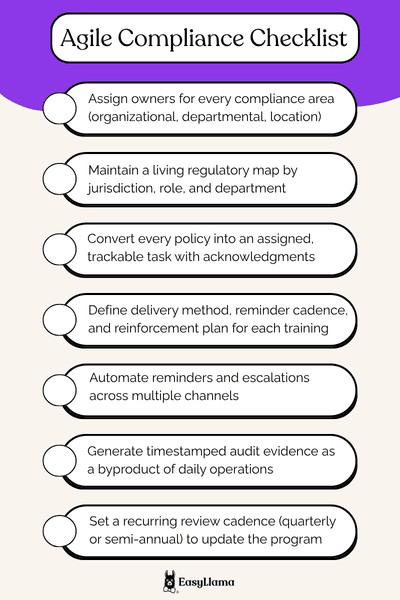
- Assign owners for every compliance area (organizational, departmental, location)
- Maintain a living regulatory map by jurisdiction, role, and department
- Convert every policy into an assigned, trackable task with acknowledgments
- Define delivery method, reminder cadence, and reinforcement plan for each training
- Automate reminders and escalations across multiple channels
- Generate timestamped audit evidence as a byproduct of daily operations
- Set a recurring review cadence (quarterly or semi-annual) to update the program
Let's look at each of these steps in more detail.
Step 1: Assign owners for every compliance area
When no one clearly owns a compliance area, tasks get handled reactively by whoever notices them first. Responsibilities shift without documentation. No one can say who is accountable for audit prep, policy updates, or training oversight for a specific department or location.
Agile compliance programs fix this by assigning clear ownership at the organizational, departmental, and location levels. When regulations or staffing change, responsibilities stay consistent because they are documented, not assumed.
Your organization should be able to name the specific owner for each of these compliance activities:
- Training administration and course assignments
- Policy creation and updates
- Audit preparation and evidence collection
- Incident response and documentation
- Regulatory monitoring by jurisdiction
A RACI matrix is a simple way to formalize this. For each compliance activity, identify who is Responsible, Accountable, Consulted, and Informed. Keep the framework lightweight so it supports fast decisions while maintaining proper sign-off authority.
Step 2: Maintain a living regulatory map
Many teams rely on undocumented institutional knowledge or static spreadsheets to track regulatory requirements. When a key team member leaves or a new regulation takes effect, gaps appear quickly. Teams cannot determine which requirements apply to which employees, and compliance obligations become inconsistent across departments.
Agile compliance programs update regulatory mappings continuously, not just during annual reviews. Ask yourself: does your organization maintain a living inventory of every regulation that applies, mapped to the specific policies and training courses each one requires?
Segment your requirements by jurisdiction, industry, role, and department so employees only receive the compliance obligations relevant to them. This targeted approach prevents information overload. It also makes it easier to spot gaps when new laws take effect.
Version-controlled policy storage and centralized document management can make it easier to keep your regulatory map current. When a regulation changes, you update the mapped policy and course assignments in one place rather than tracking changes across scattered files.
To help make this step easier, EasyLlama offers a free Compliance Grader tool, which maps mandatory legal mandates to the right training for your employees, and helps you understand what compliance training is required (or recommended) for your organization.
Step 3: Convert every policy into an assigned, trackable task
Policies that exist only on paper create a blind spot. For example, sign-offs get scattered across email threads and paper forms, so organizations can't quickly prove which employees acknowledged updated requirements. During an agile audit, this becomes a serious liability.
Agile compliance programs link every policy to a documented, trackable record that shows each employee received and completed the required actions.
Start by translating your policy requirements into specific assigned tasks:
- Role-specific training assignments
- Policy acknowledgment requests
- Document sign-off collection
- Recertification deadline tracking
Replace manual spreadsheets, paper forms, and email approvals with centralized tracking workflows to make the process easier.
That’s exactly what EasyLlama's Document Management and Signature tools are built around. HR teams can upload policies, assign them to specific employees or groups, and collect acknowledgments with timestamped e-signatures—every record is audit-ready from the moment it is created.
Step 4: Define the delivery and reinforcement plan for each training
Unstructured training programs create predictable problems:
- Completion rates are low or unknown.
- Employees rush through long sessions without retaining information.
- There is no escalation path when deadlines pass.
Incomplete or ineffective training creates the same risk as no training at all. That's why agile compliance programs think through not just how training is delivered, but also how employees are reminded and how learning is reinforced over time.
For example, match the format to the material. Microlearning suits simple policy refreshers, while sequenced paths and longer courses work better for multi-part or complex regulatory topics.
EasyLlama's Course Authoring Tool is designed for exactly this. Admins can turn existing policies, PDFs, or internal documents into trackable, scenario-based courses in under an hour.
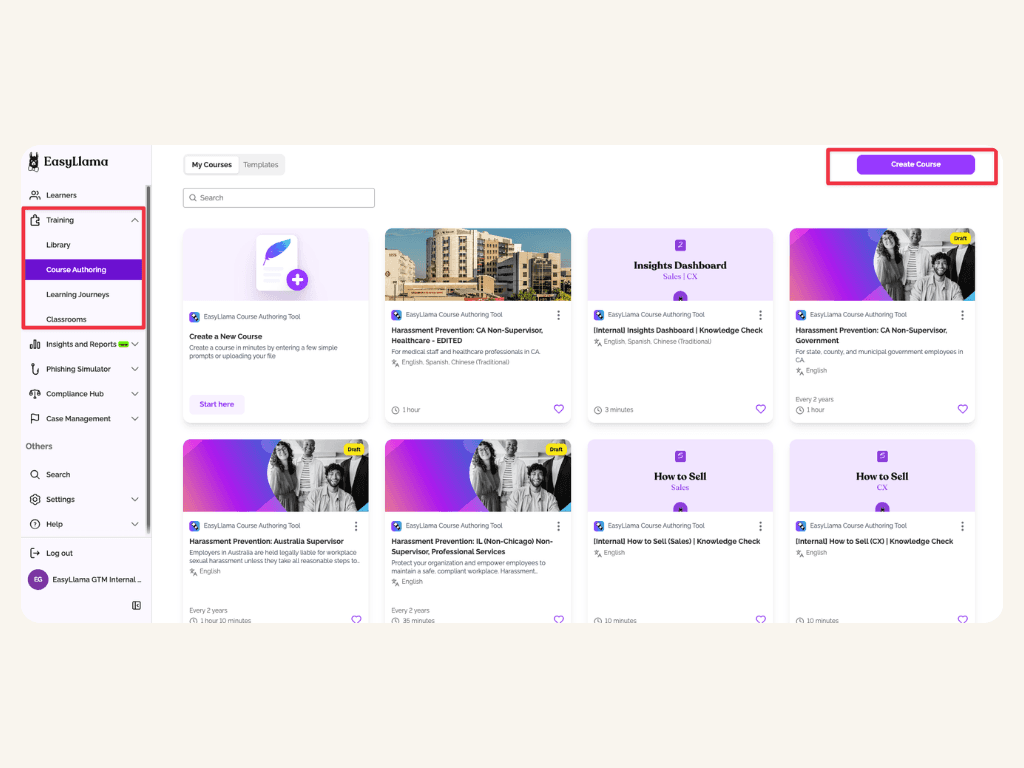
The tool generates outlines, quiz questions, and realistic workplace scenarios that help employees apply what they learn on the job. When policies change, courses can be edited and re-assigned in minutes with no vendor delays.
Learning Journeys also let you sequence those courses by role, location, or department. Onboarding and ongoing compliance training flow as a single connected path, so employees move through requirements in the right order.
Step 5: Automate reminders and escalations
Manual compliance tracking eats hours every week. HR sends individual follow-up emails, and some managers enforce completion while others don't. Then overdue items go unnoticed until audit time which creates inconsistent enforcement and preventable risk.
Agile compliance programs automate reminders and escalation workflows so every employee receives consistent follow-up regardless of their team or location.
Ask yourself: are your compliance reminders and escalation workflows automated across multiple channels, or are they manually managed through spreadsheets and one-off emails?
Here is what an automated reminder workflow should include:
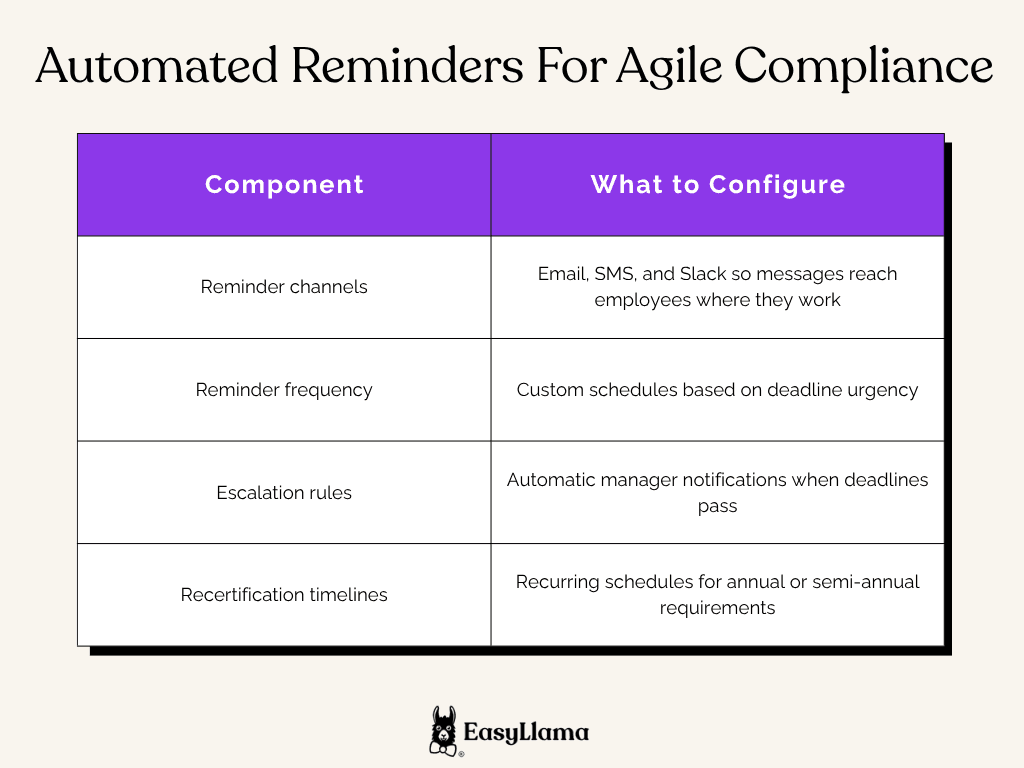
EasyLlama's automated reminders are delivered through email, SMS, and Slack with custom frequencies. Admins configure escalation rules and recurring recertification schedules once. The system handles follow-up without manual intervention.
As one customer put it:
“I adore the automated reminder feature. That is something that makes my life so much easier, just knowing that people are going to get pinged until they complete the training. It cuts down on the reminder emails that I have to send. And obviously, when they get those reminders from the system, the link is right there for them to just click into the training and go." - Anna Robbins, Waud Capital Partners.
Step 6: Generate timestamped audit evidence as a byproduct of daily operations
Scattered evidence turns audit preparation into a weeks-long project. When documentation lives across email threads and shared drives, teams can't quickly confirm whether a specific employee completed a required action on a specific date.
Agile compliance programs generate audit evidence automatically as part of normal operations. Instead of reconstructing records when auditors request them, every compliance activity creates its own timestamped documentation.
Can your organization quickly produce complete compliance records for any employee? That includes:
- Training completion dates and scores
- Policy acknowledgment timestamps
- E-signature records with version history
- Exception documentation and remediation notes
Producing that on demand requires the records to be generated automatically, not assembled later. EasyLlama's document management, document signature, and Custom Report Builder work together to make this automatic. Every training completion is paired with the signed policy version.
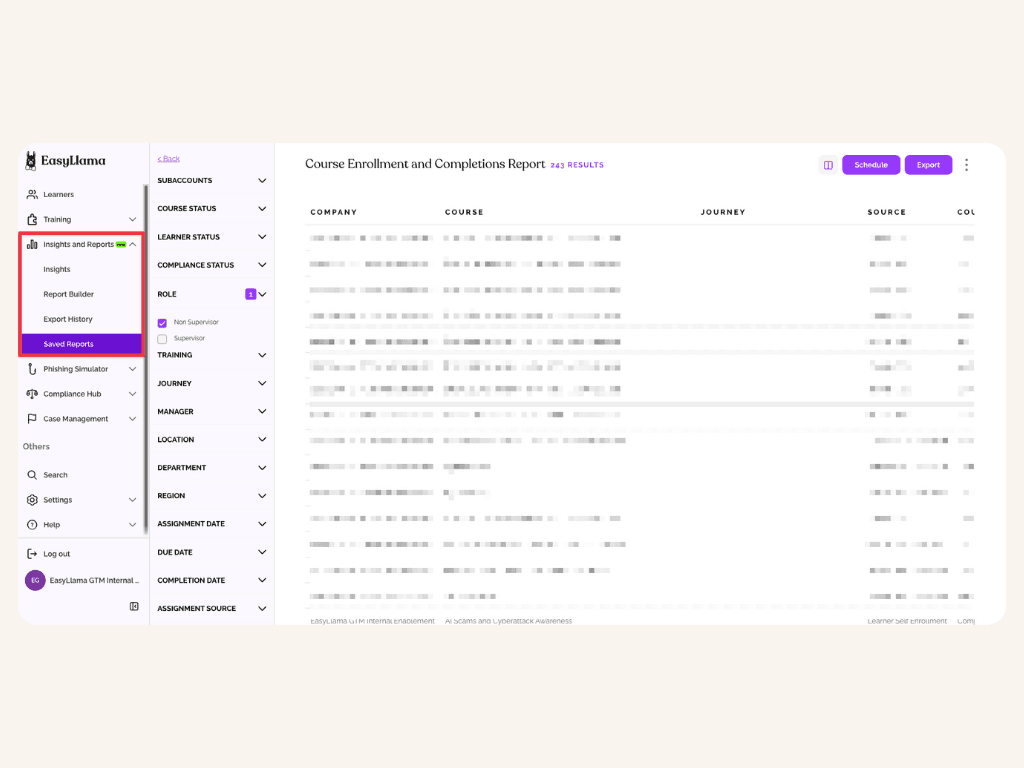
The report builder lets you filter and bulk-export records by team, location, department, or custom field. Audit evidence becomes a one-screen export instead of a weeks-long reconstruction project.
Step 7: Set a recurring review cadence
When static compliance programs get outdated, training materials end up falling behind new regulations. Plus, when lessons learned from audits or incidents are never documented, updates only happen after problems occur.
Agile compliance programs build in recurring review cycles and operational feedback loops so gaps get caught early. These cycles help your team incorporate regulatory changes and improve processes based on what is actually working.
Build these review activities into your compliance calendar:
- Run quarterly or semi-annual reviews of the full compliance program
- Review completion rates and engagement data after each training cycle
- Update the regulatory map whenever new laws take effect
- Document lessons learned from audits, incidents, or near-misses
- Score your program against this checklist during each review cycle
EasyLlama's Insights Dashboard and Report Builder give you the data to make these reviews actionable. Completion analytics, quiz performance, and learner feedback show you which compliance activities are working and which need to be redesigned.
Audit your compliance process, not just your compliance status
Checking who completed what training is necessary. But it doesn't tell you whether your compliance system itself is keeping pace with new regulations, organizational changes, or workforce growth. A team with 100% completion rates on outdated training is still at risk.
Agile compliance is a living system that adapts to regulatory changes, scales with organizational growth, and evolves alongside your workforce. The seven steps above give you a recurring self-assessment you can score your program against every quarter.
After each review cycle, score your program against each step. Identify which areas are strong and where gaps exist. Then produce a prioritized action list so improvements happen before the next review, not after the next audit finding.
The right platform turns this checklist into an automated workflow. EasyLlama combines compliance training, policy management, automated reminders, and audit-ready reporting in one platform—helping your team to focus on strategic priorities instead of manual compliance tasks.
Book a demo to see how EasyLlama can help your team build an agile compliance program that keeps pace with change.
Share this


Frequently
Asked
Questions

- An agile compliance checklist should cover the full lifecycle of compliance management: ownership assignments, regulatory mapping, policy tracking, training delivery, automated reminders, audit evidence generation, and recurring reviews. Each item should have a clear owner, a defined process, and measurable criteria so your team can assess whether it is working.
- Most organizations benefit from quarterly reviews of their full compliance program, with more frequent checks after major regulatory changes or organizational shifts. Review completion rates and engagement data after each training cycle. Update your regulatory map as soon as new laws take effect.
- Each checklist item should have a single accountable owner, even if multiple people contribute. Use a RACI matrix to clarify who is responsible, accountable, consulted, and informed for each compliance activity. Ownership should be documented and updated whenever roles or organizational structure change.
- A standard compliance checklist is a static list of requirements that gets reviewed once a year. An agile compliance checklist is a living self-assessment tool with built-in review cycles and continuous improvement processes. It focuses on the health of your compliance system, not just whether individual tasks were completed.
 Articles
Read More Blogs
Explore what others in your field are learning
![7 Best Online Compliance Training Providers [2026]](/_next/image?url=https%3A%2F%2Fd230yvp9l0f4m2.cloudfront.net%2Fbusiness_people_meeting_and_computer_in_group_pla_2023_11_27_05_22_36_utc_7a8a1249a6.jpg&w=1200&q=75)
7 Best Online Compliance Training Providers [2026]
Discover the 7 top online compliance training providers, and which is the best fit for you.

Sarah Hamilton

2026 Overview: What Constitutes Harassment in California?
![12 Best Security Awareness Training Providers [2026]](/_next/image?url=https%3A%2F%2Fd230yvp9l0f4m2.cloudfront.net%2FCybersecurity_654735261c.jpg&w=1200&q=75)
12 Best Security Awareness Training Providers [2026]
Discover the 12 best Security Awareness Training providers that drive real behavior change—not just compliance checkboxes.

Michael Devyver
Start Modernizing Workplace Compliance
It’s easy to get started with EasyLlama. Speak with one of our compliance experts and get a demo tailored to your business’s needs.