HR Compliance Checklist: The Complete Guide 2026



HR's 2026 guide to ensure company-wide compliance with regulatory and risk management tactics.

This guide helps HR ensure company-wide compliance with regulatory and risk management tactics using this HR compliance checklist to avoid violations and maintain standards.
- Application and hiring compliance requirements
- Recruiting, interviewing and hiring employees
- Affirmative action plan
- Employer record-keeping and the employee handbook
- Policies and procedures
- Equal Employment Opportunity Commission (EEOC) laws
- Employee benefits and payroll compliance
- Wage and hour compliance
- Data privacy and security compliance
- How to get your staff trained and compliant
- Compliance calendar and automation
Test Your Compliance
Find out if your company is compliant in two minutes with our free Compliance Grader.
Get Your Free ReportHR managers know the rules don’t stay still for long. One month, it’s a new pay transparency law. The next month, there’s an updated deadline for training, a change to how employee data is handled, or a new requirement for tracking time. These changes can sneak up on you fast.
Over the past year, compliance has gotten even more complex. Updates to wage and hour laws, expanding state privacy rules, and new expectations around training documentation mean many teams are scrambling to keep up. But the good news? You don’t have to figure it out alone.
This 2026 HR compliance checklist walks you through what matters most. You’ll find step-by-step guidance on critical areas like:
- Application and hiring requirements
- Training and documentation tracking
- Wage and hour compliance
- Data privacy and security
- Policy updates and audit prep
Let’s make staying compliant feel more manageable.
Application and hiring compliance requirements
The application forms you use can have a big impact on your risk exposure, especially if you're ever audited by the EEOC or the Department of Labor.
Before you post your next job opening, make sure your application process includes the required notices and collects voluntary identification in the correct way. You also need to store documents for the proper amount of time.
Here’s what you need to have in place:
- EEO data collection: Voluntary self-identification forms should be offered separately from the main application. This includes race, ethnicity, and gender data for federal reporting.
- Disability self-identification form: Required for federal contractors as part of Section 503. Must be offered in a specific format provided by the OFCCP.
- Veteran status self-identification: Also required for federal contractors under VEVRAA. Collect this voluntarily and store it separately from selection materials.
- Applicant tracking for OFCCP compliance: If you're a federal contractor, keep a clear record of how applicants move through your hiring process. This helps demonstrate fairness and non-discrimination during audits.
- Application form questions: Every job application should confirm that you’re an equal opportunity employer, that the applicant certifies their answers are accurate, whether employment is at-will, and if your company shortens the time window for legal action (known as a limitation period clause).
- Record retention: Hold onto applications for at least one year for non-hires. If you're a federal contractor, that jumps to two years.
When your application forms are set up the right way, you can move candidates forward with confidence and peace of mind.
Recruiting, interviewing and hiring employees
New state laws now regulate how you post salaries, ask interview questions, and use background checks. There are also stricter rules around how (and if) you can use AI during the hiring process. It’s a lot to keep up with, especially if you're hiring across multiple states.
Here’s what to keep in mind when reviewing your recruiting and hiring practices:
- Pay transparency laws: More states now require you to include salary ranges in job postings. These laws often apply based on where your candidate lives, not just where your company is based.
- Salary history bans: In many states, you’re not allowed to ask about a candidate’s pay at previous jobs. Make sure your interview scripts, applications, and training reflect this.
- Ban-the-box and background check timing: Laws in some states (and cities) require you to delay background checks until after you’ve made a conditional job offer. Review when and how you run checks to stay compliant.
- FCRA compliance: If you use a third party for background checks, you must provide proper disclosure and obtain written consent. If you take adverse action based on results, you must follow specific steps.
- I-9 and E-Verify: Use the current version of the I-9 form (check USCIS for updates) and verify work eligibility as required. If your state or industry uses E-Verify, ensure you’re enrolled and following the process correctly.
Pay attention to how your company uses AI for recruiting. New laws are emerging that govern how companies use automated tools in hiring:
- NYC Local Law 144 requires bias audits and notice to candidates if you use automated decision-making tools.
- Colorado SB 21-169 regulates algorithmic discrimination in hiring and promotion tools.
Expect more regulations to be passed in the coming years. Make sure you test tools for bias, ensure transparency, and document your processes.
“Training leaders to ask the right questions about how AI works, how decisions are made, and how outcomes can be explained is no longer optional, it’s a compliance requirement,” says Fractional TA Leader Mike Peditto. “Defensible AI decisions protect candidates, teams, and organizations before issues become legal, reputational, or cultural failures.
Hiring laws vary and change often. EasyLlama’s Compliance Hub gives HR teams real-time updates on recruiting regulations, so you can stay compliant no matter where you hire.
Onboarding documents to have on file
Create a smooth onboarding process that goes beyond first-day logistics. Make sure to properly collect and store all required documents so they’re easily accessible.
Here’s a list of onboarding documents you should have on file for every new employee:
- I-9 form (current version; keep for 3 years after hire or 1 year after termination—whichever is later)
- W-4 form and any required state withholding forms
- State-specific new hire reporting confirmations
- Workers' compensation notices
- Unemployment insurance notices
- State disability insurance notices (if applicable)
- CPRA/CCPA notice at collection for employee data (in applicable states)
- Job descriptions for all roles
- Internal and external job postings
- Completed job applications
- Offer letter templates and signed offers
- Background check documentation that complies with state and federal laws
- Rejection letter templates
- Post-hire paperwork, including tax and wage deduction forms
- Internal onboarding policies and procedures
- Signed contracts, training schedules, and orientation materials
- New hire employee files and folder structure
Keep these documents organized to help your new hires start off on the right foot, protect your business during audits, and make future HR tasks way easier.
Interview questions
Interview questions should focus only on whether the candidate can do the job—nothing more. Avoid asking about age, race, religion, disability, marital status, or any other protected category. In many states, it’s also illegal to ask about salary history.
If a candidate requests an accommodation, follow a documented interactive process and handle it with care. Standardize your interview questions and keep written records to reduce bias and protect your team if decisions are ever questioned. Use DiSC to support fair and consistent assessments.
Affirmative action plan
If your company does business with the federal government, you need an affirmative action plan. The Executive Order 14173 modified previous requirements, but some obligations remain in place.
If you have 50 or more employees and at least $50,000 in federal contracts, you must maintain a written plan under Section 503 to support individuals with disabilities. For contracts of $150,000 or more, VEVRAA requires you to include outreach and tracking for protected veterans. These plans help ensure fair access to hiring, promotions, and training.
The federal government no longer requires race and gender-based AAPs, but staying proactive with your recruiting and workplace culture still matters. A thoughtful, well-documented approach keeps your company eligible for federal contracts and shows a commitment to equity.
If you’re looking to build a more inclusive workplace, our diversity and inclusion training course can help you turn your goals into action. You can also find up-to-date guidance and templates on the OFCCP website.
Employer record-keeping and the employee handbook
Make sure every employee signs the required legal documents and acknowledgment forms and receives a current copy of the employee handbook. These records support onboarding and help you stay audit-ready and compliant over time.
You should also clearly document how you classify each worker—whether exempt, nonexempt, or an independent contractor. Follow federal and state retention rules before disposing of any documents. Deleting or shredding the wrong file, especially during a legal issue, can create serious problems even if it happens unintentionally.
EasyLlama’s Certificate of Completion and Bulk Export tools make it easy to manage training records, generate proof of compliance, and prep for audits. Employers using these features report up to a 50% reduction in audit prep time.
Storing files and confidentiality
Store employment records in a way that protects sensitive information and meets legal requirements. Secure all documents—from applications to background checks—and limit access to authorized team members only. Keep confidential information, such as criminal history or credit data, private and use it strictly for hiring purposes.
Follow federal and state retention rules to determine how long to keep each type of file. Disposing of records too early or holding onto them longer than required can lead to compliance issues.
Here’s a general retention guide to help:
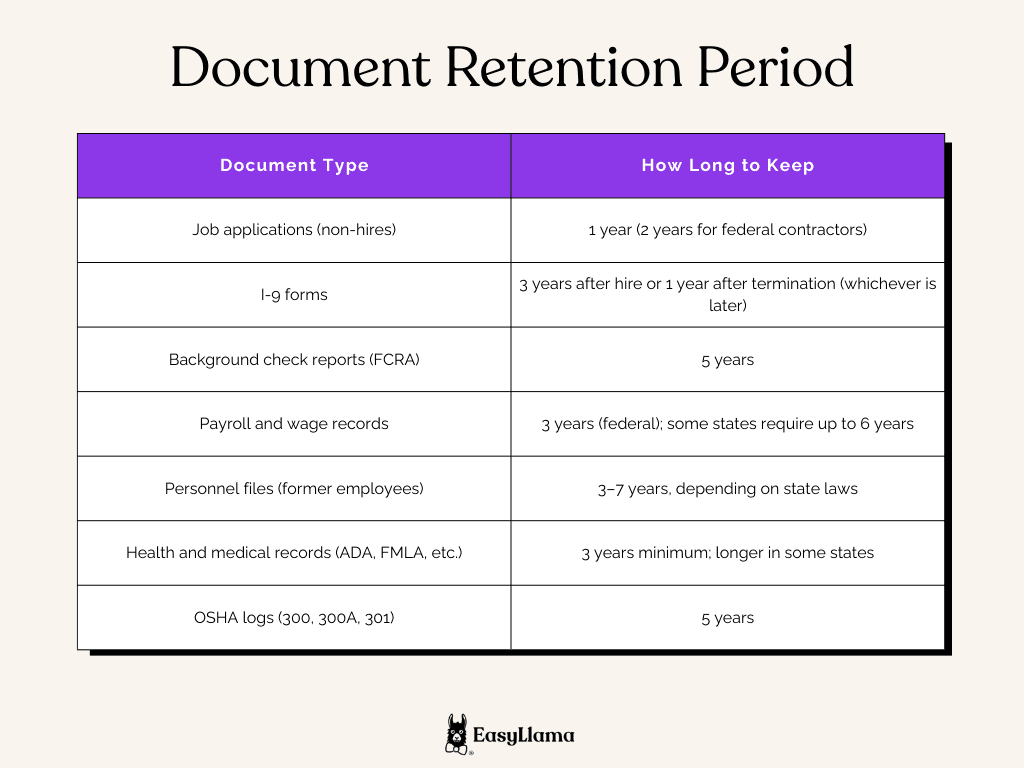
Always double-check your state’s specific rules, and when in doubt, err on the side of caution. Secure, compliant file storage is one of the simplest ways to reduce risk and keep your HR practices audit-ready.
Health records confidentiality
Employee medical information requires extra care. Store health records separately from personnel files and share them only on a strict need-to-know basis. For employers with self-insured health plans, this includes full HIPAA compliance to prevent unauthorized access or disclosure.
You’ll also need to account for other protections. The Genetic Information Nondiscrimination Act (GINA) limits how genetic and family medical information can be collected or used. Mental health and substance abuse records often have additional confidentiality rules, and many states enforce medical privacy laws that go beyond federal requirements.
Before sharing any health-related information internally, confirm that it complies with HIPAA, the ADA, and applicable state laws—or you could face a HIPAA violation in the workplace. To reduce risk, make sure managers and HR teams understand what they can and cannot access.
Check out EasyLlama’s HIPAA Compliance Training course to help your team handle sensitive health information correctly and confidently.
Records to collect and review
Keep the right records on file so you can respond quickly to audits, resolve disputes, and stay compliant. Make sure these documents stay accurate, up to date, and easy to access when needed.
- Employment agreements
- Freelancer or sales representative agreements
- Policies around reviewing personnel files
- A sample employee file
- A sample medical file
- OSHA 300/300A/301 logs (if 11+ employees)
- EEO-1 reports (if 100+ employees)
- ACA 1094/1095 forms (if an applicable large employer)
- State pay data reports (where required)
- Workers' compensation claims history
- Unemployment claims and responses
Maintaining these records makes things easier for everyone and shows that you take compliance and fair workplace practices seriously.
Best record-keeping techniques for employers
Use strong record-keeping practices to stay compliant, respond quickly to audits, and reduce legal risk. A little upfront organization can save you time when it matters most.
- Create a process for confirming whether applicants are bound by prior employment agreements
- Seek legal guidance when classifying freelancers or independent contractors
- Review job offer letters to avoid implying guaranteed employment
- Ensure all employment agreements (like non-competes) are fully executed and up to date
- Keep I-9s, W-2s, FCRA forms, and medical records separate from general personnel files
- Train managers on how to handle employee file review requests
- Create an audit binder with clearly indexed sections
- Maintain version control on all company policies
- Track policy acknowledgments electronically
- Use the EasyLlama LMS for automated training records and certificate tracking
Clear systems and the right tools help you respond confidently to audits or employee requests when they come up.
Policies and procedures
Clear, up-to-date policies play a major role in HR compliance. They set expectations, reduce risk, and protect both your team and your business.
Every company has different policy needs. Some depend on your size, your state, or the type of work you do. If you operate in multiple states, things can get complicated quickly.
Make sure your team puts these core practices in place:
- Required policies based on company size and state
- Consistent policy acknowledgment process (physical or digital)
- Clear schedule to review and update policies at least once a year
- Separate versions for states with unique requirements (e.g., CA, NY, IL)
- Documentation that shows how you share and explain policies to employees
To make this easier, use EasyLlama’s Course Authoring Tool to turn your policies into custom training modules. You can add quizzes, track completions, and issue certificates—so you know every employee is aligned and your documentation stays audit-ready.
Equal Employment Opportunity Commission (EEOC) laws
When working through your compliance audit checklist, make sure your policies and practices align with Equal Employment Opportunity (EEO) laws. These regulations are designed to prevent workplace discrimination. Depending on your company's size, different laws may apply.
Here’s a quick breakdown:
- Title VII of the Civil Rights Act applies to employers with 15 or more employees
- The Americans with Disabilities Act (ADA) also applies at the 15-employee mark
- The Age Discrimination in Employment Act (ADEA) applies to employers with 20 or more employees
- The Equal Pay Act (EPA) applies to all employers, regardless of size
It’s also essential to show that your company accommodates employees with disabilities, including physical access (such as ramps or elevators) and job-related accommodations (such as modified duties or assistive tech). Newer laws like the Pregnant Workers Fairness Act (PWFA) and PUMP Act require employers to provide reasonable accommodations for pregnancy and lactation needs.
Make sure your team documents all accommodation requests and follows a consistent interactive process. And if you operate in multiple states, check for additional accommodation rules—some are stricter than federal law.
Being proactive with EEOC protects your employees and your business—and helps foster a workplace where everyone can thrive.
Sexual harassment prevention
Sexual harassment training requirements vary by state, but one thing is clear: every business should have clear prevention policies and a plan to train employees regularly. There are more complex workplace dynamics from remote work setups to changes to DEI initiatives at the federal level, which means there’s greater confusion.
Fractional Director of People and Culture Pooja Samuel says, “Employees are more aware of their rights and more willing to speak up. If organizations don’t invest in prevention-focused training that teaches people to recognize issues early and intervene appropriately, they’ll stay in reaction mode. And by then, the damage to employees, culture, and the business is already done.”
Skipping this step can also lead to big compliance fines. Some states require specific training formats, content, and frequency. For example, sexual harassment training is mandatory in New York and California and must meet strict legal standards. Illinois, Delaware, Connecticut, and others have similar requirements.
Here’s a quick look at which states currently require training:
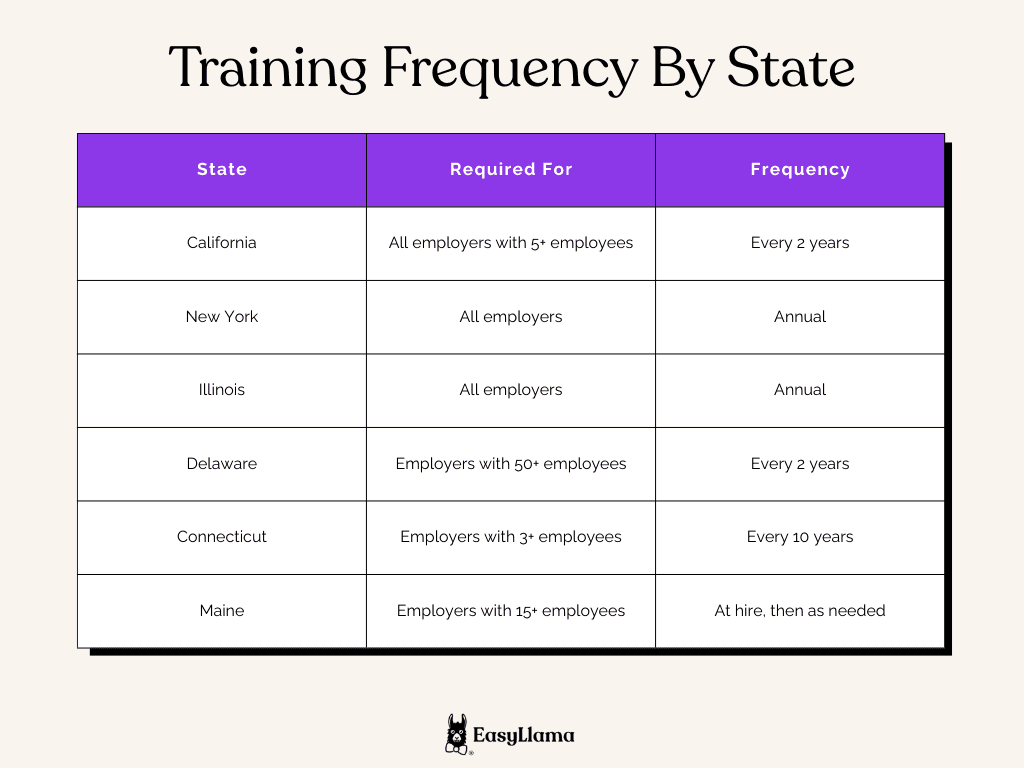
In addition to harassment prevention, some states now require workplace violence prevention plans. California’s SB 553 mandates that employers maintain a written plan, train staff, and keep a log of violent incidents. Other states may follow with similar laws, so it's smart to stay ahead of the curve.
EasyLlama’s Sexual Harassment Prevention training courses meet legal requirements in every state and use engaging content built for your team. You can train employees in California or onboard a new hire in Maine and stay compliant without guesswork.
Employee benefits and payroll compliance
Benefits and payroll can be complex, but they’re also essential for staying compliant and building employee trust. Mistakes in this area can lead to penalties, back pay, or even legal action, so it’s worth reviewing your policies regularly.
If you have 50 or more full-time equivalent (FTE) employees, you’re considered an Applicable Large Employer (ALE) under the Affordable Care Act (ACA). That means you’re required to offer affordable health insurance to qualifying employees and report this coverage using IRS Forms 1094-C and 1095-C.
ACA rules also require you to track full-time status using a measurement and stability period. If an employee averages 30+ hours per week during the measurement period, they must be offered coverage during the corresponding stability period, even if their hours drop later. Missing these requirements can result in fines of thousands of dollars per employee, per year.
Beyond the ACA, make sure your payroll policies align with:
- The Equal Pay Act
- Overtime pay rules under the Fair Labor Standards Act (FLSA)
- Paid time off, sick leave, and FMLA policies
- Local and state labor laws
- Clear documentation of hours worked and timekeeping practices
When done right, your benefits and payroll systems keep you compliant while helping you attract and retain great people.
Benefits and payroll documents to collect and review
To stay compliant and audit-ready, it’s important to keep detailed, up-to-date records related to employee pay, time off, and benefits. These documents help you demonstrate fair practices and meet federal and state requirements.
- Information on hours worked by all employees, regardless of classification
- All job descriptions
- Policies and procedures related to employee classification
- Company policy on compensation and overtime pay
- Policies on leave requests and time off
- Accurate records of all leave requests
- Policies around FMLA leave approval
- FMLA forms and supporting documentation
- ERISA plan documents, including Summary Plan Descriptions (SPD) and Summaries of Material Modifications (SMM)
- Summary of Benefits and Coverage (SBC)
- 5500 filings (for applicable benefit plans)
- COBRA notices and election forms
- State disability insurance and paid leave notices, where required
Keeping these documents organized helps your team respond quickly to questions, audits, or employee concerns.
Wage and hour compliance
Wage and hour compliance comes down to paying employees correctly, tracking time accurately, and following the most employee‑friendly law that applies. Employers must follow federal rules and state requirements. Mistakes in this area are one of the fastest ways to trigger audits, back pay, and penalties.
Here’s what every employer should keep an eye on:
- Federal and state minimum wage laws (whichever is higher applies)
- Overtime eligibility, exemptions, and proper pay calculations
- Meal and rest break rules based on state law
- Timekeeping accuracy and rounding practices
- Pay for on-call time, travel between worksites, and training hours
- Final paycheck deadlines and payout rules by state
Many of the most common Fair Labor Standards Act (FLSA) violations—like unpaid overtime or misclassified roles—are preventable with the right training. EasyLlama’s Wage and Hour Law Training course helps your team stay informed and avoid costly mistakes, with guidance that covers 14,000+ common violations.
Taking the time to get wage and hour compliance right protects your business and ensures employees are treated fairly.
Employee benefits best practices
Offer the right benefits, manage them well, and communicate them clearly to stay compliant and support your team. How you apply and document your policies matters just as much as what you offer.
- Keep records current for all hours worked, regardless of role or classification
- Ensure employee pay aligns with their role, experience, and qualifications
- Double-check that exempt roles meet Fair Labor Standards Act (FLSA) exemption criteria
- Provide clear written policies outlining FMLA rights and eligibility
- Coordinate state-paid family and medical leave with federal FMLA (where both apply)
- Follow requirements for military leave under USERRA
- Track compliance with jury duty and voting leave by state
- Establish clear guidelines for paid time off, sick leave, and flexible leave programs
- Regularly review required benefits like unemployment, workers’ compensation, and (for 50+ employees) health insurance
- Consider voluntary benefits to stay competitive—dental, vision, life insurance, and retirement plans can boost retention
Strong, well-documented benefits policies show employees you care and help your company stay out of legal trouble. Review them often and apply them consistently to build trust and stay compliant.
Data privacy and security compliance
Protecting employee data is a legal requirement in many states, and a smart practice for every business. You have to handle sensitive information with care, from drug testing results to Social Security numbers.
If you operate in California, you’re likely already familiar with the California Privacy Rights Act (CPRA), which gives employees specific rights around how their personal data is collected, used, and shared. Similar laws now exist in Colorado, Connecticut, Virginia, and Utah, with more states expected to follow. Even if you’re not based in one of these states, your responsibilities may still apply if you have employees or operations there.
Make sure your compliance checklist includes:
- CPRA/CCPA notices at the time of data collection
- A review of which state privacy laws apply based on your workforce
- Clear data retention schedules for HR records
- Contracts with vendors that outline how employee data is protected
- A written breach response plan with required notification steps
- Employee training on secure data handling
Leaking sensitive information—like drug testing results—can result in lawsuits, fines, or serious reputational harm. EasyLlama’s Security Awareness Training gives your team the knowledge they need to protect employee data and reduce risk. It’s structured, up to date, and built for real workplace scenarios.
How to get your staff trained and compliant
Training is a key part of compliance, but manually assigning courses and following up with employees can eat up valuable time. That’s why automation makes such a big difference.
With EasyLlama, you can set up automated course assignments that trigger when a new hire joins or when it’s time for recertification. Built-in email and SMS reminders nudge employees until training is complete, so HR doesn’t have to chase people down. Recertification alerts help ensure ongoing compliance, and integrations with your HRIS system make setup seamless.
Our platform offers specialized training for your specific state, along with real-world scenarios, interactive quizzes, and mobile-friendly lessons. And because completion is tracked in real time, you always know who’s done and who’s still pending.
Getting everyone trained shouldn’t be a full-time job. Automation helps you keep compliance on track without the manual work.
Company policy documents to gather
To stay audit-ready and support a consistent employee experience, it's important to keep all company policy documents in one place and ensure they’re regularly reviewed and acknowledged by staff.
- Workplace specifications and compliance posters in shared spaces
- Employee handbook and acknowledgment forms
- Records of handbook updates and distribution
- Sexual harassment and discrimination policies, including how to file a harassment complaint or investigation procedures
- Reasonable accommodation policy forms (ADA)
- Policy forms related to drug screening results
- Performance evaluation and disciplinary policy forms
- Remote work and hybrid work policies
- Data privacy and security policies
- Social media and employee communications policies
- AI use policies for hiring, performance, or productivity tools
- Emergency response and workplace safety procedures
Making sure employees acknowledge your policies is a simple way to stay compliant and reduce risk. It also helps everyone understand what’s expected.
As organizations manage larger volumes of policy updates and compliance documentation, maintaining clear records of employee acknowledgments becomes increasingly important for audits and internal accountability. Using an e-signature can help create a verifiable record of policy acceptance while reducing the administrative burden associated with paper-based processes.
Best techniques for employment policies
Creating strong policies is only the first step. Keeping them current, consistent, and clearly communicated is what ensures long-term compliance and a healthy workplace culture.
- Create a procedure for regularly reviewing job descriptions and minimum qualifications
- Update the employee handbook annually to reflect current laws and company standards
- Use the handbook and acknowledgment forms to document at-will employment, limitation periods, and reporting procedures
- Review work rules frequently to confirm HR policies are being followed
- Distribute updated policies to all employees and collect acknowledgment forms
- Establish a system for regular performance evaluations to support fairness and consistency
- Review drug testing policies to ensure compliance with federal, state, and local laws
- Maintain signed acknowledgments from employees in their personnel files
- Define clear procedures for providing employment references
- Set guidelines for the appropriate use of social media and networking platforms
- Ensure compliance with Occupational Safety and Health (OSHA) requirements relevant to your location
Use a consistent policy review process to catch gaps before they become risks and help employees do their jobs with confidence.
Compliance calendar and automation
Keeping up with HR deadlines is overwhelming. A simple way to stay on track is to build a compliance calendar and automate as much of it as possible.
Start by mapping out all annual deadlines: training renewals, handbook updates, policy reviews, and reporting requirements. Then assign clear owners to each task so nothing falls through the cracks. Automated reminders can help keep everyone on schedule without manual follow-ups.
Use your HRIS or LMS to track completions, store records, and pull reports when needed. This makes it easier to respond to audits or leadership questions with confidence.
EasyLlama’s Compliance Hub takes the heavy lifting off your plate with built-in notifications, tracking tools, and legal guidance powered by VirgilHR’s AI. It keeps you updated on new laws and helps your team act quickly, without having to constantly check for changes.
When compliance is organized and automated, it doesn’t have to feel like a scramble. A little planning upfront gives you peace of mind all year long.
Schedule a demo of EasyLlama to see how we make compliance easy.
Share this


Frequently
Asked
Questions

- Every HR team should have up-to-date job applications, I-9 and W-4 forms, employee handbooks with signed acknowledgments, payroll records, training completion certificates, and documentation of policies and procedures. Organized, easily accessible records are key to passing a compliance audit smoothly.
- Organizations should review and update their HR policies and employee handbooks at least once a year—or sooner if there are significant legal or regulatory changes. Regular updates ensure policies reflect current laws, reduce risk, and keep employees informed about expectations, benefits, and workplace procedures across all locations.
- Non-compliance can lead to fines, lawsuits, damaged reputation, and lost employee trust. Organizations can minimize risk by staying up to date on labor laws, maintaining accurate records, regularly training employees, and using tools such as automated tracking systems to ensure deadlines, documentation, and policy updates aren’t missed.
- EasyLlama helps HR teams stay on top of training with automated course assignments, real-time progress tracking, and built-in reminders. It ensures employees complete required training on time without manual follow-up. This makes it easier to meet compliance deadlines and prove completion.
- Yes, EasyLlama can automate reminders for compliance deadlines and required training across multiple locations. The platform supports email and SMS notifications, tracks completion in real time, and integrates with your HR systems, making it simple to manage training at scale, no matter where your team is.
- EasyLlama supports audit readiness with features like real-time training dashboards, downloadable completion certificates, and bulk export options. HR teams can quickly generate reports, verify employee compliance, and access documentation on demand.
 Articles
Read More Blogs
Explore what others in your field are learning

The Agile Compliance Checklist: 7 Steps To Reduce Risk
Use this 7-step agile compliance checklist to assess your program, identify gaps, and build a system that keeps pace with changing regulations.

Katrine Reddin

3 Tips for Preventing Digital Harassment and Cyberbullying in the Workplace

A Checklist to Ensure Code of Conduct Compliance in Your Company
Ensure your company's code of conduct compliance with our checklist. Learn best practices to foster a respectful and law-abiding workplace environment.

Saphira Ensley
Start Modernizing Workplace Compliance
It’s easy to get started with EasyLlama. Speak with one of our compliance experts and get a demo tailored to your business’s needs.