
Workplace Harassment California: A Complete Guide for 2026
12 Mar 2026


Most workplace harassment situations don’t start with something obvious. It might begin with a joke that crosses the line, repeated comments that make someone uncomfortable, or behavior that slowly creates a tense work environment. Situations like these damage trust, disrupt teams, and expose organizations to serious legal risk.
Employers have to understand and comply with the law's mandatory training requirements in order to avoid large compliance fines and major hits to company culture. This guide explains what workplace harassment in California is, how to recognize common forms, and what employers and employees should do to prevent and address it appropriately.
Let’s start with what workplace harassment means in plain English—and how to recognize it.
What is considered workplace harassment in California
Workplace harassment in California is unwelcome behavior at work that targets someone because of a protected characteristic or becomes severe or pervasive enough to create a hostile, intimidating, or offensive work environment. This behavior can come from supervisors, coworkers, clients, or vendors and may include verbal comments, visual materials, or physical actions.
In other words, harassment that interferes with someone’s ability to do their job or feel safe at work may violate California law.
It’s important to note that not all workplace conflict is harassment. Disagreements, personality clashes, or isolated rude behavior typically don’t qualify unless the conduct is severe, repeated, or connected to a protected characteristic under state or federal law.
Lawful harassment claims typically involve protected characteristics covered by employment law. Before we look at those categories, it helps to understand the legal frameworks that govern workplace harassment in California:
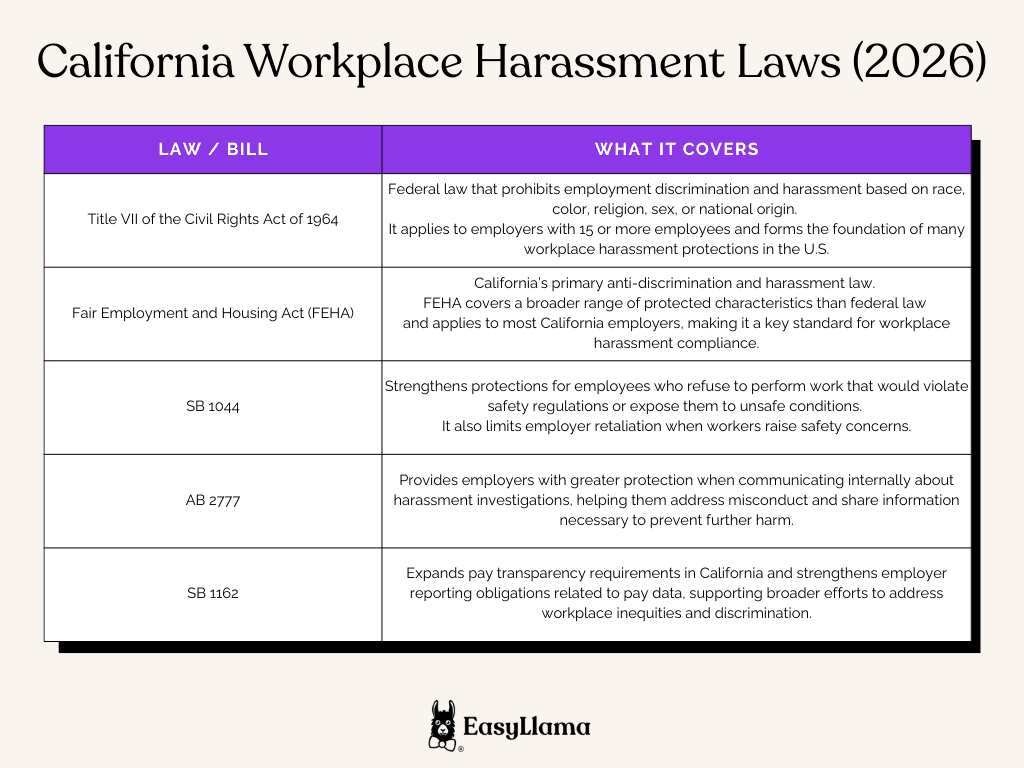
California law prohibits both employers and employees from harassing workers based on protected characteristics. In many cases, the key legal question is whether the behavior created a hostile work environment that negatively affected the employee’s ability to perform their job.
Because California harassment laws are detailed and continue to evolve, many organizations rely on structured training programs to help employees and managers recognize problematic behavior early. Tools like EasyLlama’s California harassment prevention training translate legal standards into real workplace scenarios and help teams understand how to report concerns and respond appropriately.
Protected characteristics (quick reference)
Under California law, harassment often involves conduct targeting specific protected characteristics. These categories are defined primarily under the Fair Employment and Housing Act (FEHA) and related employment laws.
- Race, color, or ancestry
- Religion or religious beliefs
- National origin or immigration status
- Sex, gender identity, or gender expression
- Pregnancy, childbirth, or related medical conditions
- Sexual orientation
- Age (40 and older)
- Physical or mental disability
- Medical conditions (such as cancer or genetic characteristics)
- Genetic information
- Marital status
- Military or veteran status
When harassment targets one of these characteristics, it is considered discriminatory harassment, which carries specific legal obligations for employers under California law.
With those categories in mind, here are the most common forms of harassment at work.
Types of harassment you need to recognize
Workplace harassment can take many forms, and it isn’t always obvious at first. The key question is whether the behavior is unwelcome and severe or pervasive enough to create a hostile or intimidating work environment, or whether it involves quid pro quo pressure tied to job benefits or decisions.
Common examples of unlawful harassment at work in California include:
- Inappropriate jokes or comments about someone’s identity, background, or personal characteristics.
- Unwanted physical contact, such as touching, blocking movement, or invading personal space.
- Verbal or implied threats that intimidate or pressure an employee.
- Offensive images, posters, or messages displayed in the workplace or shared digitally.
- Repeated requests for sexual favors or personal relationships after someone has declined.
- Favoritism tied to protected characteristics, such as giving opportunities or promotions based on age, gender, or another protected trait.
Understanding these behaviors is the first step to identifying and addressing harassment early.
Sexual harassment
Sexual harassment is one of the most commonly reported forms of workplace harassment in California. Under state and federal law, it generally falls into two categories: quid pro quo harassment and hostile work environment harassment.
Quid pro quo occurs when job benefits—such as promotions, scheduling, pay increases, or continued employment—are tied to quid pro quo sexual favors or other sexual conduct.
A hostile work environment is when unwelcome sexual behavior becomes severe or repeated enough to create an intimidating, offensive, or uncomfortable workplace.
Common examples of sexual harassment at work include:
- Repeated sexual comments or jokes: Ongoing remarks about someone’s appearance, body, or sexual life that make them uncomfortable.
- Unwanted physical contact: Touching, hugging, brushing against someone, or invading personal space without consent.
- Leering or suggestive gestures: Staring, body language, or expressions that create a sexually intimidating environment.
- Explicit images or messages: Sharing sexual jokes, memes, or images in emails, chat platforms, or workplace displays.
- Repeated requests after rejection: Continuing to ask a coworker out or for personal contact after they’ve clearly declined.
- Sexual propositions tied to work decisions: Suggesting that promotions, schedule changes, or favorable treatment depend on sexual cooperation.
Harassment isn’t limited to sexual conduct. Discriminatory harassment and abusive conduct can look very different in day-to-day workplace situations.
Discriminatory harassment and abusive conduct in practice
Not all harassment involves sexual behavior. Discriminatory harassment occurs when someone is targeted because of a protected characteristic such as race, religion, gender, disability, or another legally protected status. Abusive conduct or workplace bullying may still harm employees even when it is not tied to a protected trait—but it can create legal risk when it becomes severe, pervasive, or overlaps with protected characteristics.
Common examples include:
- Slurs or repeated stereotypes: Making derogatory comments about someone’s race, religion, nationality, or another protected identity, especially when repeated over time.
- Exclusion tied to identity: Leaving someone out of meetings, opportunities, or workplace communication because of their age, gender, religion, or another protected category.
- Mocking disabilities or accommodations: Making jokes about an employee’s disability, assistive device, or approved workplace accommodation.
- Public humiliation or intimidation: Repeatedly belittling an employee in front of others, threatening job security, or deliberately undermining their work to damage their reputation.
Now, let’s look at the high-level legal context that shapes employers' obligations.
Employer requirements: policy, training, and prevention
Employers in California play a key role in preventing workplace harassment. A strong system usually includes three parts: a clear policy, consistent training, and day-to-day practices that reinforce respectful behavior.
Policies set expectations. Training builds shared understanding. And, prevention practices help teams catch problems early and report them confidently.
What a strong anti-harassment policy includes
A clear anti-harassment policy helps employees understand what behavior crosses the line and how to report concerns. It also shows regulators and courts that the organization takes steps to prevent discrimination and address misconduct.
A strong policy typically includes:
- Clear definitions and examples: The policy should explain what harassment looks like in practical terms, with examples that employees can recognize in everyday workplace situations.
- Multiple reporting paths: Employees should have more than one option for reporting concerns, such as HR, another manager, or a reporting hotline—not just their direct supervisor.
- Confidentiality expectations: The policy should explain how the company will handle complaints confidentially while still conducting a fair investigation.
- An explicit anti-retaliation statement: Employees need to know the company will not tolerate retaliation against anyone who reports harassment or participates in an investigation.
- Investigation and commitment to corrective action: The policy should outline what happens after a report, including investigation steps and the possibility of corrective action if misconduct is confirmed.
Employees should be able to easily find this policy, understand it, and know exactly how to use it if an issue arises.
Training requirements
Training helps employees recognize harassment early and understand how to respond when it happens. It also gives managers clear guidance on how to handle complaints and support a respectful workplace.
Most organizations train both employees and supervisors as part of their compliance program. Many companies schedule recurring mandatory training sessions to ensure new hires receive training and existing staff receive refresher sessions.
Key training practices include:
- Train both employees and supervisors: Everyone should understand workplace expectations. Supervisors typically receive additional guidance on how to respond to complaints and escalate issues properly.
- Provide training during onboarding and refresh regularly: New employees should complete training early in their employment. Periodic refreshers help reinforce expectations and keep teams aligned as laws and workplace norms evolve.
- Track completion and maintain records: Organizations should document who completed training and when. Clear records support audit readiness and help HR teams stay consistent across departments and locations.
Many HR teams also explore external resources or find free California harassment training online when building their programs.
A learning platform like EasyLlama can simplify the operational side of training. Teams can assign courses, track completion, and export reports in one place so HR doesn’t have to manage compliance manually.
Prevention practices that actually reduce incidents
A written policy and training program set the foundation, but daily workplace behavior matters just as much. The way leaders respond, enforce rules, and document issues shapes whether employees feel safe speaking up.
Practical prevention steps include:
- Manager accountability: Leaders set the tone. When managers address inappropriate behavior quickly and respectfully, they signal that harassment will not be tolerated.
- Bystander enablement: Encourage employees to speak up when they see concerning behavior. Early intervention can stop small issues before they escalate into larger problems.
- Consistent enforcement: Apply policies evenly across the organization. When rules apply to everyone—regardless of role or seniority—employees trust the process more.
- Documentation culture: Record complaints, conversations, and actions taken. Clear documentation helps HR respond consistently and shows the organization takes reports seriously.
Even with strong prevention, issues can still happen—here’s what to do next.
What to do when harassment happens
When harassment occurs, the response should focus on three things: safety, documentation, and a fair process. Quick action helps prevent the situation from escalating and shows employees that concerns will be taken seriously.
Both employees and employers play a role here. Employees need clear ways to report concerns, and employers must respond promptly, investigate fairly, and prevent retaliation.
For employees: report, document, protect yourself from retaliation
Reporting harassment can feel uncomfortable. Some employees worry about retaliation or feel unsure whether the situation qualifies as harassment. Still, using official reporting channels helps ensure the issue receives proper attention.
If you experience harassment at work, take these steps:
- Report the issue through official channels: Use the reporting process described in your company’s policy. This may include your manager, HR, a reporting hotline, or another designated contact.
- Use alternate reporting paths if needed: If your direct manager is involved in the situation, report the issue to HR, another supervisor, or the company’s reporting hotline instead.
- Document key details: Write down what happened as soon as possible. Include dates, times, locations, witnesses, and any messages or emails related to the incident.
- Report retaliation immediately: If someone treats you negatively after you report harassment, report that behavior as well. Retaliation violates workplace policy and may also break the law.
Once a report is made, the employer’s response matters just as much as the policy on paper.
For managers/HR: respond quickly and prevent retaliation
When a harassment report comes in, managers and HR should focus on stabilizing the situation and starting a fair process. The goal is simple: acknowledge the concern, protect everyone involved, and handle the issue promptly and professionally.
Early steps set the tone for the entire investigation. A clear, consistent response helps build trust and reduces the risk of escalation:
- Acknowledge the report and outline next steps: Confirm that you received the complaint and explain what will happen next. Let the employee know who will handle the investigation and when they can expect updates.
- Put interim measures in place: Take practical steps to protect employees while the investigation proceeds. This may include adjusting schedules, separating parties, or temporarily reassigning duties without punishing anyone involved.
- Preserve evidence and limit information sharing: Collect relevant emails, messages, or documents early. Share details only with people who need the information to handle the investigation.
- Reinforce anti-retaliation expectations: Remind everyone involved that retaliation is not allowed. Make it clear that the organization will address any retaliation quickly.
From there, your investigation process helps ensure fairness and accountability.
Investigation checklist
A consistent investigation process protects everyone involved. It helps HR move quickly, document facts clearly, and show that the organization handled the complaint fairly. When employees see a structured process, they are more likely to trust the outcome.
Here’s a simple, fair checklist many HR teams follow.
- Interview the complainant: Start by gathering details about what happened. Ask about dates, locations, witnesses, and the timeline to understand the situation clearly.
- Interview the accused employee: Give the accused person a chance to respond. Share the relevant concerns and allow them to explain their perspective.
- Interview relevant witnesses: Speak with coworkers or others who may have seen or heard the events. Focus on facts rather than opinions or speculation.
- Review available evidence: Examine emails, messages, documents, and any other records that relate to the complaint. Past reports or patterns may also provide important context.
- Document findings and decide corrective action: Record what you learned and how you reached your conclusions. If misconduct occurred, apply corrective action that is fair and consistent with company policy.
- Close the loop appropriately: Inform the parties that the investigation has concluded. Share the outcome within privacy limits and reinforce expectations for respectful behavior going forward.
When employers fail to prevent or respond appropriately, the legal and cultural consequences can be significant. That’s why a clear, repeatable process is so important.
Consequences and liability (what’s at stake)
Policies and processes help organizations reduce both workplace harm and legal risk. When companies train employees, respond quickly to complaints, and document actions, they create safer workplaces and stronger compliance practices.
Ignoring harassment—or handling it inconsistently—can lead to serious consequences for both employees and the organization. Here are a few examples of liability HR teams need to consider:
- Duty to act once on notice: Once an employer becomes aware of possible harassment, they must act. Ignoring reports or delaying a response can increase legal exposure and allow the behavior to continue.
- Retaliation exposure: Retaliation claims often escalate situations quickly. If an employee faces negative treatment after reporting harassment, the organization may face additional legal risk.
- Operational fallout: Harassment issues can disrupt teams, lower morale, and increase employee turnover. Over time, these problems can damage productivity and an employer’s reputation.
- Why consistency matters: When companies enforce rules unevenly, employees lose trust in the system. Consistent enforcement helps reduce risk and shows employees the organization takes workplace conduct seriously.
Make sure to define harassment, train for it, prevent it, and respond consistently.
Build a safer workplace in California with EasyLlama
If you walk away with nothing else, remember these three points:
- Recognize harassment early. Train employees to spot common types of workplace harassment and the warning signs that something isn’t right.
- Build the system. Clear policies, consistent training, and everyday prevention practices help create a workplace where employees understand expectations and feel safe reporting concerns.
- Respond correctly. Use structured reporting channels, investigate complaints fairly, and enforce strong anti-retaliation protections.
A learning platform like EasyLlama helps businesses stay aligned with California workplace laws by delivering harassment training, tracking completion, and keeping audit-ready documentation in one place. Get a demo of EasyLlama to learn more.
 Get more from EasyLlama





Learn more
Workplace harassment in California FAQs

- Federal law under Title VII protects employees from harassment based on race, religion, sex, and national origin. California’s Fair Employment and Housing Act (FEHA) covers more protected categories and applies to more employers, giving workers broader protections and imposing stronger compliance duties on employers.
- Employees usually report workplace harassment through their employer’s internal process, such as HR, a manager, or a reporting hotline. If the employer fails to address the issue, workers can file a complaint with the California Civil Rights Department or the EEOC.
- In California, employees generally have three years to file a harassment complaint with the California Civil Rights Department. After receiving a right-to-sue notice, the employee typically has one year to file a lawsuit in civil court against the employer or responsible party.