
Hostile Work Environment in California: What HR Needs to Know
07 May 2026


What actually qualifies as a hostile work environment in California? For HR teams and People Ops leaders, that question comes up more often than you might expect.
A hostile work environment creates real consequences. It increases legal risk, erodes employee trust, and disrupts productivity. Under the Fair Employment and Housing Act (FEHA), harassment becomes unlawful when conduct tied to a protected characteristic is severe or pervasive enough to alter working conditions.
California Government Code §12923 also codifies key principles for evaluating hostile work environment claims. Courts must consider the totality of circumstances, and in some cases even a single severe incident may be enough.
In this guide, we explain how to identify a hostile work environment in California, evaluate complaints, and respond appropriately.
What constitutes a hostile work environment in California?
Under the Fair Employment and Housing Act (FEHA), a hostile work environment exists when harassment based on a protected characteristic becomes severe or pervasive enough to alter an employee’s working conditions. This conduct violates both state law and, in some cases, federal law when it interferes with an employee’s ability to perform their job.
It's also worth noting that California Government Code §12923 instructs courts to evaluate hostile work environment claims by considering the totality of circumstances, including: frequency, severity, whether conduct is physically threatening or humiliating, and whether it unreasonably interferes with work performance.
Workplace harassment can come from anyone present in the work environment. For specific examples, read our guide on what is considered harassment in California.
A toxic workplace vs. a legally hostile work environment
Not every unpleasant workplace qualifies as a hostile work environment under California law. A company may have poor leadership, communication issues, or general incivility without meeting the legal threshold for harassment.
For conduct to qualify as a hostile work environment under FEHA, two elements must typically be present:
- The behavior targets or references a protected characteristic such as race, religion, sex, disability, or another legally protected trait.
- The conduct is severe or pervasive enough to alter the employee’s working conditions.
In other words, a workplace can feel toxic without meeting the legal definition of harassment. HR teams must evaluate complaints carefully before determining whether the conduct violates FEHA.
California courts also apply a reasonable person standard when evaluating hostile work environment claims. The question is not simply whether someone found the conduct offensive.
Instead, courts ask whether a reasonable person in the complainant’s position would view the behavior as creating a hostile or abusive work environment. This standard accounts for the complainant’s protected characteristics and lived experience.
For example, comments that might seem harmless to one employee may reasonably feel threatening or degrading to someone targeted because of their race, gender, or other protected trait.
How a hostile work environment differs from other workplace violations
HR professionals often encounter confusion between hostile work environment harassment, quid pro quo harassment, and discrimination. The concepts overlap, but they address different forms of unlawful workplace conduct:
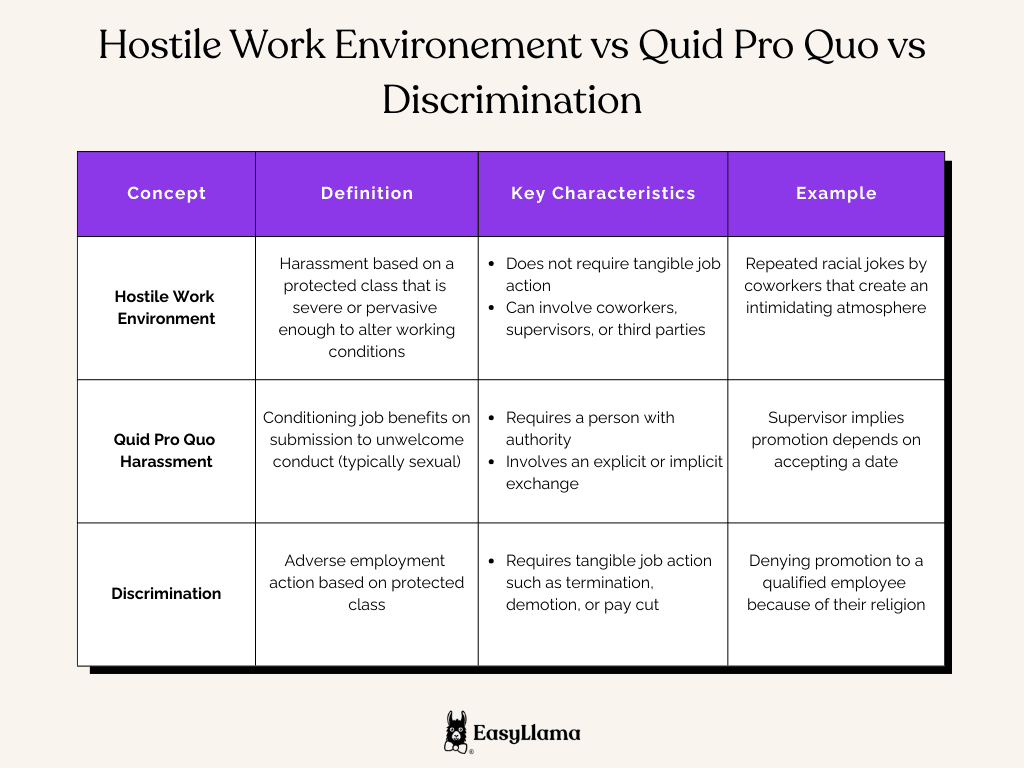
These categories can overlap. For example, quid pro quo harassment is a form of workplace harassment, and harassment can occur alongside discriminatory actions such as demotion or termination.
Employers should understand how these violations differ when evaluating complaints, investigating incidents, and determining the appropriate response. Reviewing harassment training requirements for California can also help organizations build internal awareness and prevent issues before they escalate.
Understanding and proving "hostile work environment" legally
HR teams need more than a definition of harassment. They need a practical way to evaluate complaints against the legal standard. Understanding how courts analyze hostile work harassment helps HR investigate complaints consistently and reduce risk.
Harassing behavior meets the legal definition of hostile work environment harassment when it meets two criteria: the conduct must target a protected class, and the behavior must be severe or pervasive enough to alter working conditions.
Rare, sporadic, trivial, or isolated incidents usually do not meet this threshold. However, a single incident may be sufficient if it is severe enough—such as a physical assault, explicit threat, or egregious slur—depending on the totality of circumstances.
HR should gather evidence to determine whether the conduct is severe, pervasive, or both, including:
- Frequency of incidents: Determine how often the behavior occurred. Repeated incidents over time often demonstrate pervasiveness.
- Severity of each incident: Evaluate whether the conduct was physical or verbal, explicit or implied. Physical aggression or explicit harassment carries greater legal weight.
- Whether the conduct was physically threatening or humiliating: Courts pay close attention to intimidation, threats, or public humiliation.
- Whether conduct interfered with work performance: Document whether the employee’s ability to perform their job declined because of the behavior.
- Comparative treatment: Determine whether the complainant was singled out compared to other employees.
Rapid triage tip: When evaluating whether reported conduct meets the “severe or pervasive” threshold, HR teams can use EasyLlama's Compliance Hub (powered by VirgilHR) to ask plain-language questions about the facts and receive instant, jurisdiction-aware guidance. This helps ensure consistent decision-making and reduces time spent on manual legal research.
Protected classes under California law
California law prohibits illegal discrimination and harassment when the conduct targets a legally recognized protected class. These protected characteristics define the types of harassment covered under FEHA.
Protected traits include:
- Race or skin color
- National origin or ancestry
- Religion or creed
- Age (40 and older)
- Physical or mental disability
- Sex or gender
- Pregnancy, childbirth, or related medical conditions
- Reproductive health decision-making
- Sexual orientation
- Gender identity or gender expression
- Medical condition
- Genetic information
- Marital status
- Military or veteran status
- Off-duty cannabis use (effective January 1, 2024 under AB 2188)
But not every workplace conflict involves discrimination. HR must determine whether the behavior occurred because of a protected characteristic.
Look for signals such as:
- Explicit references to race, religion, gender, disability, or other protected traits
- Different treatment compared to employees outside the protected class
- Stereotyping language or biased assumptions
- Timing that connects the conduct to a disclosure, such as pregnancy or religion
When the connection to a protected class is unclear, document the facts thoroughly and consult legal counsel or compliance guidance tools before concluding no link exists.
For example, some workplace bullying or conflict does not involve a protected class. In those situations, the behavior may not meet FEHA’s hostile work environment standard.
However, the issue still requires action. Treat it as a policy violation, management issue, or culture concern, and document both the assessment and the intervention taken.
Employee rights in reporting a hostile work environment in California
Employees who believe they are experiencing a hostile work environment have several options for reporting the issue and seeking relief. In many cases, the process begins internally with filing a complaint with the employer before moving to external enforcement agencies.
The steps below outline the typical complaint pathway under California law, focusing on the general process employees may encounter when reporting harassment.
External complaint process through CRD or EEOC
Employees may file a complaint with the California Civil Rights Department or with the federal Equal Employment Opportunity Commission (EEOC) if the issue involves federal discrimination laws.
The general process typically follows these steps:
- File a complaint with CRD or EEOC: An employee may submit a formal complaint alleging harassment or discrimination. State complaints are usually filed with the agency formerly known as DFEH, now called the California Civil Rights Department.
- Agency review or investigation: The agency may investigate the complaint or offer dispute-resolution services such as mediation. In some cases, the agency may issue an immediate Right-to-Sue notice upon request.
- Right-to-Sue notice issued: A Right-to-Sue notice allows the employee to pursue a civil lawsuit in court.
- Civil lawsuit filed: After receiving the notice, the employee may file a lawsuit alleging harassment or discrimination.
Employees generally have three years from the date of the alleged violation to file a complaint with the state agency. Filing with the agency is typically required before bringing a lawsuit, a process known as administrative exhaustion.
Please keep in mind that this overview is for informational purposes only and does not constitute legal advice. Employees should consult an attorney for guidance on their specific situation.
Potential remedies in hostile work environment cases
If an employee prevails in a hostile work environment claim, several remedies may be available, depending on the facts of the case.
Potential remedies may include:
- Back pay and lost benefits: Compensation for wages, benefits, or opportunities lost because of unlawful conduct.
- Compensation for emotional distress: Damages for mental anguish, humiliation, or other emotional harm caused by the harassment.
- Attorney’s fees and litigation costs: Courts may require the employer to pay the employee’s legal expenses if the claim succeeds.
- Injunctive relief: Courts may require the employer to implement policy changes, provide training, or take other corrective actions.
- Punitive damages: In cases involving malice or reckless indifference, courts may award additional damages to deter similar misconduct.
The availability and amount of damages depend on the specific facts and applicable law. Employees should consult legal counsel for case-specific guidance.
Employers' obligations for handling hostile work environment complaints in California
California law requires employers to take reasonable steps to prevent a hostile work environment and correct unlawful behavior when it occurs. Once HR becomes aware of a complaint, the clock starts. A prompt, well-documented response protects employees and reduces legal risk.
HR should treat every report seriously. Even if the conduct ultimately falls short of a legal violation, the organization still has a duty to investigate and address the behavior.
Immediate response checklist for HR
When an employee reports harassment, HR should follow a clear intake process. Consistency matters. It protects the complainant and creates a defensible record of the company’s response.
- Thank the complainant for coming forward: Acknowledge the report and reinforce that the company takes concerns seriously. Avoid promising specific outcomes before an investigation.
- Document the initial report: Record the date, time, people involved, and a clear summary of the allegations. Accurate documentation becomes the foundation of the investigation.
- Assess immediate safety risks: Determine whether the employee is at ongoing risk of harm. If necessary, implement interim measures to protect the parties involved.
- Notify appropriate internal stakeholders: Inform HR leadership and involve legal counsel if the allegations are serious or complex.
- Preserve relevant evidence: Secure emails, chat logs, security records, and other documentation that may relate to the complaint.
- Communicate next steps and timeline: Let the complainant know how the investigation will proceed and when they can expect updates.
- Remind all parties of anti-retaliation protections: Make it clear that retaliation against anyone involved in the complaint process is prohibited.
Operational tip: Implementing a centralized complaint intake system—such as EasyLlama's Anonymous Reporting & Case Management tool—allows employees to submit reports securely, with two-way anonymous chat for follow-up questions. This creates a consistent, audit-ready record and ensures no details are lost between intake and investigation.
Choose appropriate interim measures
HR often needs to take temporary steps while the investigation proceeds. The goal is to protect employees without prematurely penalizing anyone involved.
Follow these best practices when selecting interim measures:
- Choose the least disruptive option that ensures safety. Adjust schedules, reporting lines, or work locations when necessary.
- Avoid measures that penalize the complainant. Do not transfer or disadvantage the employee who reported the issue unless they request it.
- Document the rationale for each measure. Keep written records explaining why HR selected a specific interim step.
Take corrective action
If the investigation confirms that harassment occurred, HR should take corrective action to stop the behavior and prevent recurrence. The response should match the severity of the misconduct.
Corrective measures may include:
- Coaching or counseling
- Formal warnings or written reprimands
- Mandatory training
- Demotion or compensation changes
- Termination in serious cases
Even when the investigation cannot confirm a legal violation, HR should still address problematic behavior. Early intervention helps prevent issues from escalating into a hostile work environment claim.
Maintain policy essentials
Strong policies form the foundation of workplace compliance. HR should regularly review the organization’s anti-harassment policy to ensure it reflects current California law.
An effective policy should include:
- A clear definition of prohibited conduct
- Multiple reporting channels, including an anonymous option
- A supervisor duty to report complaints
- A commitment to prompt and thorough investigations
- A clear anti-retaliation statement
- Confidentiality expectations and limitations
- A range of potential corrective actions
- Contact information for the CRD and EEOC
Reviewing policies after a complaint can reveal gaps in reporting procedures or training. Updating these policies and reinforcing them through training helps organizations strengthen prevention and respond more effectively to future concerns.
How to determine legal violations vs. policy/cultural issues
Not every workplace complaint rises to the level of illegal harassment. Some situations violate the law. Others signal poor management, workplace bullying, or culture problems that still require action.
HR teams need a clear way to triage these reports. A simple decision framework helps determine whether the issue likely meets the FEHA standard for a hostile work environment or requires a different response.
Step 1: Assess protected-class links
Start by determining whether the reported conduct involves a protected characteristic. These include race, sex, religion, disability, age, sexual orientation, and other legally protected traits.
- If YES: Proceed to Step 2.
- If NO: The situation may not meet FEHA hostile environment standards. Continue to Step 4 to evaluate policy or cultural interventions.
Step 2: Evaluate severity and pervasiveness
Next, determine whether the conduct appears severe or pervasive. FEHA harassment claims typically require one of these thresholds.
Consider factors such as:
- How often the behavior occurred
- Whether the conduct involved threats, humiliation, or slurs
- Whether the conduct was physical or verbal
- Whether it interfered with the employee’s ability to work
These factors will determine your next steps.
- If YES: The complaint may meet the FEHA threshold. Proceed to Step 3.
- If UNCLEAR: Document the facts carefully, consult legal counsel or compliance tools, and continue the investigation.
Step 3: Identify the harasser’s role
The role of the alleged harasser affects employer liability.
- Supervisor with authority over the complainant: The employer may face strict liability. Escalate the issue immediately and begin a formal investigation.
- Coworker or third party (customer, contractor, vendor): Employer liability depends on whether the organization knew—or should have known—about the conduct and failed to take prompt corrective action.
Step 4: Assess immediate safety risk
Regardless of legal classification, HR must evaluate whether the employee faces immediate harm.
Ask whether there is a risk of:
- Physical harm
- Ongoing harassment
- Retaliation
If risk exists, implement interim protective measures immediately. These may include schedule changes, temporary separation of the parties, or, in serious situations, administrative leave for the accused.
Step 5: Determine the appropriate intervention path
After reviewing the facts, decide how the organization should respond.
- If a FEHA hostile environment is likely: Conduct a formal investigation, document all findings, implement corrective action, and follow up with the affected employee.
- If the conduct does not meet FEHA standards but remains problematic: Address the issue through internal policy enforcement, coaching, performance management, or workplace civility training. Document the assessment and the steps taken.
Consistency matters: Using a standardized triage process ensures every complaint receives a consistent, defensible response—whether it rises to the level of a FEHA violation or requires a different intervention. Document your assessment at each step.
Need help assessing edge cases? EasyLlama’s Compliance Hub provides instant, jurisdiction-aware guidance to help HR teams evaluate whether reported conduct may meet FEHA standards. This supports consistent triage decisions and reduces reliance on ad-hoc legal research.
Preventing a hostile work environment in your organization
Prevention starts long before a complaint appears. California law requires employers to train employees and supervisors on harassment prevention. These rules create a baseline standard that helps organizations reduce risk and build healthier workplaces.
The requirements apply to employers with five or more employees. The table below summarizes the core training obligations under California law.
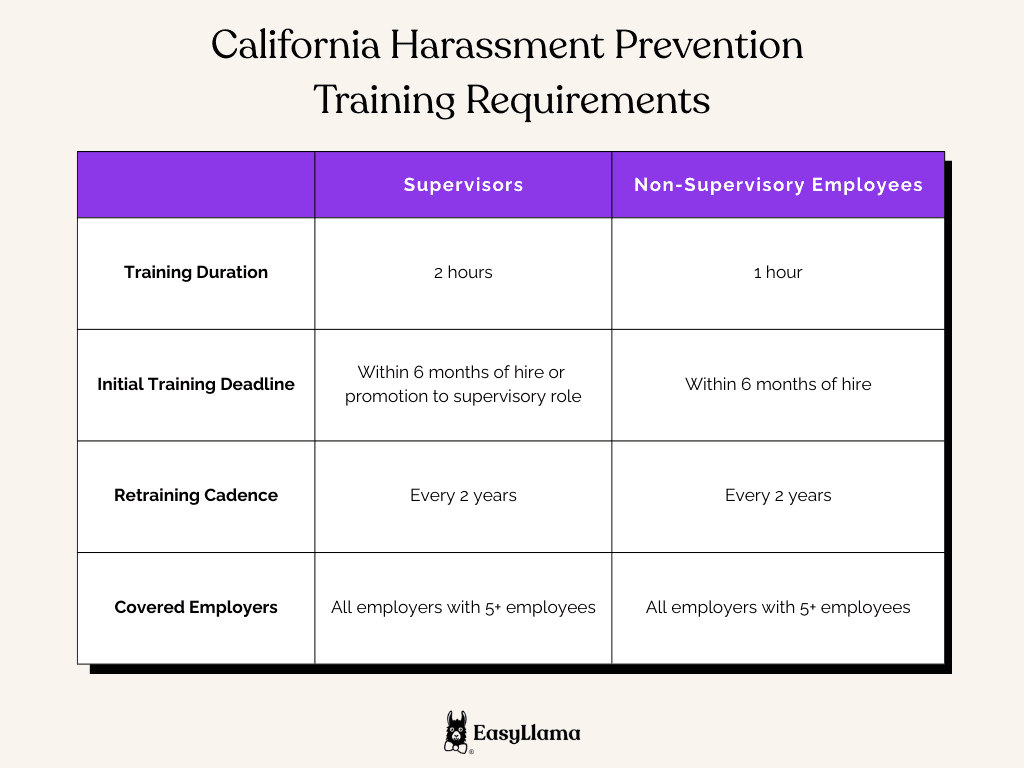
Training alone does not prove compliance. HR must also maintain clear documentation showing the organization took reasonable steps to educate employees and prevent harassment.
Records HR should maintain for compliance
Good recordkeeping supports a “reasonable steps” defense if a complaint arises. HR should retain documentation demonstrating both training completion and the enforcement of workplace policies, including:
- Completion records: Track who completed training, when they completed it, and which course they took. These records help demonstrate compliance during audits or investigations.
- Training content or curriculum documentation: Maintain copies of the training materials used. This shows regulators what topics the organization covered and how employees received instruction.
- Acknowledgment forms or electronic signatures: Employees should confirm receipt and understanding of the training and related policies.
- Follow-up records for non-completers: Document reminders or escalation steps taken when employees fail to complete required training.
- Evidence of refresher training: Retain proof that employees completed the required retraining every two years.
Operational tip: EasyLlama automatically assigns required harassment prevention training by role and location, sends reminders via email, SMS, or Slack, and tracks completion—so HR can prove who completed what and when without manual follow-up. This supports audit readiness and demonstrates reasonable prevention efforts.
Building awareness across the organization
Training should do more than check a compliance box. Effective programs help employees recognize early warning signs, speak up when something feels wrong, and understand how reporting works.
EasyLlama's California sexual harassment training program provides interactive courses designed for modern workplaces. The training aligns with FEHA, AB 1825, and SB 1343 requirements and helps employees understand the difference between inappropriate workplace behavior and illegal harassment.
The goal is simple: build a workplace where problems get addressed early. When employees understand expectations and trust the reporting process, organizations reduce risk and create a safer environment for everyone.
Book a demo to see how EasyLlama helps HR teams manage reporting, training, and compliance from one platform.
 Get more from EasyLlama





Learn more
Hostile work environment California FAQs

- Employers with 5 or more employees must provide 2 hours of harassment prevention training to supervisors and 1 hour to non-supervisory employees within 6 months of hire, with retraining every 2 years.
- Yes, if the incident is severe enough. California Government Code §12923 recognizes that a single incident may be sufficient depending on the totality of circumstances—such as a physical assault, explicit threat, or egregious slur.
- A "toxic workplace" is a general term for an unpleasant or stressful work environment. A legally actionable hostile work environment under FEHA requires conduct that is (1) based on a protected characteristic and (2) severe or pervasive enough to alter working conditions.
- Thank the employee, listen without judgment, document the report, and immediately escalate to HR. Do not investigate independently, promise specific outcomes, or confront the accused.
- California law requires a "prompt" investigation but does not specify a fixed timeline. Best practice is to begin within 24–48 hours and complete the investigation as quickly as thoroughness allows—typically within 30 days for straightforward matters.
- Employers can address legitimate performance issues, but must ensure any discipline is based on objective, documented criteria unrelated to the complaint. Consult HR or legal counsel before taking adverse action against a complainant.
- Employees may file a complaint with the California Civil Rights Department (CRD) or the federal Equal Employment Opportunity Commission (EEOC). They may also request an immediate Right-to-Sue notice from CRD to pursue a civil lawsuit.