Data Privacy Compliance Explained [2026 Checklist]



Get the guide designed to make data privacy compliance easier to understand and easier to manage.
![Data Privacy Compliance Explained [<span>2026 Checklist</span>]](/_next/image?url=https%3A%2F%2Fd230yvp9l0f4m2.cloudfront.net%2Fit_engineer_in_server_room_2021_09_24_04_10_08_utc_1f05370f45.jpg&w=1200&q=75)
This guide is designed to make data privacy compliance easier to understand and easier to manage. You’ll find simplified explanations of key concepts, a practical, HR‑led checklist to help you build a compliant program, and clear guidance on handling data requests, managing consent, and training your team.
- What is data privacy compliance?
- Understanding the 7 principles of the GDPR
- Overview of US Privacy Regulations
- 5 Key privacy and data protection requirements to ensure compliance
- Who is responsible for ensuring data privacy compliance
- Training employees to protect data privacy
- How to build your privacy compliance program
Test Your Compliance
Find out if your company is compliant in two minutes with our free Compliance Grader.
Get Your Free ReportBusinesses must keep up with an ever-growing number of data privacy laws. As of early 2026, 20 U.S. states have enacted comprehensive consumer data privacy laws. That’s a clear signal that data privacy is no longer optional.
This growing patchwork of state laws means companies of all sizes and industries are now expected to follow stricter rules for how they use personal information. With even more states moving toward similar legislation, most businesses will soon be on the hook. This is overwhelming, especially for small and mid-sized teams without dedicated legal resources.
That’s why a proactive, operational approach to compliance matters more than ever. This guide is designed to make data privacy compliance easier to understand and easier to manage. You’ll find simplified explanations of key concepts, a practical, HR‑led checklist to help you build a compliant program, and clear guidance on handling data requests, managing consent, and training your team. You’ll also see how tools like EasyLlama’s Compliance Hub can simplify automation, tracking, and audit readiness so compliance feels manageable, not daunting.
What is data privacy compliance?
Data privacy compliance is the process of following legal regulations and best practices that protect people’s personal information.
- Privacy is about why and how you collect someone’s personal information. It focuses on individual rights and control.
- Security is about protecting that data from being lost, stolen, or accessed by the wrong people.
- Compliance is about following the laws, regulations, and internal policies that say how you should handle that data.
To meet data privacy compliance requirements, your organization needs to know what personal data you’re handling. From there, work on understanding what laws apply. Then, set up clear processes to protect that data and honor people’s rights.
Here’s a quick glossary to get you started:
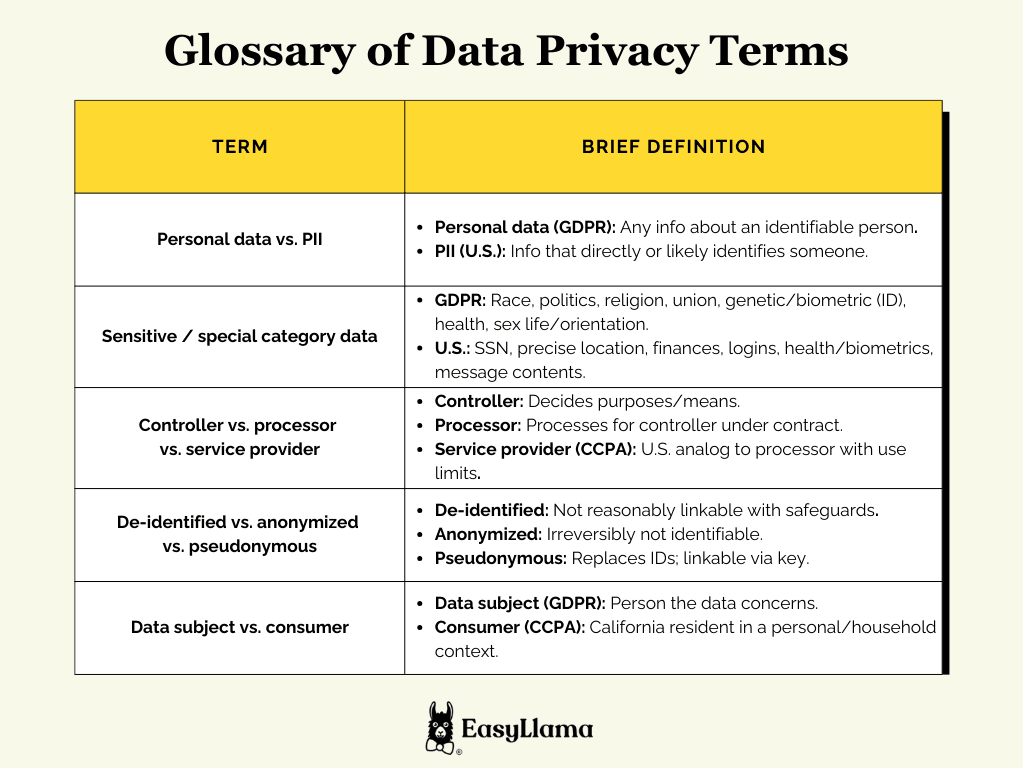
Understanding these terms is a great first step. Most privacy laws follow the same core principles inspired by the General Data Protection Regulation (GDPR). This European law sets the gold standard for data privacy.
Legal importance of data privacy compliance
Laws across the U.S. increasingly require businesses to give people more control over their personal information. Noncompliance can lead to serious consequences, including investigations, fines, and reputational damage.
20 US States have already passed data privacy laws, and that number could reach 24 to 28 by the end of the year if trends continue.
While the specifics vary by state, most of these laws include consumer rights to access, delete, or opt out of the sale or sharing of their data. They also outline strict requirements for how businesses handle, store, and protect that data.
Under the GDPR (Europe’s privacy law), companies can be fined up to €20 million or 4% of global annual revenue, whichever is higher. In California, the CCPA and CPRA allow fines of $2,500 to $7,500 per violation.
These fines can add up fast if you’ve mishandled large amounts of data:
- Meta was fined €1.2 billion under GDPR for unlawful data transfers to the U.S.—the largest privacy fine to date.
- TikTok was fined £12.7 million by the UK for misusing children's data.
- The California Attorney General secured a record‑setting CCPA settlement with Healthline Media LLC, requiring the company to pay $1.55 million for violations, including failing to honor consumer opt‑out requests and improper data sharing practices
Even if your business is smaller than these giants, you have to follow the same regulations. Keep in mind that these state laws apply in addition to sector-specific laws such as HIPAA and GLBA.
Business benefits of data privacy compliance
Here’s how you can get ROI from your compliance efforts:
- Win more B2B deals: If you work with larger companies, privacy compliance can give you a leg up in procurement. Many now require vendors to prove compliance before signing a contract.
- Lower cyber insurance costs: Strong privacy programs and employee training can reduce your premiums, or make you eligible for coverage in the first place.
- Improve data hygiene: Knowing what data you have, where it lives, and why you’re keeping it leads to better organization and fewer risks.
- Build brand trust: Today’s consumers care about how their data is used. Showing that you take privacy seriously can strengthen your reputation and customer loyalty.
Data privacy compliance pays you back long after the rollout, especially because GDPR has turned privacy rights into the global baseline.
GDPR and its impact on international data privacy laws
GDPR took effect in 2018, giving individuals greater control over their personal information by allowing them to access, correct, or delete their data. It also sets strict rules on how businesses collect and use it.
GDPR’s influence doesn’t stop in Europe.
GDPR has inspired laws in:
- UK: Maintained GDPR as UK GDPR post-Brexit
- Brazil: Modeled LGPD directly on the GDPR structure
- Canada: Proposed CPPA adds GDPR-style rights
- U.S. states: CPRA, CPA, and others mirror GDPR’s rights and consent requirements
“New rules have expanded rights related to erasure, portability, consent, and profiling. They have also increased obligations in areas such as governance, impact assessment, and record keeping.” – Anamarija Pogorelec, compliance journalist.
Understanding the 7 principles of the GDPR
The GDPR is built on seven core principles. They help you design a data handling approach that’s not only compliant today but also better prepared for future privacy laws.
1. Lawfulness, fairness, and transparency: You must collect and use personal data lawfully and for a valid purpose, such as consent or a contractual need. Just as importantly, you should be honest and clear with people about what data you collect and how you use it.
2. Purpose limitation: Personal data should only be collected for a specific, clearly stated purpose. If you later want to use that data for a new reason, you need to inform the individual and get their consent again.
3. Data minimization: Only collect the data you actually need to accomplish your goal. Asking for extra information “just in case” increases risk and makes compliance harder.
4. Accuracy: Personal data should be kept accurate and up to date. You need processes in place to correct or delete outdated, incomplete, or incorrect information.
5. Storage limitation: You shouldn’t keep personal data longer than necessary. Once the data has served its original purpose, it should be securely deleted or anonymized.
6. Integrity and confidentiality: Personal data must be protected against unauthorized access, loss, or damage. This includes using appropriate security measures and limiting access to those who truly need it.
7. Accountability: You need to be able to prove that you’re following the rules. That means documenting your data practices and keeping records that clearly demonstrate your compliance with privacy requirements.
Overview of US Privacy Regulations
Unlike Europe, the U.S. doesn’t have one single federal privacy law. Instead, businesses must navigate a growing patchwork of state laws and industry-specific regulations. The good news is that many of these laws share similar goals: giving people more control over their personal information and requiring businesses to handle it responsibly.
CCPA and CPRA: Leading the way in California
The California Consumer Privacy Act (CCPA) and its updated version, the California Privacy Rights Act (CPRA), have become the model for other states.
If your business collects data from California residents, here’s what you need to know:
- Consumers have the right to access, correct, or delete their data.
- They can opt out of the sale or sharing of their personal information.
- “Sensitive personal information” (like race, health data, or geolocation) requires additional protections.
- You must honor Global Privacy Control (GPC) signals that let users opt out through their browser.
- You may need updated contracts with service providers or contractors to reflect how data is handled.
Now in its seventh year, California has passed important updates for 2026, particularly around automated decision-making technology (ADMT). These changes relate to the use of ADMT in decision-making that affects both consumers and employees. Compliance journalist Joe Duball writes:
Rules specific to ADMT require opt-outs when those defined technologies are used in decisions that "replace or substantially replace human decision-making." With human oversight obligations, anyone reviewing automated decisions must be able to interpret ADMT-driven outputs and have the authority to change or correct the final decision.
Other state privacy laws
As of early 2026, the twenty states that have passed comprehensive privacy laws are: California, Colorado, Connecticut, Delaware, Florida, Indiana, Iowa, Kentucky, Maryland, Minnesota, Montana, Nebraska, New Hampshire, New Jersey, Oregon, Rhode Island, Tennessee, Texas, Utah, and Virginia.
While many follow California’s lead, there are key differences you should know:
- Consumer rights can vary, including rights to appeal if a request is denied.
- Some states require universal opt-out mechanisms.
- Enforcement agencies and fine structures differ by state.
California offers a good foundation, but you need to be compliant in each state where you operate or where your customers live.
Foley offers a U.S. State Comprehensive Consumer Data Privacy Law Comparison that gives you a bird's-eye view of the differences and overlaps.
5 Key privacy and data protection requirements to ensure compliance
If you get the core privacy practices right, you’ll be in a much better position to stay compliant now and in the future. Below are five foundational elements that act as your starting point for building a stronger privacy program.
1. Implement a complete DSAR process
DSAR stands for Data Subject Access Request. It’s how people ask your business for access to their personal information, including requests that you delete, correct, or stop using it.
To comply with privacy laws such as the CPRA and GDPR, you need a DSAR system to handle these requests from start to finish.
Here’s what that typically includes:
- Request intake: Make it easy for users to submit requests via your website or other channels.
- Identity verification: Confirm that the requester is who they claim to be to avoid disclosing data to the wrong person.
- Timely response: Most laws require you to respond within 30 to 45 days.
- Evaluate exemptions: Understand when you're allowed (or required) to withhold certain data, like trade secrets or legal records.
- Redact third-party information: If a document includes data about others, you may need to remove or mask it before sharing.
- Appeals process: Some state laws now require you to offer an appeals process if a request is denied.
Before you can fulfill any of these requests, you need to know what personal data you collect, where it’s stored, and who has access to it. Create a data inventory or “map” of your systems and document the types of data you collect and why.
Also, review what’s shared with vendors or partners. If you don’t have this visibility, now is the time to build it. This is key to building trust with your customers.
2. Design compliant consent and cookie management
Different laws have different rules about how and when you need to get consent to collect personal data—especially for things like cookies and online tracking. Some states require opt‑in consent for sensitive data, while others allow opt‑out, so it’s important to understand which model applies to your business.
A good place to start is by categorizing your cookies into groups like necessary, functional, analytics, and marketing. Not all cookies require consent, but many do. Your cookie banner should be clear, easy to understand, and give users real choices. Test different designs to improve clarity and engagement.
You’ll also need a preference center where users can review and update their choices at any time. Behind the scenes, it’s just as important to log and retain consent records so you can demonstrate compliance during an audit.
3. Establish vendor and third-party risk management
Data privacy doesn’t stop at your own systems. If you work with vendors, contractors, or cloud providers who handle personal data on your behalf, you’re still responsible for what happens to that data. That’s why a clear vendor risk management process is essential.
Start with due diligence: before onboarding any vendor, ask them to complete a privacy and security questionnaire. This helps you understand what data they access and how they protect it.
From there, use a risk scoring system to evaluate vendors based on the type of data they handle, the safeguards they use, and how critical they are to your business.
Make sure every vendor who touches personal data signs a Data Processing Agreement (DPA) that outlines their responsibilities. If data is being transferred internationally, you may also need Standard Contractual Clauses (SCCs) in place.
Finally, don’t “set it and forget it.” Build in regular reviews or audits to confirm vendors are following through on their promises. Well-managed third-party risk not only keeps you compliant, but it also helps prevent problems before they start.
4. Build incident response and breach notification capabilities
Start by building a response playbook (sometimes called a “runbook”) that outlines what happens when you detect a potential incident. It should include clear roles and responsibilities, so your team isn’t scrambling to figure out who does what in the moment.
You’ll also want to define how you classify incidents and determine severity. Not every security issue requires the same level of response.
Make sure your plan includes:
- Customer notification deadlines (72 hours for GDPR and 30 to 90 days for most state laws)
- Decision trees for when to notify regulators vs. individuals
- Steps to preserve evidence in case of legal review
- Pre-written communication templates for customers, partners, and legal teams
A solid plan won’t stop a breach, but it can help you respond quickly, meet your obligations, and maintain trust when it matters most.
5. Create and maintain compliance documentation
Good documentation is proof that you’re doing the right things to protect people’s data.
You’ll want to maintain a clear set of documents that show how your business collects, uses, stores, and shares personal information. These records not only help demonstrate compliance but also make it easier to respond to customer requests and regulatory inquiries.
At a minimum, your documentation should include:
- Privacy policies and notices (for both internal teams and external users)
- Records of Processing Activities (RoPA)
- Data Protection Impact Assessments (DPIAs)
- Transfer Impact Assessments (TIAs)
- Employee training records and policy acknowledgments
- Audit reports and any remediation steps taken
Also, make sure you have a simple way to generate reports if a customer asks for their data. That includes pulling all relevant personal data into a clear, understandable format that they can easily review. The goal is to be transparent, organized, and ready before anyone asks.
Who is responsible for ensuring data privacy compliance
Data privacy compliance isn’t just an IT or legal issue—it’s a shared responsibility across your entire organization. From executives to HR, marketing to customer support, everyone plays a part in keeping personal data safe and handled properly.
That said, the structure of your privacy team will depend on your size and risk level.
- Small businesses may assign privacy oversight to an operations or HR lead.
- Mid-sized companies often designate a privacy manager or cross-functional team.
- Larger organizations may require a Data Protection Officer (DPO)—a legal requirement under GDPR if you process large amounts of sensitive data or monitor individuals on a large scale.
In the EU and UK, businesses without a physical presence but that handle citizen data may also need to appoint a local representative to liaise with regulators.
To clarify roles, many companies use a RACI matrix to outline who is Responsible, Accountable, Consulted, and Informed for various privacy tasks.
While tech tools and safeguards matter, compliance ultimately comes down to people. That’s why businesses also need an effective data privacy learning program to ensure everyone understands their role in protecting personal information.
Training employees to protect data privacy
Technology plays a big role in privacy compliance—but people make or break it. The most secure system can still be compromised by human error, whether it’s sending the wrong email or falling for a phishing link.
That’s why training is essential. The right program helps every employee understand how data privacy applies to their role and equips them to do the right thing every day.
Role-based privacy training paths
Not everyone needs the same training. Tailoring lessons by role helps teams focus on the risks and responsibilities that matter most to them.
- Engineering: Secure coding practices, privacy by design, data minimization
- Marketing: Consent and cookie management, email compliance, audience segmentation
- HR: Handling employee data, background checks, and retention policies
- Customer Support: Responding to DSARs, sharing data with third parties, and authentication protocols
Training should be clear, relevant, and delivered in formats that employees can actually engage with.
Microlearning for modern privacy challenges
EasyLlama blends real-world examples with short, scenario-based modules that keep employees focused and engaged.
- Interactive, high-quality video lessons
- Manager toolkits for real-world reinforcement
- Mobile and multilingual accessibility
- In-training pulse checks to track understanding
This microlearning format makes it easier to fit training into busy schedules—and easier to retain information.
Tracking success and driving results
A strong data privacy training program should also deliver measurable outcomes. EasyLlama helps teams track:
- Completion rates by team or department
- Time to completion and knowledge assessment scores
- Policy attestations for audit readiness
Just ask Sounds True, a customer who saved 120–160 hours by automating compliance training with EasyLlama—freeing up their team to focus on strategy instead of paperwork.
Plus, with our Course Authoring Tool, admins can quickly update and publish new content as laws change—keeping your privacy training aligned and up to date without a major lift.
When your team is confident in its data protection, your entire organization becomes stronger and safer.
How to build your privacy compliance program
Getting compliant can feel overwhelming, especially with so many moving parts—from data mapping and policies to training and vendor oversight. That’s where a checklist comes in. Breaking the work into manageable phases helps ensure you’re building a program that’s both thorough and achievable.
Use this 12-week plan to get started, scale smartly, and stay aligned with evolving laws across states and countries. This structure works whether you’re starting from scratch or tightening up what you already have.
Week 1 - 2: Foundation and assessment
This is your time to get organized. Focus on laying a solid foundation by identifying which laws apply and how your current practices measure up:
- Identify which privacy laws apply based on your business’s footprint
- Appoint a privacy lead or Data Protection Officer (DPO), if required
- Conduct a data inventory to understand what personal information you collect, store, and share
- Perform a gap assessment to spot where your current practices fall short of legal requirements
Week 3 - 4: Policy development
Once you understand your obligations, the next step is to get your documentation in place. Strong policies set expectations and demonstrate to regulators that you're taking privacy seriously:
- Draft or update essential privacy documents like your privacy notice, data retention schedule, incident response plan, and cookie policy
- Set up a compliance calendar to keep track of due dates, refresh cycles, and regulatory updates
- Assign ownership for updating each policy moving forward
Week 5 - 8: Operational implementation
Now it’s time to put your plan into action. Focus on the systems and workflows that bring your policies to life:
- Build and test your DSAR (data subject access request) intake process
- Launch a consent and cookie management system tailored to your user base
- Develop a vendor onboarding and assessment workflow to quantify third-party risk
- Set up internal procedures for securely retaining and deleting personal data
Week 9 - 12: Training and culture
The final step is making sure your people are informed and engaged. Compliance isn’t one-and-done. It’s part of your culture. Here’s how to round off your program design:
- Roll out a role-based privacy training program that’s clear, relevant, and engaging
- Implement a system for tracking policy attestations and training completions
- Schedule ongoing training refreshers, whether quarterly or annually, depending on risk and role
EasyLlama’s Compliance Hub can make all of this easier. It gives you access to real-time legal updates, expert-vetted policy templates, and automated course assignments tailored to your role and location. Customers using the platform see 80%+ training completion rates, saving hours of admin time and dramatically reducing audit prep stress.
Staying compliant helps you avoid penalties, build trust, reduce risk, and run your business with confidence. A well-structured program shows employees, customers, and partners that you take data privacy seriously.
Ready to make privacy easier? Book a demo and see how EasyLlama can help.
Share this


Frequently
Asked
Questions

- It depends on where your customers live and what kind of data you collect. Most state privacy laws apply based on the consumer's location (not your company's), so multi-state businesses often need to comply with multiple laws.
- You may need a Data Protection Officer if laws like GDPR apply and you handle large amounts of sensitive data. Otherwise, many small and mid-sized businesses assign privacy responsibilities to an HR, legal, or operations lead.
- A controller decides why and how personal data is used. A processor handles that data on the controller’s behalf, following their instructions. Many small businesses act as controllers, while vendors such as payroll or email tools act as processors.
- Yes. [EasyLlama’s Course Authoring Tool](https://www.easyllama.com/product/course-authoring-tool) lets admins quickly update training content and policies as laws change. New versions can be published in minutes, with automated reassignment and tracking to ensure employees always complete the latest training.
- EasyLlama provides detailed training records, completion rates, policy attestations, and certificates, all accessible from a single dashboard. You can generate reports instantly, export proof in bulk, and confidently show auditors that your team is fully trained.
- EasyLlama offers up-to-date courses aligned with the latest laws and includes tools to automatically update and distribute company policies. You’ll get real-time legal updates, expert guidance, and automated workflows to stay compliant without extra manual work.
 Articles
Read More Blogs
Explore what others in your field are learning

A Checklist to Ensure Code of Conduct Compliance in Your Company
Ensure your company's code of conduct compliance with our checklist. Learn best practices to foster a respectful and law-abiding workplace environment.

Saphira Ensley
![12 Best Security Awareness Training Providers [2026]](/_next/image?url=https%3A%2F%2Fd230yvp9l0f4m2.cloudfront.net%2FCybersecurity_654735261c.jpg&w=1200&q=75)
12 Best Security Awareness Training Providers [2026]
Discover the 12 best Security Awareness Training providers that drive real behavior change—not just compliance checkboxes.

Michael Devyver

Start Modernizing Workplace Compliance
It’s easy to get started with EasyLlama. Speak with one of our compliance experts and get a demo tailored to your business’s needs.