
Understanding SB 553 California Workplace Violence Prevention Law
17 Apr 2026


California Senate Bill 553, codified as Labor Code § 6401.9, is the state's comprehensive workplace violence prevention law. Signed into law on September 30, 2023, it took effect on July 1, 2024.
SB 553 hit the ground running—no phased rollout, no grace period, no optional framework. Employers caught in non-compliance face citations that sting and penalties that pile up fast.
If your organization employs workers in California, you need to know exactly what this law demands. This guide cuts through the legal language and hands you a practical compliance roadmap: what to do, who owns it, and what proof to keep on file.
How is workplace violence defined under SB 553?
Per Labor Code section 6401.9, "workplace violence" is defined as any act of violence or threat of violence that occurs in a place of employment. The definition is intentionally broad, covering:
- Physical force. The threat or use of physical force against an employee that results in, or has a high likelihood of resulting in, injury, psychological trauma, or stress — regardless of whether the employee sustains an injury.
- Weapons. An incident involving a threat or use of a firearm or other dangerous weapon, including the use of common objects as weapons, regardless of whether the employee sustains an injury.
- Threats. Verbal, written, or electronic threats that reasonably convey intent to cause physical harm.
- Intimidation. Harassment that creates a reasonable fear of violence.
The law explicitly states that "workplace violence" does not include lawful acts of self-defense or defense of others. It covers violence from all sources — strangers, customers, coworkers, and individuals with personal relationships to employees.
Who is covered by SB 553 (and who is exempt)
As of July 1, 2024, SB 553 applies to nearly all California employers unless specifically exempt. The WVPP requirement covers all California employers, employees, workplaces, and employer-provided housing, with limited exceptions:
- Remote employees working at a location of their choosing that is not under the employer's control
- Small worksites with fewer than 10 employees at a given time that are not accessible to the public, provided the employer complies with Cal/OSHA's IIPP regulation
- Law enforcement agencies and facilities operated by the Department of Corrections and Rehabilitation
Healthcare facilities already covered by Cal/OSHA's Violence Prevention in Health Care regulation (Section 3342) only need to comply with that existing standard, not SB 553.
The statute specifies that employees "teleworking from a location of the employee's choice, which is not under the control of the employer" are exempt. A location is considered "under the control of the employer" when the employer has the authority to operate business, set rules, and oversee safety measures — such as in company-owned or leased office spaces. For hybrid employees, coverage applies when they're working on-site at an employer-controlled location.
Here's a quick reference for how SB 553 coverage applies across common workforce scenarios:
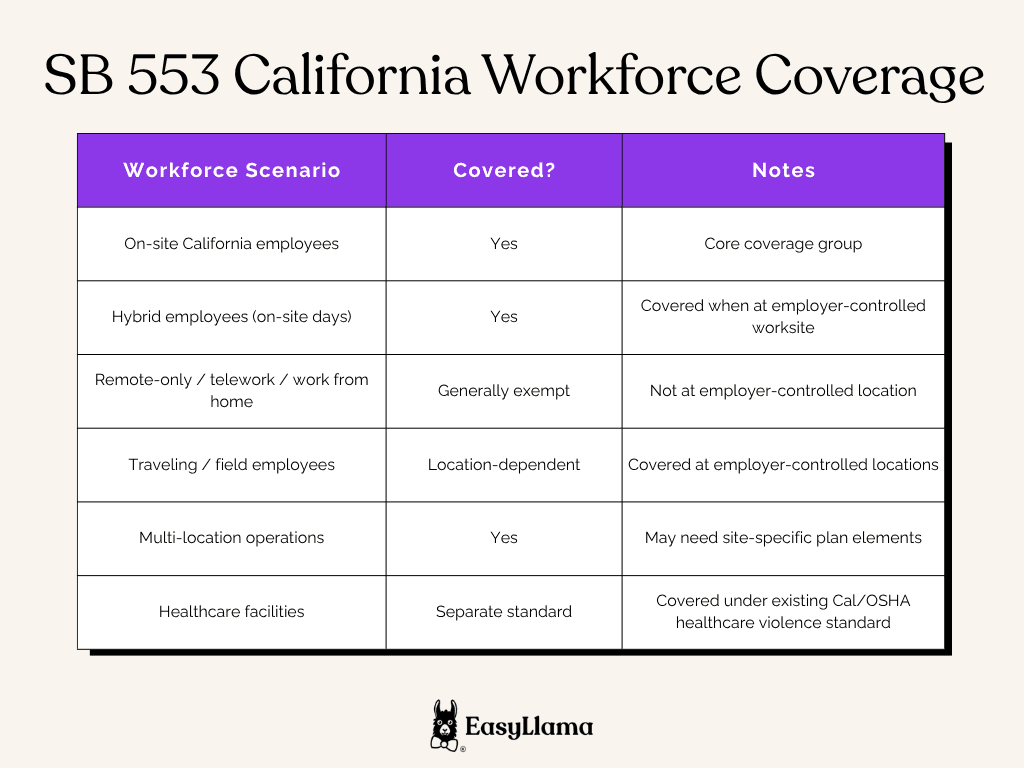
EasyLlama's California SB 553 workplace violence course provides a standardized, state-specific curriculum that gives every covered employee the same training regardless of location. The course is fully mobile and tablet-friendly, so remote, traveling, and multi-location employees can complete the same 30-minute training wherever they work.
Core employer duties under SB 553 in California
SB 553, codified in California Labor Code section 6401.9, requires California employers to adopt a comprehensive Workplace Violence Prevention Plan (WVPP), train employees on workplace violence, and log safety incidents. These duties break down into four core obligations:
- Establish a written Workplace Violence Prevention Plan (WVPP).
- Implement the plan across all covered worksites.
- Maintain the plan with ongoing updates, training, and recordkeeping.
- Review the plan periodically and after triggering events such as a violent incident, a newly identified hazard, or a change in operations.
These are ongoing obligations, not one-time tasks. The law requires employers to review their plan at least annually and to provide effective training at least annually. Treating SB 553 as a "set it and forget it" exercise is a fast track to a citation.
Key components of the workplace violence prevention plan
Every covered employer is required to establish, implement, and maintain an effective workplace violence prevention plan. Employers may incorporate the WVPP into their existing Injury and Illness Prevention Program (IIPP) or maintain it as a standalone document, but either way, the plan must be tailored to each employer's specific worksites and operations.
The following are the required plan elements, along with a practical tip for each:
- Designated responsible parties. The plan must clearly identify — by name or job title — who is accountable for carrying out the WVPP. HR should assign ownership to specific individuals or roles so accountability is unambiguous.
- Employee participation procedures. The WVPP must outline how the employer will actively engage employees and their authorized representatives in shaping and carrying out the plan. Create a simple feedback mechanism — such as a survey or a standing committee — to ensure frontline workers contribute to plan development.
- Multi-employer coordination methods. When multiple employers share a worksite, the plan must spell out how they will align their respective violence prevention efforts. If you share a building or use staffing agencies, document how you'll coordinate safety protocols with those entities.
- Reporting and response procedures. The WVPP must establish clear channels for employees to report incidents or threats, explain how the employer will investigate those reports, and describe how employees will be kept informed of outcomes. Build these channels with confidentiality protections.
- Employee compliance and accountability measures. The plan must describe how the employer will hold all workers — both supervisory and nonsupervisory — to the WVPP's standards. Incorporate the WVPP into your employee handbook and reference it during onboarding.
- Hazard identification and correction procedures. The WVPP must lay out a systematic process for spotting, assessing, and resolving workplace violence risks. Schedule regular worksite inspections focused on violence risk factors.
- Emergency response procedures. Define clear steps employees should take during an active violent event, including evacuation, sheltering, and how to contact emergency services.
- Post-incident response and investigation procedures. After an incident, employers must record required information in the violent incident log and investigate the event to determine and implement necessary changes.
- Training requirements. Ensure all training is documented, accessible to employees, and delivered in a language and vocabulary appropriate to the workforce.
- Plan review procedures. The WVPP must include a process for periodic reassessment — at minimum annually, whenever a gap or deficiency surfaces, and following any workplace violence incident.
To help your organization get started, download a California Workplace Violence Prevention Plan template to simplify building or updating your compliance-ready program.
Hazard identification, assessment, and correction
SB 553 requires employers to conduct targeted violence-risk assessments. In practice, hazard identification looks like this:
- Reviewing past incidents and near misses for patterns.
- Conducting worksite inspections focused on violence risk factors such as working alone, handling cash, working late hours, and public-facing roles.
- Soliciting employee input on perceived risks through surveys, meetings, or anonymous reporting channels.
- Evaluating physical security measures such as lighting, access control, panic buttons, and camera placement.
Once hazards are identified, employers must assess severity and likelihood to prioritize corrective actions. The correction step requires employers to implement timely fixes and document what was done.
This process must be ongoing — the WVPP must be reviewed at least once per year and updated whenever a workplace violence incident occurs, new hazards are identified, or operations change.
SB 553 California training requirements
The training obligations under SB 553 are detailed and prescriptive, covering who needs training, when it must happen, and what topics it must address.
Who must complete the training
All covered employees must learn to identify warning signs, report concerns, and respond to potential violence. Supervisors and managers have added responsibilities for recognizing threats, handling reports, and supporting investigations. New hires receive training during onboarding.
When training must occur
Training is required at initial plan rollout, annually, when the plan changes, and when new hazards emerge. Updates triggered by specific changes can focus on those changes only.
What training must cover
- The employer's WVPP and how to access and participate in it
- Reporting procedures with anti-retaliation protections
- Role-specific and worksite-specific violence hazards
- Available prevention and response resources
- Safety strategies, including de-escalation and evacuation
- The violent incident log and record access procedures
- A live Q&A with someone knowledgeable about the plan
Additionally, employers must ensure training content is delivered at a level that matches employees' education, literacy, and language needs. EasyLlama's California SB 553 training course covers each of these requirements in a 30-minute interactive format. It's available in several languages by default with automated tracking and instant certificate downloads that simplify compliance documentation.
What to document and retain
SB 553 imposes specific recordkeeping obligations across three areas: incident logging, post-incident investigations, and long-term record retention.
The violent incident log
SB 553 requires employers to maintain a violent incident log as a distinct compliance document, separate from general incident reports or OSHA 300 logs. The law requires the employer to record information in a violent incident log for every workplace violence incident.
Each log entry must capture the following details:
- Date, time, and location of the incident
- Workplace violence type (Type 1, 2, 3, and/or 4 as defined by the statute)
- Detailed narrative describing what occurred
- Perpetrator category, for example, client/customer, family member, or associate of a client, stranger, coworker, supervisor, domestic partner, relative, or other individual
- Circumstances at the time of the incident (e.g., staffing level, lighting conditions, working alone)
- Whether the incident involved a physical injury, threat, or other type of violence
- Consequences of the incident
- Actions taken by the employer in response
Incidents must be logged even if they do not result in injury, and must exclude any personal identifying information that could identify any person involved in the incident.
Investigation and post-incident response
When a threat is reported or an incident occurs, managers should take these immediate steps:
- Secure the area and remove employees from imminent danger.
- Ensure the safety and medical needs of anyone affected.
- Document initial facts while details are fresh.
- Notify the designated WVPP coordinator.
From there, the investigation follows a clear path: assess immediate risk, investigate the circumstances, document findings, implement corrective actions, and update the WVPP if needed.
Record retention and audit readiness
SB 553 sets clear retention timelines. Employers must keep training records for at least one year, documenting session dates, a summary of content covered, the qualifications of trainers, and the names and job titles of attendees.
Records subject to a five-year retention requirement include
- Hazard identification
- Evaluation
- Correction documentation
- Workplace violence incident investigations
- Violent incident logs
During an inspection, Cal/OSHA would expect to see the written WVPP, training records, violent incident logs, hazard assessment documentation, and evidence of employee involvement in plan development and review.
Employers must also make all hazard identification, training, and violent incident records available to employees and their authorized representatives at no cost and within 15 calendar days of a request.
When proof of training is needed for an audit or inspection, EasyLlama allows admins to export completion certificates in bulk with a single click.
SB 553 compliance roadmap: A step-by-step action plan
Reaching and maintaining compliance with California's workplace violence law doesn't have to feel overwhelming. Breaking it into sequential steps gives HR teams a clear path from assessment to ongoing maintenance:
- Step 1: Confirm coverage. Determine whether your organization and worksites fall within SB 553's scope using the coverage table above. Document any exemptions.
- Step 2: Assign ownership. Designate the person or persons responsible for developing, implementing, and maintaining the WVPP.
- Step 3: Conduct a workplace violence hazard assessment. Involve employees in identifying risks and document all findings.
- Step 4: Draft the written WVPP. Use the Cal/OSHA model plan or EasyLlama's WVPP template as a starting point. Ensure all ten required components are addressed.
- Step 5: Establish reporting and response procedures. Set up internal reporting channels, create investigation workflows, and prepare the violent incident log template.
- Step 6: Deploy initial training. Train all covered employees on the WVPP and their rights and responsibilities. EasyLlama's California SB 553 course offers a standardized, 30-minute training experience with automated tracking.
- Step 7: Document everything. Retain training records, the written WVPP, violent incident logs, and hazard assessment documentation.
- Step 8: Establish an ongoing compliance cadence:
- Annual. Refresher training for all employees; review and update the WVPP.
- After incidents. Investigate, log, update the plan, and retrain as needed.
- After operational changes. Reassess hazards when worksites, roles, or conditions change.
- Ongoing. Monitor reporting channels, maintain the violent incident log, and track training completion.
Ready to see how it works? Request a free course preview to explore the full training experience.
 Get more from EasyLlama





Learn more
SB 553 California workplace violence law FAQs

- California SB 553 is a legislative bill that mandates workplace violence prevention plans for California employers. It obligates employers to evaluate violence-related risks at their worksites, put preventive measures in place, and deliver employee training on identifying and addressing potential threats. It's codified as Labor Code § 6401.9 and has been enforceable since July 1, 2024.
- The law carves out an exemption for remote workers. Under SB 553, employees who telework from a self-selected location outside the employer's control are not subject to the WVPP requirements. Hybrid employees are covered when they report to an employer-controlled worksite.
- Employers must deliver training when the WVPP is first put in place and on an annual basis thereafter. Supplemental training is also triggered when a new or previously unrecognized hazard comes to light, when the plan is revised, or following a violent incident.
- Yes, it's required. Employers must track every incident of violence as defined in the regulation, capturing specific data points in the log. Violent incident logs must be maintained for a minimum of five years. The log must exclude personally identifiable information and be available to employees and Cal/OSHA upon request.
- Noncompliant employers risk enforcement action from Cal/OSHA, which can include citations and monetary fines. Penalty amounts depend on factors such as the nature and severity of the violation and the degree of risk posed to employee safety.