Navex vs EasyLlama: Which Platform Is Better For You?



Explore Navex vs. EasyLlama: Uncover the ultimate compliance training solution. Compare features, pricing & benefits. Make an informed choice today!

Explore Navex vs. EasyLlama: Uncover the ultimate compliance training solution. Compare features, pricing & benefits. Make an informed choice today!
Test Your Compliance
Find out if your company is compliant in two minutes with our free Compliance Grader.
Get Your Free ReportIf you're an HR leader trying to roll out harassment prevention training across multiple states while meeting a HIPAA deadline next month—all while onboarding the next wave of new hires—you already know that choosing the wrong compliance training platform makes everything harder. The wrong fit means more manual follow-ups, missed deadlines, and frustrated employees clicking through training they don't retain.
This guide breaks down the Navex vs EasyLlama comparison in plain terms. You'll get an objective look at scope, training capabilities, customization options, pricing, and third-party reviews—plus a simple decision framework to match the right platform to the program you're actually running.
Quick pros and cons summary
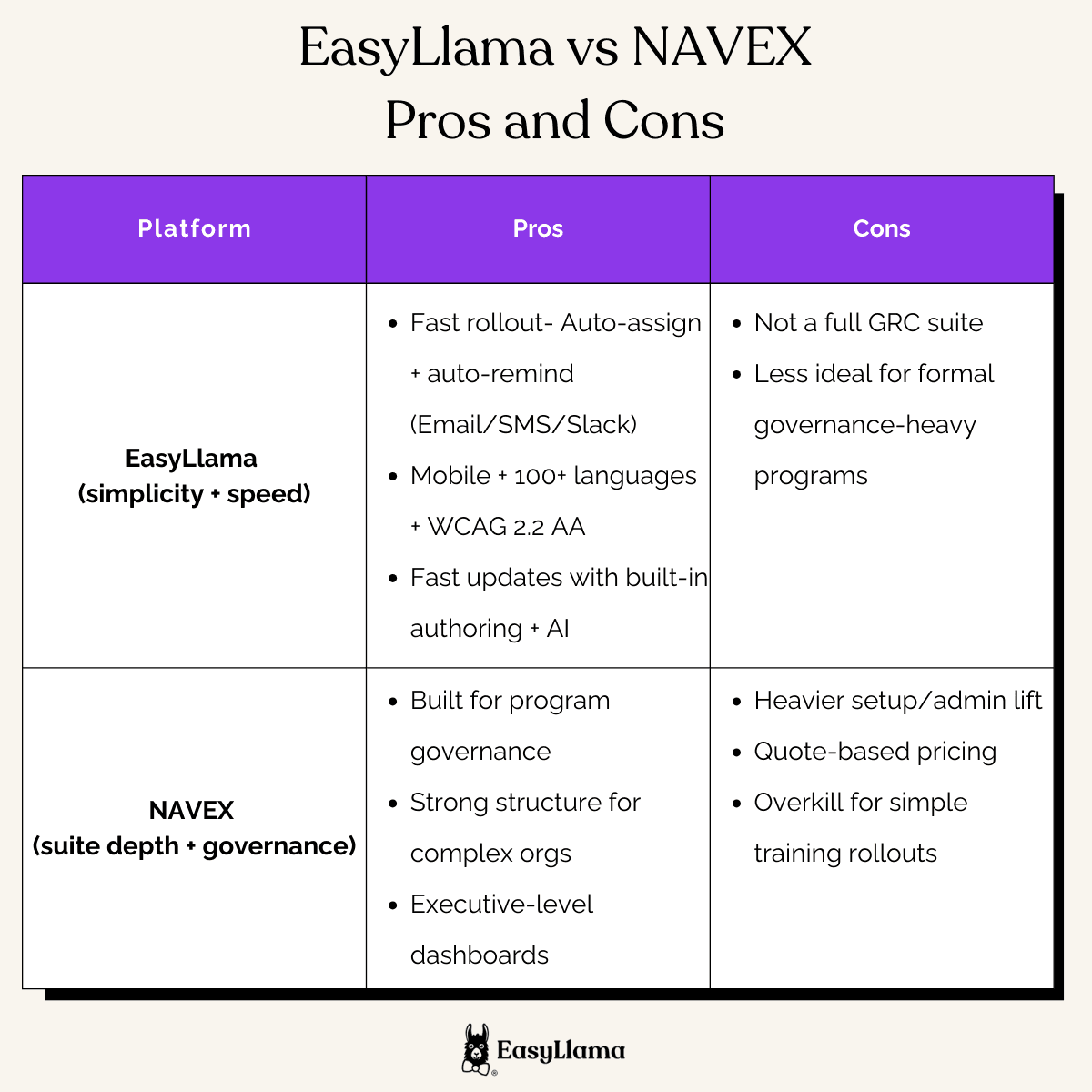
Both platforms serve real compliance needs. The question isn't which is "better" overall—it's which one fits the program you're running today.
Who are EasyLlama and Navex built for?
NAVEX and EasyLlama both help organizations meet compliance training goals, but they orbit different centers of gravity.
NAVEX One is an AI-powered GRC platform that unifies your entire risk and compliance program—from training and whistleblowing to policies and disclosures—with cross-program metrics in board-ready dashboards. Training is one module within that broader ecosystem, not the whole product.
EasyLlama takes a different approach. It's built to deliver premium compliance and workplace training from a library of 400+ expert-developed, legally vetted courses. The platform features interactive AI scenarios and ready-made content kept current with federal and state law. It's designed for HR teams managing compliance across multiple jurisdictions who need to assign, track, and report on training without getting buried in configuration—whether you're managing 50 employees in one state or 5,000 across twenty.
This distinction matters. EasyLlama's simplicity isn't a limitation—it's what makes the platform scale.
Enterprise organizations managing multi-state compliance obligations, recurring training cycles, and large onboarding waves benefit from a platform that automates the complexity away rather than adding layers of configuration on top of it. A training-first LMS gets you to that first rollout faster and keeps every rollout after it just as efficient.
EasyLlama vs Navex: Training capabilities side-by-side
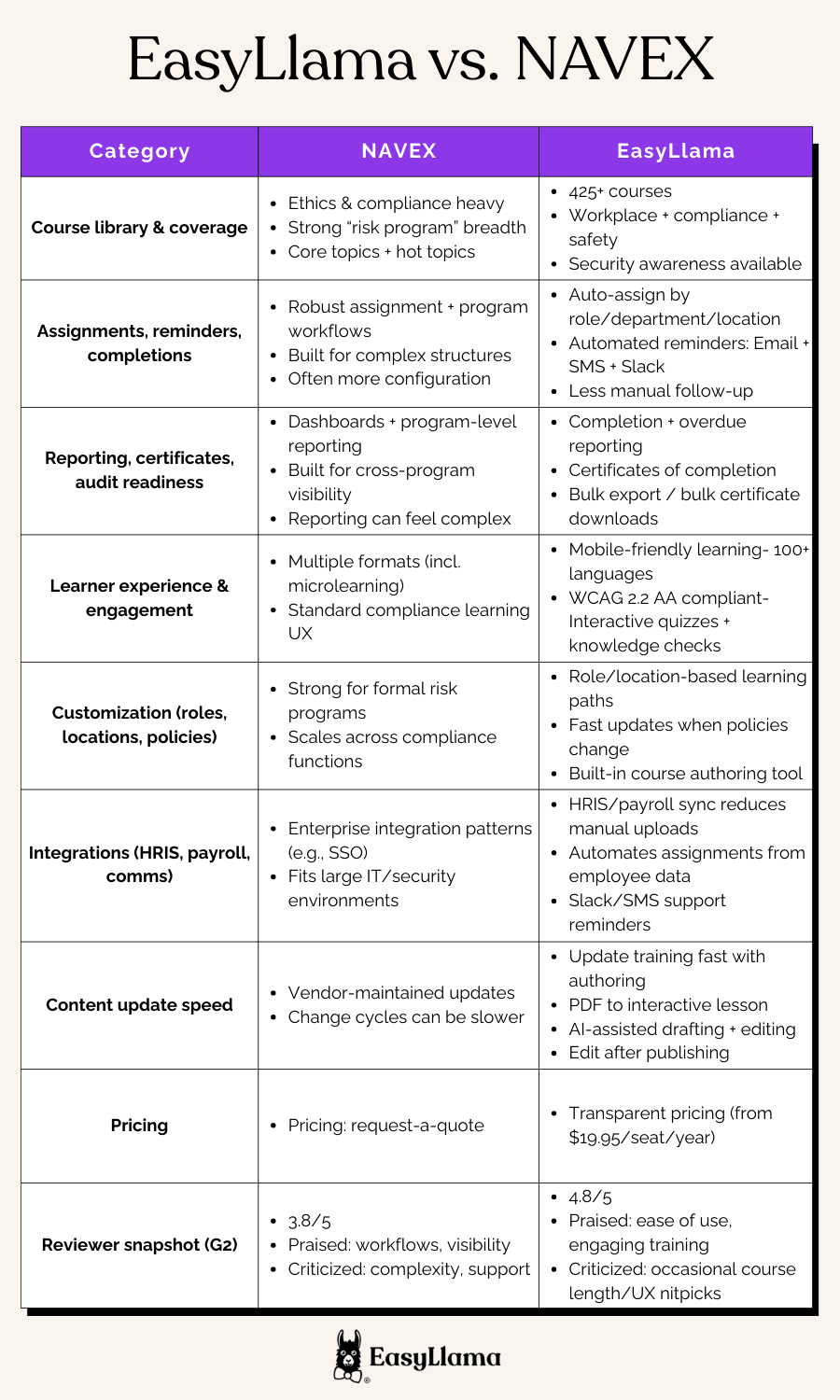
When comparing Navex vs EasyLlama on training specifically, the differences show up across eight key dimensions. Below is an at-a-glance comparison covering course libraries, assignments, reporting, learner experience, customization, integrations, content updates, and pricing—followed by a deeper look at each area.
Course library breadth and compliance coverage
The depth of a platform's course library determines whether you can meet compliance requirements without cobbling together content from multiple vendors.
- NAVEX covers hot topics like cybersecurity, workplace harassment, and social media, plus core issues such as anti-bribery and code of conduct. It offers over 100 courses in various formats, lengths, and languages, with content updated regularly to reflect new regulatory requirements.
- EasyLlama offers over 425 interactive courses spanning harassment prevention, DEI, workplace safety, cybersecurity and data privacy. It includes state-specific training for regulated markets (e.g., California SB 553 workplace violence prevention) and features Llama Bites—5-to-10-minute microlearning modules delivered monthly for ongoing reinforcement.
State-specific and regulated-training requirements are often the forcing function for any platform purchase. Your platform needs to cover those topics with trackable, certificate-generating courses out of the box.
Assignments, reminders, and completion management
The gap between "we assigned it" and "everyone completed it" is filled with manual follow-ups and chasing emails.
- NAVEX manages assignments and tracking via a central admin dashboard, with the ability to delegate control by region or department. It automates training due reminders and manager notifications, built for complex organizational structures with formal program workflows.
- EasyLlama auto-assigns training by role, department, and location—so new hires in different states receive the right courses automatically. It sends automated reminders via email, SMS, and Slack, and automates yearly reminders for annual courses like HIPAA and harassment prevention.
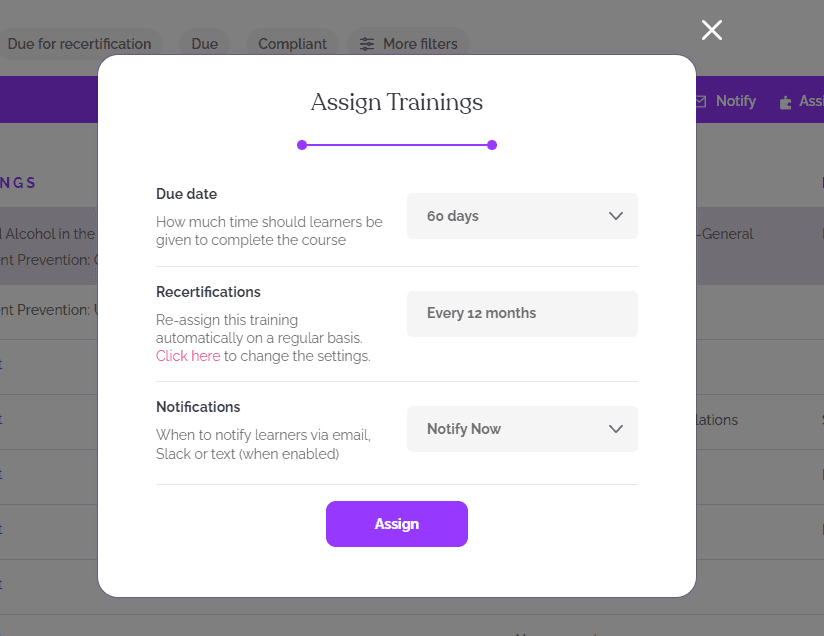
The multi-channel reminder approach is a real differentiator. Deskless workers who don't check email still get a text, and remote teams get Slack nudges—directly reducing the "chasing" problem HR teams know all too well. For enterprise organizations with thousands of employees across multiple states and work environments, this automation eliminates a massive administrative bottleneck.
Reporting, certificates, and audit readiness
When an auditor asks for proof that 100% of your California workforce completed harassment prevention training, you need that answer in minutes—not days of spreadsheet assembly.
- NAVEX provides dashboards showing key performance metrics, links training performance to wider GRC data in the NAVEX One platform, and offers filterable reporting by course, date, and risk category.
- EasyLlama provides detailed reporting tools to track completion rates and generate compliance reports. It delivers instant certificates of completion with bulk download and export options, plus an AI-powered report builder with filtering by department, state, role, location, and custom fields.
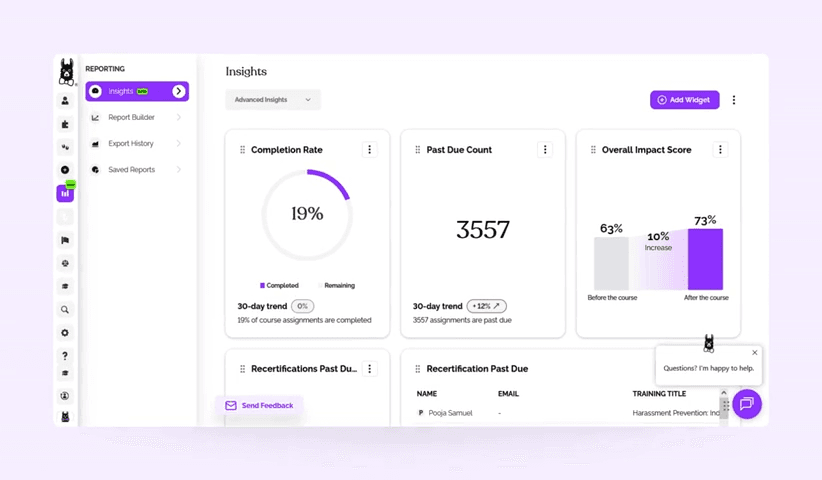
EasyLlama's bulk certificate export is particularly useful during audits—you can download every completion record in one action rather than pulling them individually.
Learner experience and engagement controls
A training platform only works if employees actually finish the courses.
- NAVEX offers Micro Learning (under 10 minutes) and Full Length formats. Adaptive learning courses adjust to each learner's knowledge level, and story-based scenarios mirror real workplace challenges.
- EasyLlama delivers a mobile-friendly platform accessible to all employees regardless of location. It supports over 100 languages and meets WCAG 2.2 AA accessibility standards, using a mix of videos, interactive scenarios, and quizzes to boost engagement and retention.
EasyLlama's interactive quizzes and knowledge checks reduce "click-through risk," where employees mindlessly advance slides without absorbing anything. That active engagement translates to stronger knowledge retention.
Customization for roles, locations, and policies
A manager in Texas and a non-manager in New York shouldn't see identical training.
- NAVEX allows organizations to customize courses to reflect their brand—from editing text and images to adding custom content—with adaptive learning that personalizes the learner experience.
- EasyLlama supports role-based and location-based learning paths, so managers receive supervisor-specific training automatically. Its built-in Course Authoring Tool lets HR teams create courses from scratch, templates, or existing materials like PDFs. AI helps draft outlines, rewrite content, and generate quiz questions—and you can update courses after publishing without rebuilding.
Practical example: if your company operates in California, Illinois, and New York, EasyLlama lets you assign state-specific harassment prevention courses by location while adding a manager supplement for supervisors—all without manual sorting. That kind of automated, location-aware assignment is what makes multi-state compliance manageable at scale.
HRIS, payroll, and communication integrations
Manual CSV uploads and duplicate data entry waste time and introduce errors. The right integrations eliminate both.
- NAVEX integrates with other solutions on the NAVEX One platform or existing LMS systems, with SSO and API access designed for enterprise IT environments.
- EasyLlama integrates with dozens of HRIS and payroll tools such as ADP, Gusto, and BambooHR, plus Workday, Paylocity, Slack, Zapier, REST API, and Vanta. New employees sync automatically, triggering assignments without manual work.
For HR teams at any size—whether managing 200 or 20,000 employees—HRIS integration is the difference between spending 20 minutes per new hire on training setup and spending zero. At enterprise scale, that time savings compounds into hundreds of recovered admin hours per year.
Training content update speed
When a policy changes mid-year, how fast can you update training? Waiting weeks for a vendor to revise content isn't an option when deadlines are measured in days.
EasyLlama's Course Authoring Tool gives HR teams direct control over content creation and updates, so a single policy change can reach thousands of learners across regions without creating a central bottleneck:
- Build a course fast. Start from a template, a prompt, or scratch with drag-and-drop editing.
- Turn a PDF into an interactive lesson. Upload an existing policy document or SOP and convert it into a trackable course.
- Use AI to draft and update content. AI generates first drafts, rewrites sections, creates scenarios, and builds quiz questions.
- Edit after publishing. Update content once and apply changes wherever it's used—no need to unpublish and reassign.
NAVEX maintains vendor-updated content, but change cycles for custom modifications can be slower given the platform's broader scope.
What you'll actually pay—and how much work it takes to go live
Price per seat is only one piece of the puzzle. The real cost of any platform includes the time to implement it, the admin effort to maintain it, and the support you get when something breaks. Here's how NAVEX and EasyLlama compare on total cost of ownership.
Pricing transparency
NAVEX doesn't publish pricing. Teams need to submit a form or call to get a tailored quote, making upfront comparison harder without a sales conversation.
EasyLlama publishes transparent, per-seat annual pricing:
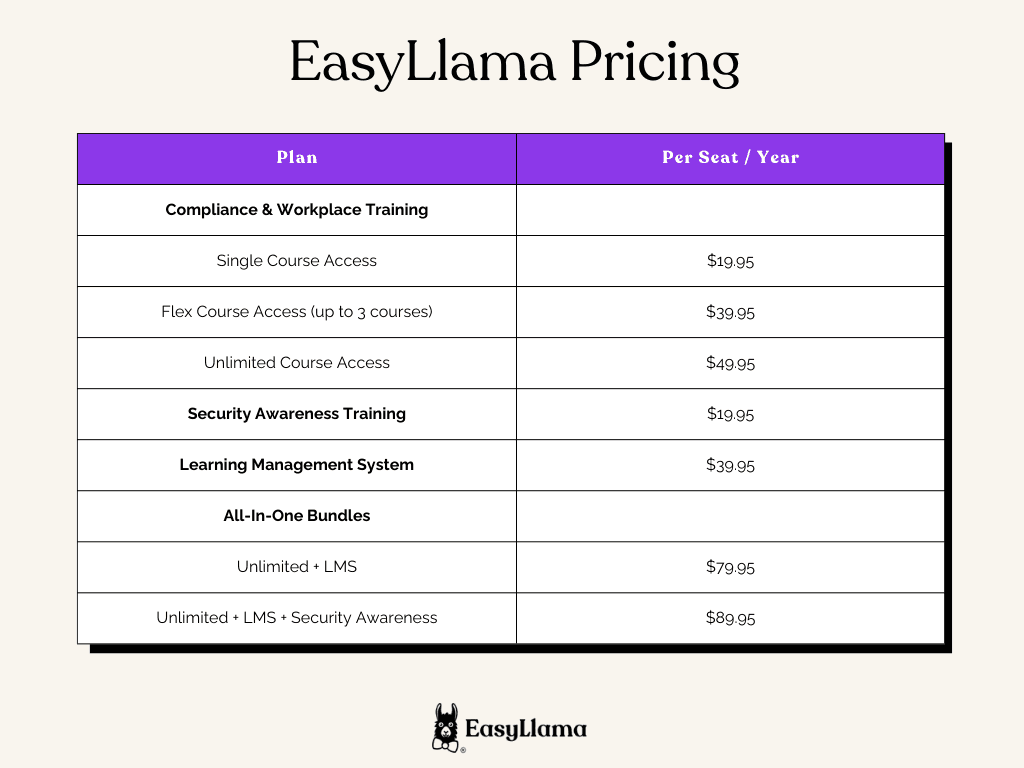
Bundles save more than 20% compared to purchasing plans individually, with volume pricing at higher seat counts. For enterprise buyers, published pricing also means faster procurement cycles, easier budget approvals, and no surprise costs at renewal.
Setup complexity and time to launch
NAVEX's implementation fits organizations configuring complex org structures, connecting training to policy workflows, and setting up role-based access across departments. That's valuable for enterprise rollouts, but it means a longer runway before your first course goes live.
EasyLlama is built for speed—without sacrificing the structure enterprise organizations need. Many clients implement in less than a day—sometimes less than an hour. One reviewer noted you can "stand up your entire organization to get started in an afternoon and be rolling on compliance training the next day."
For large organizations managing compliance across multiple states, that speed means you can respond to new regulatory requirements in days rather than weeks.
The tradeoff is real: if you need a whistleblowing hotline, structured investigations, and formal policy governance alongside training, a longer implementation may be worth it. If your priority is getting employees trained and staying compliant across every jurisdiction you operate in, a training-first platform gets you there faster—and keeps you there with less overhead.
Customer support and ongoing administration
Post-launch, the ongoing work that sneaks up includes quarterly new-hire waves, annual re-certifications, and policy updates from new legislation.
Some NAVEX users note that the platform can feel clunky and that the user experience leaves room for improvement. Others have found that competing vendors can provide better products and services, feeling that NAVEX is "trying to catch up with some of its new competitors."
EasyLlama reviewers consistently highlight ease of administration—the platform is user-friendly and intuitive for both employees and administrators, with flexible scheduling that lets users stop and start training at their convenience. That day-to-day simplicity means less ongoing admin overhead and fewer support tickets—a critical advantage for enterprise teams managing compliance at scale across multiple locations and regulatory environments.
What users say about each platform
Third-party reviews are especially useful if internal stakeholders are skeptical after a bad LMS experience. When evaluating reviews, look for feedback from companies with your headcount and compliance profile.
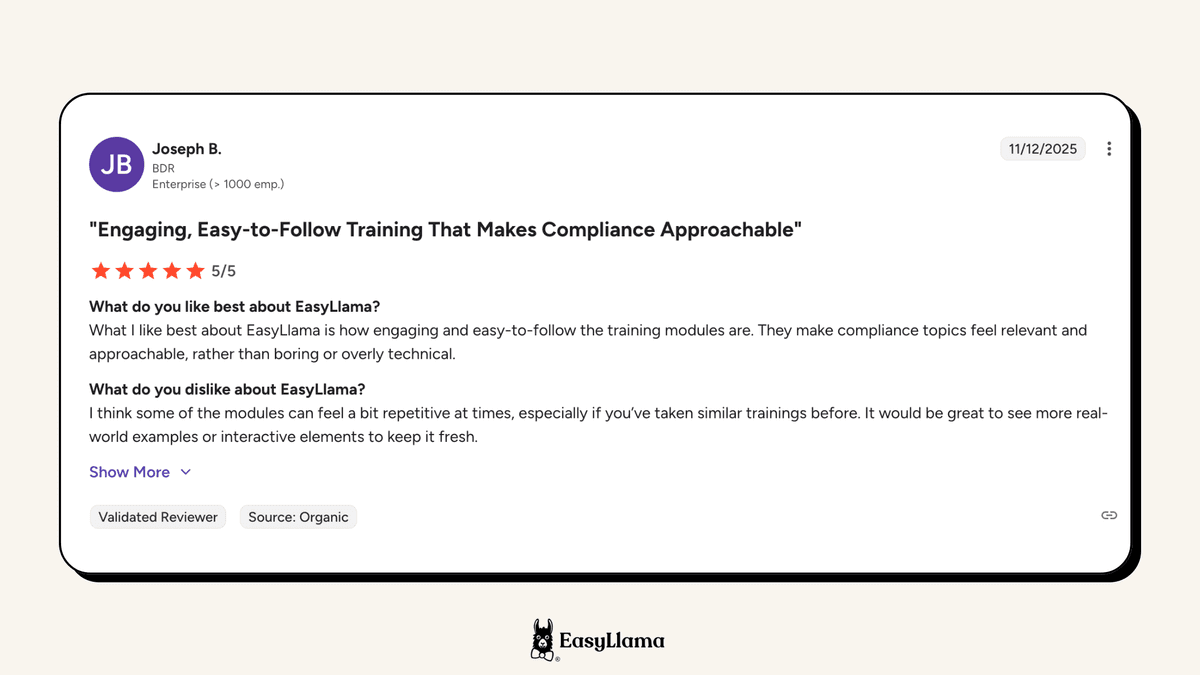
EasyLlama on G2: 4.8/5
EasyLlama earned a total of 29 badges in G2's Summer 2025 Reports across categories, including Harassment Prevention Training, Ethics and Compliance Learning, and eLearning Content. In G2's 2025 Spring Report, EasyLlama is ranked #1 in Harassment Prevention Training.
- Praised for: Ease of use, engaging training content, fast setup, admin simplicity
- Criticized for: Occasional course-length preferences, some UX nitpicks
NAVEX on G2: 3.8/5
Reviewers like NAVEX One for its strong dashboards and customizable workflows, calling it an excellent centralized platform for policies, training, and reporting.
- Praised for: Workflow visibility, centralized compliance management, policy integration
- Criticized for: Limited flexibility, occasional reporting gaps, and an interface some users find outdated
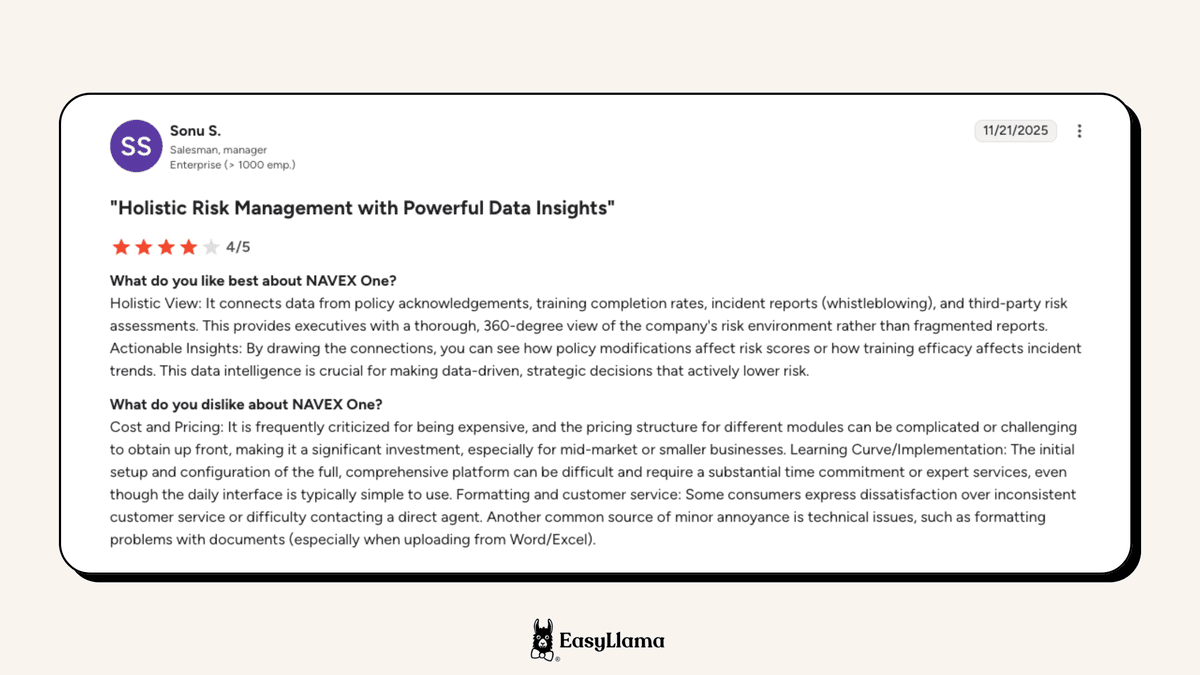
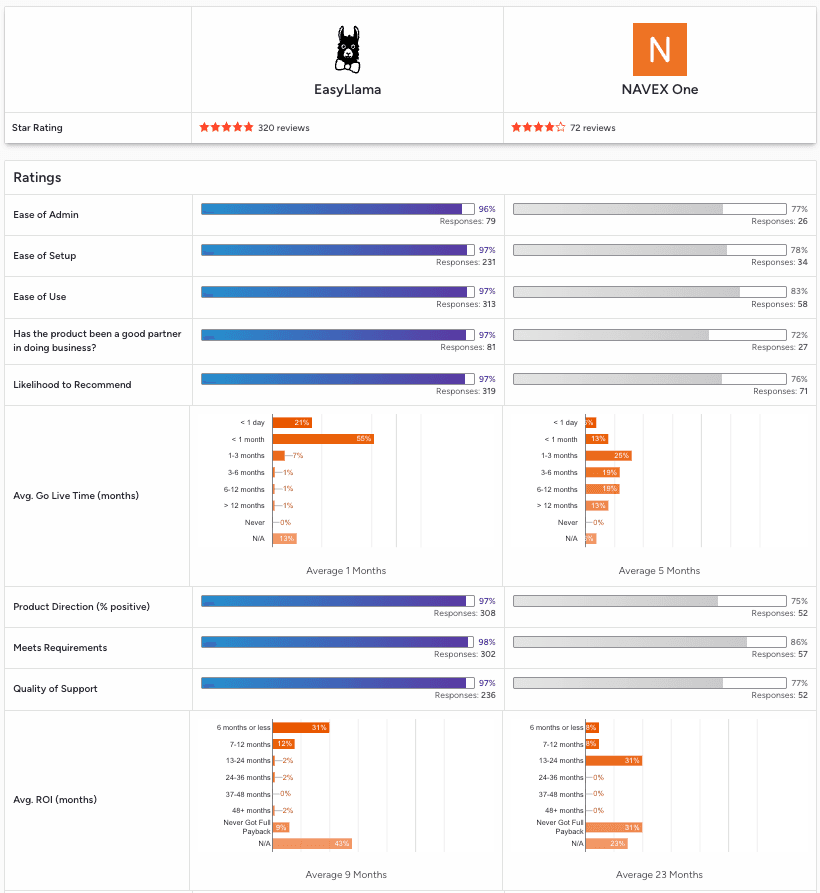
The review data tells a consistent story: EasyLlama wins on day-to-day usability and learner engagement, while NAVEX earns respect for its breadth of compliance program management.
Here’s what additional G2 data shows when stacking both platforms against each other:
Choose the right platform with a simple decision framework
Don't choose a platform based on the program you might run someday. Match it to the program you're running this year. Both platforms serve organizations of various sizes, but they solve different problems:
- If your organization needs a whistleblowing hotline, structured investigations, and enterprise policy governance, NAVEX's broader suite makes sense.
- If your primary need is multi-state compliance training, scalable onboarding, recurring certification cycles, and the ability to launch and update courses without heavy admin lift, EasyLlama's training-first approach fits better. EasyLlama is helping over 8,000 organizations handle exactly that kind of work, including enterprise teams managing compliance across dozens of states and jurisdictions
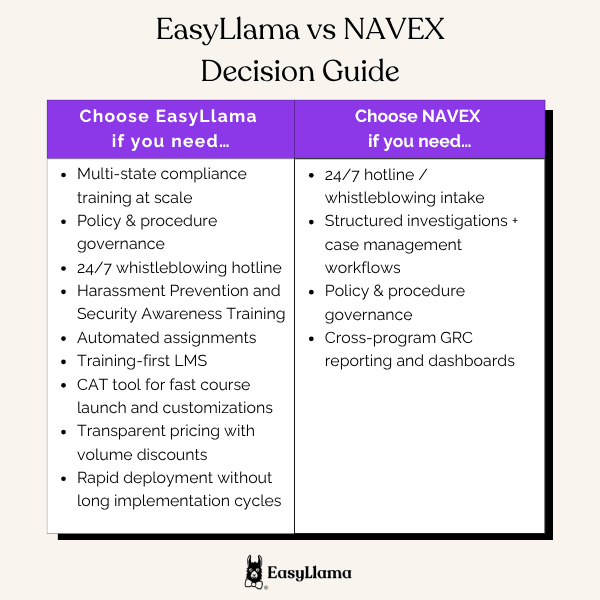
The "better" platform depends entirely on whether you need a training-first LMS or a broader ethics and risk suite. If you're leaning toward a faster, training-focused approach, book an EasyLlama demo to see how auto-assignments, automated reminders, and audit-ready reporting work in practice – whether you're managing compliance in three states or thirty.
Start with the problem in front of you—not the one you might inherit next year.
Share this


Frequently
Asked
Questions

- It depends on what "compliance training" means for your organization. If you need a standalone training platform that's fast to launch and easy to manage, EasyLlama's 425+ course library, automated reminders, and transparent pricing make it the stronger fit. If compliance training is one piece of a broader GRC program requiring hotline management and policy governance, NAVEX's integrated suite may be more appropriate.
- NAVEX One is a unified GRC platform that integrates traditionally siloed compliance functions into a single ecosystem. EasyLlama is a training-first platform built for HR teams that need to assign, track, and update compliance courses quickly with minimal admin overhead. The core distinction is suite depth versus training speed.
- Yes. NAVEX integrates with other solutions on its platform or your existing LMS, with SSO and API access. EasyLlama connects with dozens of HRIS and payroll tools such as ADP, Gusto, BambooHR, Workday, Paylocity, Slack, Zapier, and more—syncing employee data to automate training assignments.
 Articles
Read More Blogs
Explore what others in your field are learning
Emtrain vs. EasyLlama: Making the Right Choice For Your Team
Navigate compliance training options: Emtrain vs. EasyLlama. Compare features, benefits & make an informed choice. Elevate your training strategy now!
Alicia Falcon

EasyLlama vs Ethena: Which Platform Is Best For You?
Explore Ethena vs. EasyLlama: Uncover the ultimate compliance training solution. Compare features, pricing & benefits. Make an informed choice today!
Alicia Falcon

KnowBe4 vs EasyLlama: Which Platform Is Best For Your Team?
Explore KnowBe4 vs. EasyLlama: Uncover the ultimate compliance training solution. Compare features, pricing & benefits. Make an informed choice today!
Alicia Falcon
Start Modernizing Workplace Compliance
It’s easy to get started with EasyLlama. Speak with one of our compliance experts and get a demo tailored to your business’s needs.