HR Compliance Reporting: What to Track and How to Simplify It



Your practical guide to HR Compliance Tracking and Reporting. Learn what to track and how to track it.

Your practical guide to HR Compliance Tracking and Reporting. Learn what to track, how to track it, which reports each stakeholder actually needs, and how to automate the manual work.
- What compliance tracking and reporting actually means for HR
- Why compliance tracking and reporting matters for HR specifically
- Key compliance data and metrics HR teams need to track
- Reports HR needs for every stakeholder
- Common compliance reporting mistakes and how to avoid them
- How to simplify compliance tracking and reporting
- Build a compliance reporting system your team can trust
Test Your Compliance
Find out if your company is compliant in two minutes with our free Compliance Grader.
Get Your Free ReportMost HR teams can answer "did this person finish their training?" The harder question is the one an auditor actually asks: can you prove it, for every employee, across every location, the moment you're asked? For a lot of teams, the honest answer lives across three spreadsheets, a shared drive folder of signed PDFs, and a Slack thread where someone promised to follow up.
As an HR leader myself, I know that a patchwork system gets real messy, real fast.
There are so many factors that can mess up your system at any time:
- A new state law adds a training requirement.
- You didn’t realize there were different training requirements for supervisor vs non-supervisor employees.
- An investigator asks for signed policy acknowledgments from 18 months ago.
- A board member wants a one-slide summary of organization-wide compliance posture, due tomorrow.
Compliance tracking and reporting is what turns that scramble into a reliable, agile system: a defined set of things to measure, a report built for whoever's asking, and automation that handles the parts no one wants to chase by hand.
Knowing what to track and how to track is step one for setting up an always-on, agile compliance program.
Consider this my mini-guide that covers what HR compliance data actually needs to be tracked, how to build reports for admins, managers, and executives, the reporting mistakes that quietly undermine audit readiness, and how automation takes the manual follow-up off your plate.
What compliance tracking and reporting actually means for HR
Compliance tracking and reporting is the ongoing system HR uses to monitor required actions, like training completions, policy acknowledgments, certifications, recurring deadlines, and produce evidence that those actions happened on time. Based on my personal experience, a spreadsheet you update before an audit does not qualify. Rather, it’s a repeatable, agile process that runs continuously, alongside every hire, every policy change, and every new regulation.
It's worth separating two things people often lump together. Activity tracking tells you who logged in and clicked through a course. Compliance reporting tells you who completed the correct training, by the required deadline, with a record you can hand to an auditor or an investigator without a follow-up email. The first is a login log, while the second is compliance tracking and reporting — the thing that actually holds up (trust me).
Why compliance tracking and reporting matters for HR specifically
HR owns a disproportionate share of an organization's highest-risk compliance requirements: harassment prevention, workplace safety, HIPAA where applicable, and a growing list of state-specific mandates that shift by location, role, and headcount. Legal owns policy language. IT owns data security. HR owns proving that real people did the required thing on time, which just so happens to be the piece regulators, plaintiffs' attorneys, and internal investigators will ask for first.
The stakes are real and rising. The EEOC received 91,503 new workplace discrimination charges in fiscal year 2025, a 3.4% increase over the prior year... yikes! They also secured $660 million for workers, most of it before a single case reached court, through pre-litigation conciliation and settlement. To me that indicates that compliance isn't just a "silly, annoying little thing" we have to complete. It is a very serious matter that can have major consquences when not handled properly. Every one of those charges can trigger a records request: training completions, policy sign-offs, dates, versions.
Most HR teams are small relative to the compliance surface they're responsible for. A five-person HR function covering 400 employees across six states doesn't have the bandwidth to manually track who's overdue, who signed what version of a policy, and which certifications expire next quarter — not as the company grows, not as it adds locations, and not as the rules keep changing underneath it.
This is why having a really, and I mean really, good system in place for tracking and reporting matters.
Key compliance data and metrics HR teams need to track
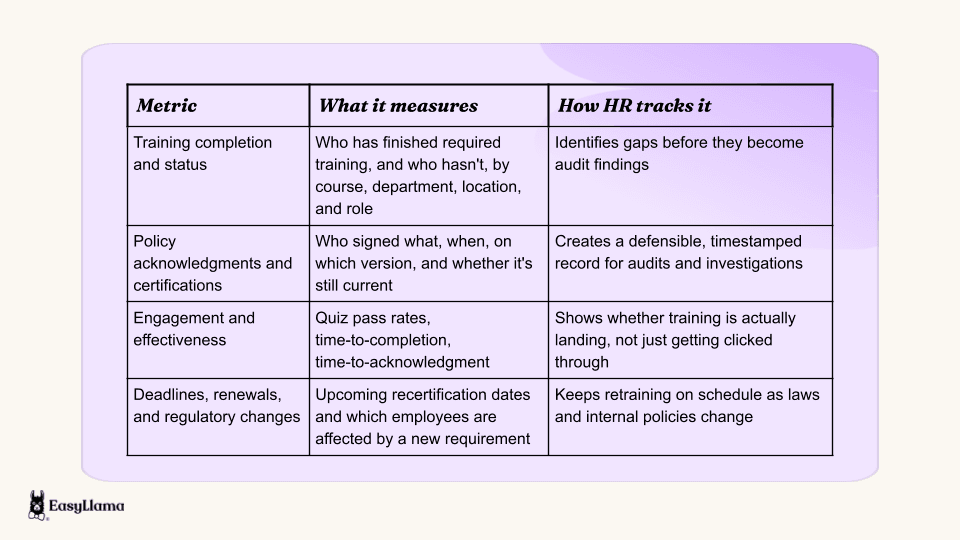
Moving from ad hoc tracking to a defined measurement framework starts with knowing exactly what to monitor. The table below is my suggested starting point and the sections after it go deeper on each row.
Training completion and status
The core metrics here are completion rate by course, department, location, and role; overdue assignments; and average time-to-completion. Segmentation matters more than the raw completion number. A 95% completion rate sounds solid until you learn the 5% still outstanding is concentrated in one warehouse location that also happens to be the one under a state deadline next month. Department, location, and role breakdowns turn a vague "mostly done" into an actionable list of exactly who needs a nudge and why.
Policy acknowledgments and certifications
Every policy update, handbook revision, or new-hire acknowledgment needs a defensible, timestamped record. I promose you that "we sent the email" won't cover you. You need to keep track of who signed, when they signed, which version of the policy they acknowledged, and whether that acknowledgment is still current. Certifications like harassment prevention or HIPAA training often carry expiration dates of their own, and those dates need active monitoring, not a note in someone's calendar.
Engagement and effectiveness metrics
Completion alone doesn't prove training worked. HR also needs a read on whether employees actually absorbed it: quiz and assessment pass rates, time-to-completion as a rough proxy for engagement (a course finished in ninety seconds is a red flag, not a win), and time-to-acknowledgment for policy updates. These numbers help identify courses that need a rework, flag teams that are checked out, and give leadership something more convincing than a completion percentage when they ask whether the training budget is doing anything. EasyLlama's Custom Report Builder lets admins segment engagement data by department, role, or course to see exactly where training is landing — and where it isn't.
Deadlines, renewals, and regulatory changes
This is where tracking tends to break down, because the requirements themselves don't hold still. States add harassment prevention mandates. OSHA updates safety requirements. A jurisdiction that had no training law two years ago has one now, with a compliance date that doesn't care whether HR noticed.
Washington State is a live example: starting January 1, 2026, covered employers in hotel, motel, retail, and security guard industries must provide sexual harassment prevention training to isolated employees, along with their managers and supervisors. That's a new population, a new deadline, and a new completion record to produce — layered on top of the roughly eight states plus Washington, D.C. that already mandate some form of harassment prevention training, several with their own local wrinkles (Chicago's ordinance goes further than Illinois's statewide requirement).
Tracking the completion is the easy part. The harder part, the part I've noticed most ranking guides skip, is tracking the whole chain: what changed, which employees the change actually touches, whether the updated training was reassigned, who acknowledged it, and whether that record is preserved somewhere you can retrieve it later. The list goes on. Treating that as a single workflow, not four disconnected tasks, is the difference between "we think we're compliant" and being able to prove it. See our HR compliance checklist for how these updates tend to stack up over a given quarter.
Reports HR needs for every stakeholder
A single report rarely satisfies everyone who needs one. The admin running the program, the manager accountable for a team, and the executive asking about organization-wide risk are all asking a version of "are we compliant?" — but they need the answer shaped differently.
HR admin view: operational compliance status
This is the day-to-day working view: every completion, every overdue item, upcoming deadlines, and gap alerts, filterable across department, location, and role. It's the report the person actually running compliance administration lives in.
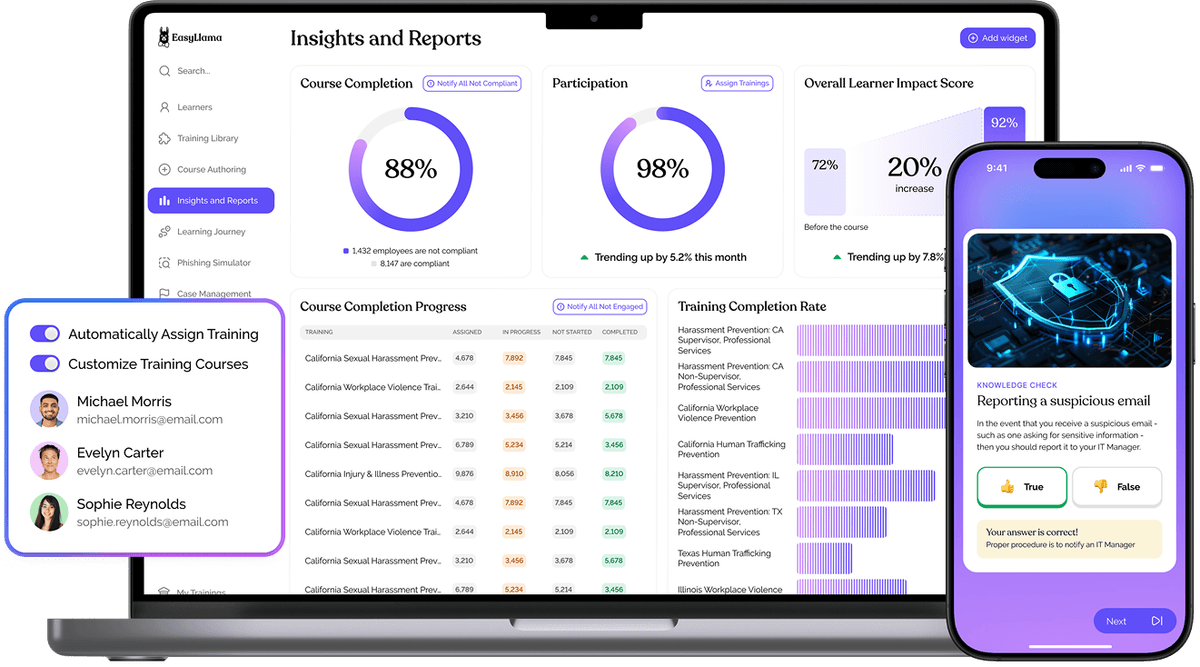
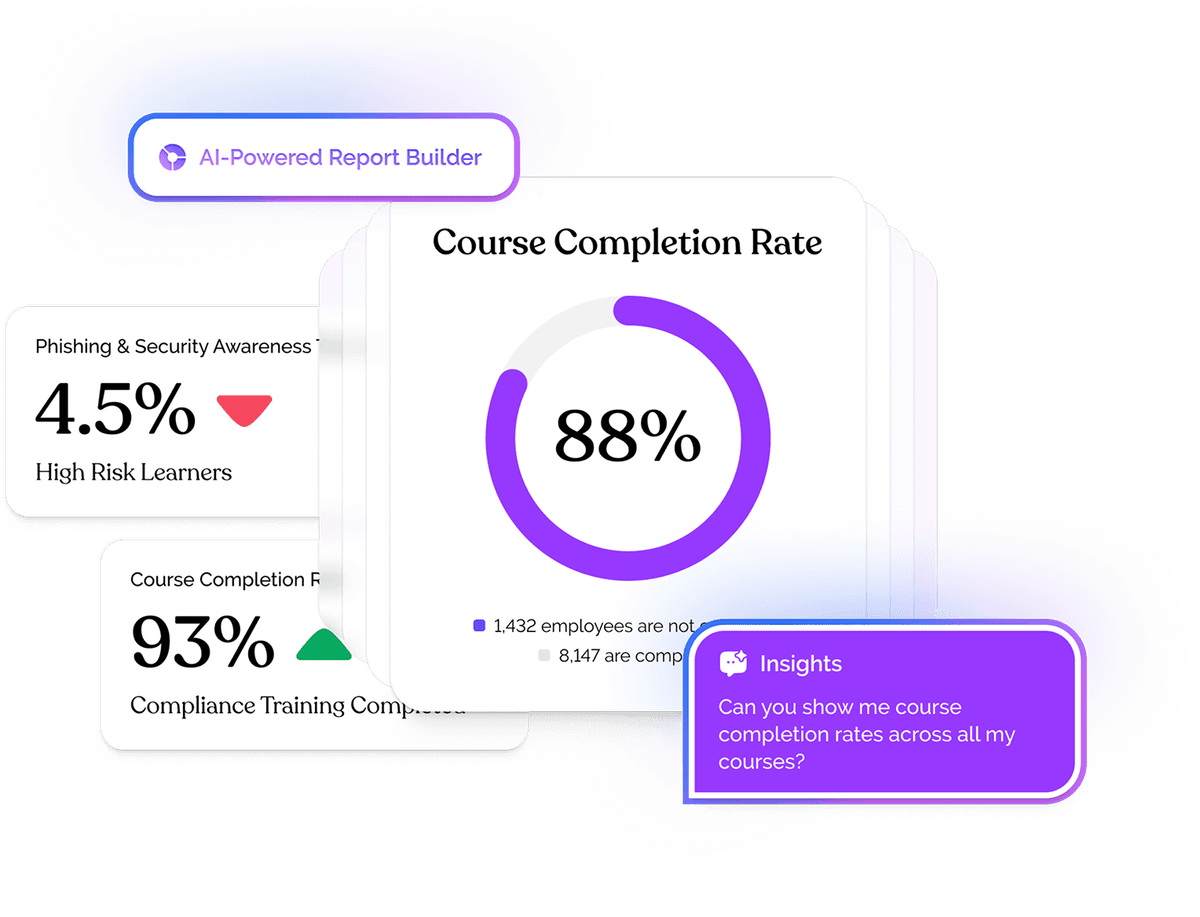
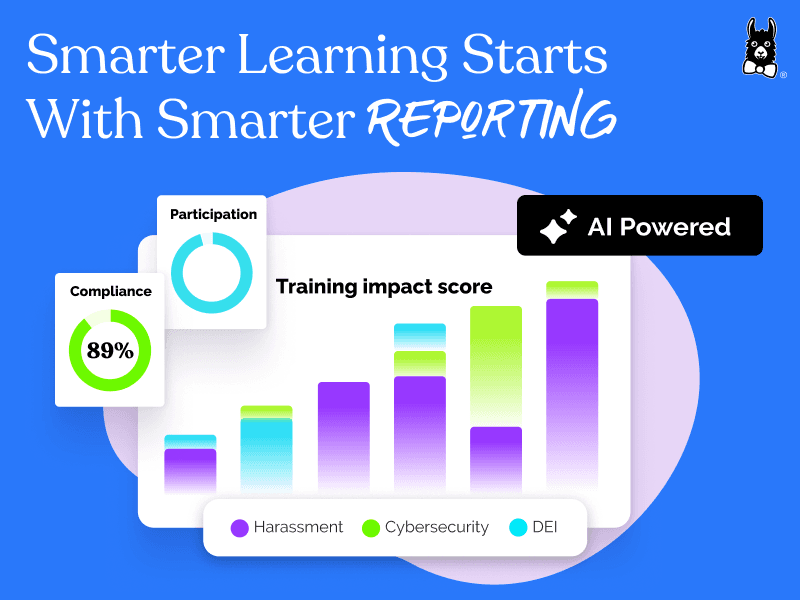
EasyLlama's AI-powered Custom Report Builder lets admins build this view with smart filtering and segmentation by department, state, role, or course — no spreadsheet exports, no IT ticket required. The Insights Dashboard pairs with it to give a centralized, real-time view of compliance status across the organization, so the operational picture and the summary view are pulling from the same live data instead of two versions that quietly drift apart.
Manager view: direct reports at a glance
Department heads generally need one thing: who on their team has completed training, who's overdue, and what's coming due next. A scoped view like this gives managers accountability without exposing data outside their team, and it cuts down the back-and-forth of HR fielding "who still needs to finish?" messages one manager at a time.
Executive view: organization-wide compliance posture
Executives need the trend, not the roster: overall completion rates, where the risk is concentrated, and whether the line is moving in the right direction over time. This view should be light enough to drop into a board deck or a leadership briefing, and it's worth configuring once with the exact metrics leadership cares about rather than rebuilding it from scratch every quarter. EasyLlama's Custom Report Builder handles that configuration directly, so the executive summary pulls from the same underlying data as the operational report below it.
Audit-ready evidence packages
When an auditor or investigator comes asking, they want something specific: proof that named employees completed named training by a specific date, with a certificate and a timestamp attached. Assembling that by hand — digging through email confirmations and old spreadsheet exports — can eat days. EasyLlama lets admins instantly bulk-export completion certificates and signature records already formatted for audits or investigations, so evidence that would otherwise take a week to assemble is ready in minutes.
Common compliance reporting mistakes and how to avoid them
A handful of habits show up again and again in HR teams that get caught flat-footed by an audit.
Relying on spreadsheets and manual tracking. Spreadsheets create version control problems, missed updates, and a single point of failure — usually one person who knows where everything lives. The fix is centralizing records in one system that everyone with the right access can see, instead of one person's local file.
Tracking completions without tracking policy versions. An employee who completed last year's harassment prevention course may not be compliant with this year's requirements if the underlying policy changed. Track the version alongside the completion, not just the date.
Waiting until audit season to assemble records. Compliance reporting that only gets attention right before an audit is compliance reporting that's perpetually behind. Maintain continuous reporting instead of treating it as a seasonal scramble.
Assigning the same generic training to everyone. Blanket training that ignores role, location, and the regulatory requirements that actually apply wastes time and creates gaps. Segmenting training by what each employee actually needs fixes both problems at once — Anne Gleaton, Director of HR and Talent at Pipl, put it this way after switching from broad, one-size-fits-all training to location-specific courses: "When you think about training 100 people, for instance, taking a one-hour location-specific EasyLlama course versus our old, broader training that lasted two hours, you've just saved 100 working hours."
How to simplify compliance tracking and reporting
None of this requires more headcount. It requires fewer disconnected systems and less manual follow-up.
1. Centralize everything in one platform
Replacing spreadsheets, email reminders, and separate file storage with a single system for compliance training, policy acknowledgments, and reporting does more than tidy things up — it creates one source of truth. Any admin can check status, pull a report, or export proof without depending on the one person who happens to know which spreadsheet is current. EasyLlama's LMS replaces disconnected tools with one platform for compliance, security, and job training, giving admins a single point of accountability for completions and certifications. Paired with Document Management & Document Signature workflows, policy acknowledgments live in the same system as the training itself, instead of a separate folder of signed PDFs.
2. Automate assignments, reminders, and renewals
Manual follow-up doesn't scale. When HR is chasing individual employees through email, deadlines slip and admin hours disappear into the gap. EasyLlama automatically triggers recurring course assignments based on key events and flexible renewal schedules, so retraining goes out on time without anyone tracking due dates by hand — and automated reminders through email, SMS, and Slack handle the nudging that used to fall on HR.
3. Connect compliance data to your HRIS
A compliance report is only as accurate as the employee data underneath it. If someone changes roles or relocates and the compliance system doesn't know, every report built on that data is quietly wrong. EasyLlama syncs employee data daily from systems like BambooHR, Workday, Gusto, ADP, and Paylocity, so assignments and segmented reporting stay aligned as people are hired, promoted, or moved between departments and locations — no manual re-uploads required.
4. Keep training content current as requirements change
This is the step that connects back to the regulatory chain described earlier. When a law changes or an internal policy is updated, HR needs to update the training content itself, reassign the employees it affects, capture who acknowledged the new version, and preserve a record of what changed and when. Skip any link in that chain and every completion record downstream becomes less defensible — proof that an employee trained on a retired policy doesn't answer an auditor's question about the current one.
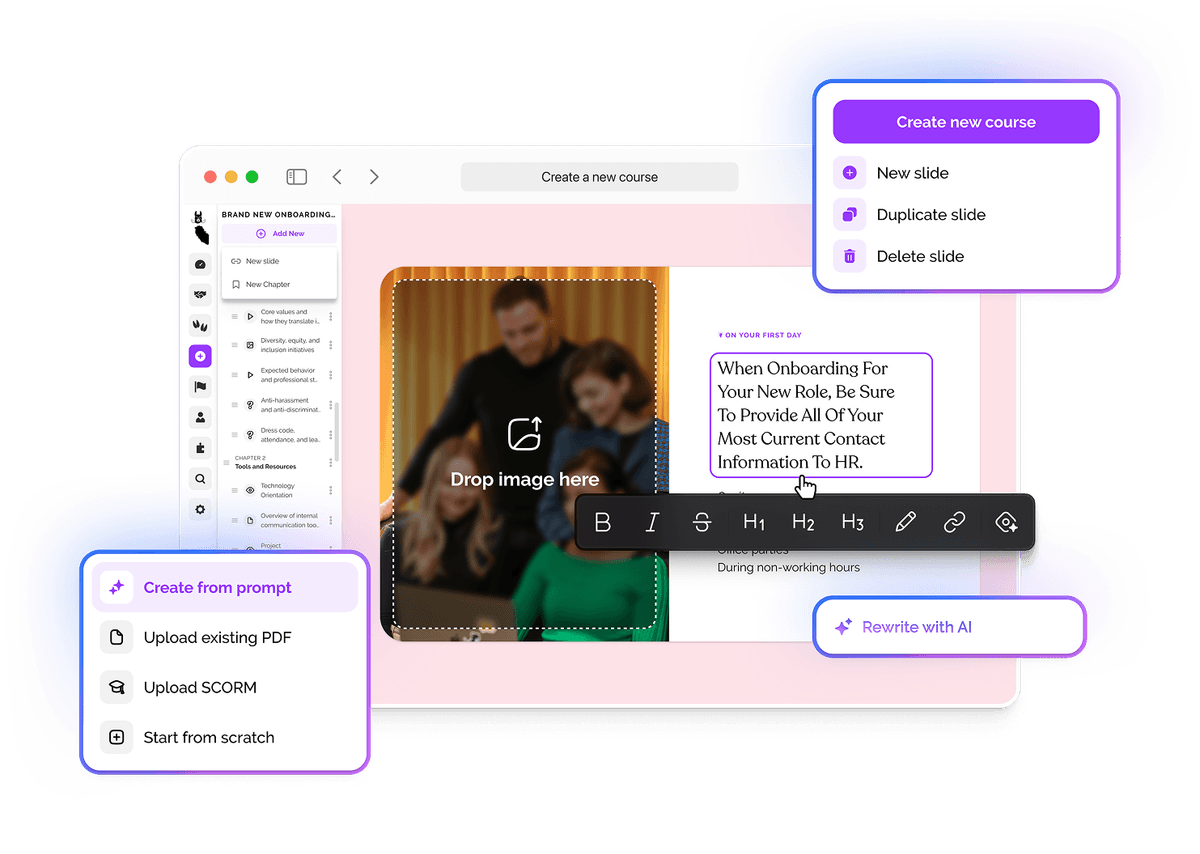
EasyLlama's AI Course Authoring Tool lets teams create or update custom compliance training from a single prompt in minutes, so an internal policy change can show up in the actual training without rebuilding a course from scratch. For regulated harassment training specifically, EasyLlama also updates 300+ courses annually through legal experts, so jurisdiction-specific content — like Washington State's new isolated-employee requirement — stays current without HR having to track statutory language itself.
Build a compliance reporting system your team can trust
Compliance tracking and reporting doesn't have to be complicated or manual. It comes down to defining what to measure, building the right report for each stakeholder, and automating the repetitive parts so nothing depends on one person remembering to check a spreadsheet.
Centralize records instead of scattering them across tools. Automate assignments, reminders, and renewals instead of chasing them by hand. Connect compliance data to your HRIS so reporting reflects who's actually on your team today. Keep training content current as the rules change, with a record of what changed and when.
Waud Capital Partners took this approach after a 2020 Illinois law required annual sexual harassment prevention training — and stayed compliant as new state laws kept arriving, without adding headcount to manage it. Anna Robbins, People Operations Associate at Waud Capital, pointed to the platform's handling of shifting requirements directly: "EasyLlama does a really good job of multi-state regulations and staying on top of different rules that come out."
I know that was a lot, so feel free to ping me on LinkedIn if you have any questions!
Book a demo to see how EasyLlama helps HR teams simplify compliance tracking and reporting with audit-ready dashboards, automated workflows, and one-click evidence exports.
Share this


Frequently
Asked
Questions

- It's the ongoing process HR uses to monitor required actions — training completions, policy acknowledgments, certifications, deadlines — and produce timestamped evidence that those actions happened on schedule.
- By centralizing completions, policy acknowledgments, and certification dates in one system, segmenting that data by department, location, and role, and generating role-specific reports (admin, manager, executive) plus audit-ready exports on demand.
- Training completion rates and overdue assignments, policy acknowledgment records with version history, engagement metrics like quiz pass rates, and upcoming renewal or recertification deadlines.
- Continuously, not seasonally. Real-time dashboards that update as employees complete training and as HRIS data syncs keep reporting accurate year-round, rather than requiring a scramble before each audit.
- Activity tracking shows who logged in or clicked through a course. Compliance tracking confirms who completed the correct, current version of required training by the deadline, with a defensible record to prove it.
- Automated assignments, renewal triggers, and reminders eliminate the manual follow-up of chasing overdue employees, while automated HRIS syncing keeps reporting accurate as people change roles or locations — without HR re-entering data by hand. All of this is possible with EasyLlama.
 Articles
Read More Blogs
Explore what others in your field are learning
How to Track Employee Progress with LMS Reporting and Analytics
Track training progress and boost compliance with LMS reporting. Learn key metrics, automation tips, and how EasyLlama makes it effortless.
Sarah Hamilton

How to Automate Compliance Reporting (Without Spreadsheets)
Learn how to automate compliance reporting for your HR team with real-time dashboards, automated alerts, and audit-ready evidence you can pull in minutes.

Alicia Falcon

How to Customize Corporate Compliance Training For Growing Teams
Generic compliance training doesn't scale with growing teams. Learn how to customize training by role and location, build it without an instructional design team, and keep it audit-ready.
Sarah Hamilton
Start Modernizing Workplace Compliance
It’s easy to get started with EasyLlama. Speak with one of our compliance experts and get a demo tailored to your business’s needs.