Top 7 AI Governance Challenges (And How HR Teams Solve Them)



This article covers the top challenges HR teams are experiencing with AI Governance and how to solve them.
This article covers the top challenges HR teams are experiencing with AI Governance and how to solve them.
- 1. Managing shadow AI and unapproved tool use
- 2. Bridging the AI literacy gap across the workforce
- 3. Clarifying ownership across HR, IT, Legal, and Compliance
- 4. Addressing bias and transparency gaps
- 5. Keeping pace with regulations that shift faster than internal policy
- 6. Preventing governance bottlenecks as AI use cases multiply
- 7. Building documentation and audit trails
- How HR teams can roll out AI governance in five steps
- How EasyLlama helps teams operationalize AI governance
Test Your Compliance
Find out if your company is compliant in two minutes with our free Compliance Grader.
Get Your Free ReportMore than half of employees now use AI tools at work, and most organizations have no formal policy governing that usage. Employees are experimenting with chatbots, generative writing assistants, and automation plugins on their own. Meanwhile, governance frameworks are still being drafted in conference rooms, if they exist at all.
This gap between adoption and oversight is widening every quarter. AI adoption tends to happen bottom-up, driven by individual employees looking for faster ways to work. Governance moves top-down, through policy committees, legal reviews, and executive sign-offs. The result is a growing compliance risk that most organizations haven't fully accounted for.
HR and compliance teams are best positioned to close this gap, and the organizations that treat AI governance as an ongoing operational discipline rather than a one-time policy project will move fastest. This article maps seven common obstacles and pairs each one with practical steps you can take right now.
1. Managing shadow AI and unapproved tool use
Shadow AI refers to employees using AI tools without organizational approval: ChatGPT for drafting emails, image generators for presentations, browser extensions that summarize meetings, and dozens of other tools that never went through a procurement or security review.
The risk is more than theoretical. When employees paste sensitive data into external AI models, that information may be stored, used for training, or surfaced in ways you can't control. There's typically no way to retrieve or delete data once it leaves your environment and enters a third-party model. A single paste of customer records or internal financials into an unapproved tool can create a data breach with no clear path to remediation.
The most effective response is a clear and accessible approved-tools list that specifies which AI tools employees can use, what types of data they can input, and what handling rules apply. Make it easy to find and update it regularly as new tools emerge.
An approved-tools list only works if employees know how to follow it. EasyLlama's AI Course Collection pairs with that list by training employees on safe AI use through six courses co-authored with AI and compliance experts, covering everything from AI Fundamentals through Recognizing Deepfakes. Each course runs 5 to 10 minutes.
Admins on Unlimited Compliance + Ultimate LMS Bundles can assign the full collection as a Learning Journey, while all customers can assign individual courses based on team needs.
2. Bridging the AI literacy gap across the workforce
Uneven AI literacy is a governance risk that's easy to overlook. Some employees understand how large language models work, recognize their limits, and use them carefully. Others trust AI outputs without question, paste confidential data into public tools, or don't realize that AI-generated content can contain fabricated information.
When knowledge gaps are this wide, even well-written policies fall short. Managers can't enforce rules that their teams don't understand, and an employee who doesn't know what a "hallucination" is won't recognize one sitting quietly in a generated report.
The fix starts with baseline AI literacy training for everyone, covering how AI models are trained, what prompts do, where bias comes from, and why outputs sometimes include made-up facts. It doesn't need to be technical. What it needs to be is practical, grounded in the tasks employees actually perform every day.
That's the approach behind EasyLlama's AI Fundamentals course, which covers core concepts in plain language so that every employee, regardless of technical background, can use AI tools responsibly and recognize when something isn't right.
3. Clarifying ownership across HR, IT, Legal, and Compliance
AI governance often falls into a gap between departments. HR sees it as a technology issue, IT views it as a policy question, and Legal wants to manage risk but lacks visibility into how tools are actually being used on the ground.
Compliance teams may not even know which AI tools are in play. The result is duplicated effort, inconsistent rules across teams, and decision-making that stalls while the backlog of unanswered questions grows. When no one owns AI governance, everyone assumes someone else is handling it.
The most practical solution is a cross-functional AI governance committee. This group should include representatives from HR, IT, Legal, and Compliance, plus at least one operational leader who understands how AI is being used day-to-day.
Define each member's responsibilities clearly: who tracks regulations, who approves tools, who manages training, and who handles incidents. Meeting quarterly at a minimum keeps the committee aligned without turning governance into a full-time job for any single person.
4. Addressing bias and transparency gaps
AI models can embed and amplify bias in ways that directly affect employees. Hiring algorithms may favor certain demographics, performance review tools might weigh factors that correlate with race, gender, or age, and promotion analytics can quietly reinforce the same historical patterns that organizations are actively trying to change.
Transparency compounds the problem. When an AI system recommends a candidate or flags an employee, most organizations can't explain how it reached that conclusion. The inability to answer a simple "why?" erodes trust among employees and creates legal exposure, especially as regulators increase scrutiny of automated employment decisions.
HR teams should require human review for any AI-assisted decision that affects hiring, performance evaluation, or promotions. Identify which use cases require disclosure to employees and make sure every AI-driven process includes a human override capability. Document these review steps so they are repeatable and auditable.
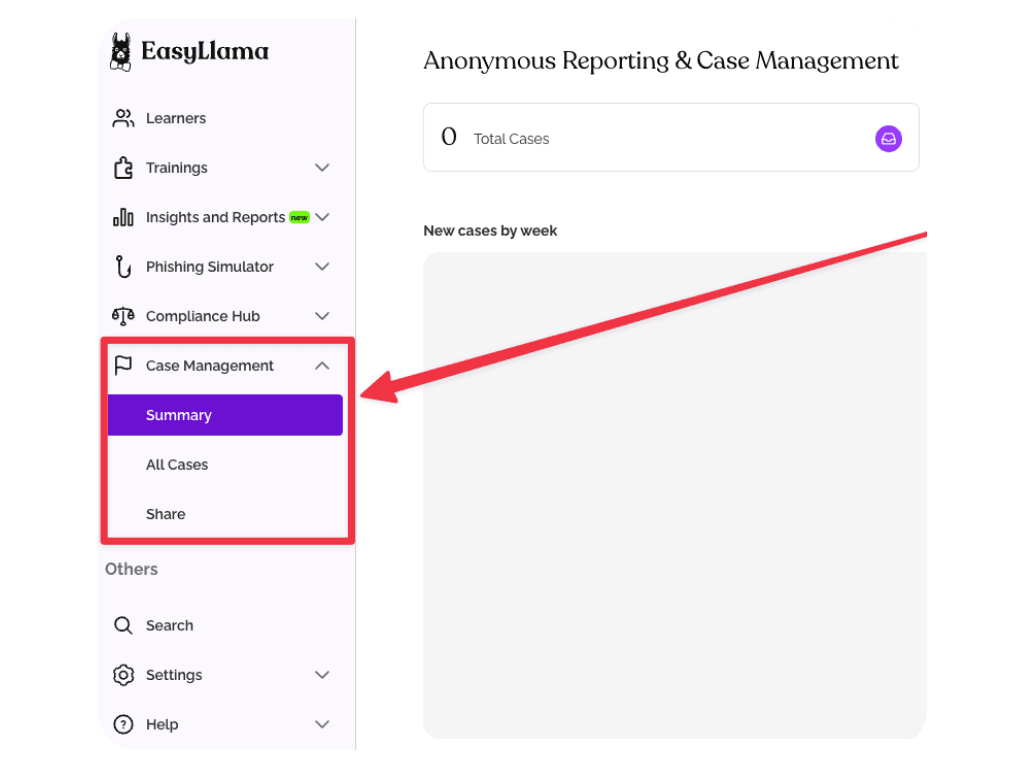
Even with review processes in place, employees need a safe channel to raise concerns when something feels off. EasyLlama's Anonymous Reporting & Case Management tool provides that channel through anonymous feedback, two-way chat, and case tracking across several categories, all with encryption to protect reporter identity.
5. Keeping pace with regulations that shift faster than internal policy
The regulatory environment around AI is evolving rapidly and unevenly. The EU AI Act introduces tiered risk classifications for AI systems. New York City and Illinois have enacted specific laws governing AI in hiring. Industry-specific regulations add another layer of complexity.
Many organizations treat their AI policies as static documents, written once and tucked into a shared drive where they quietly gather dust. This approach leaves them exposed whenever a new regulation takes effect or an existing one is updated.
Closing that lag requires a quarterly review cadence for AI policies, with a specific owner responsible for tracking regulatory changes. Template-based policy tools reduce the time between a regulatory change and an internal policy update, cutting weeks of revision down to days.
EasyLlama's Course Authoring Tool puts that speed within reach by letting HR teams update AI training content in minutes when regulations change. Instead of waiting for vendor course updates, you can convert updated policies or PDFs into interactive courses with scenario-based questions. A working course takes under an hour to build.
When a regulatory change doesn't warrant a full course revision, EasyLlama's microlearning modules deliver focused 5 to 10-minute refreshers that keep teams current without pulling them away from work for extended sessions.
6. Preventing governance bottlenecks as AI use cases multiply
Early-stage AI governance often relies on manual reviews for every new tool or use case. That works when you have three AI projects, but it collapses when you have thirty and the approval queue starts to feel like a waiting room no one wants to sit in.
When every request requires a formal review, approvals slow to a crawl. Teams that need to move quickly start bypassing the process entirely, pushing them right back toward shadow AI. The governance system designed to reduce risk ends up creating the conditions for more of it.
A risk-based triage model breaks this cycle. Low-risk applications, like using AI for internal meeting summaries, can operate under standing guidance without individual approval. High-risk use cases, like AI-assisted hiring decisions, require formal review with documented sign-off.
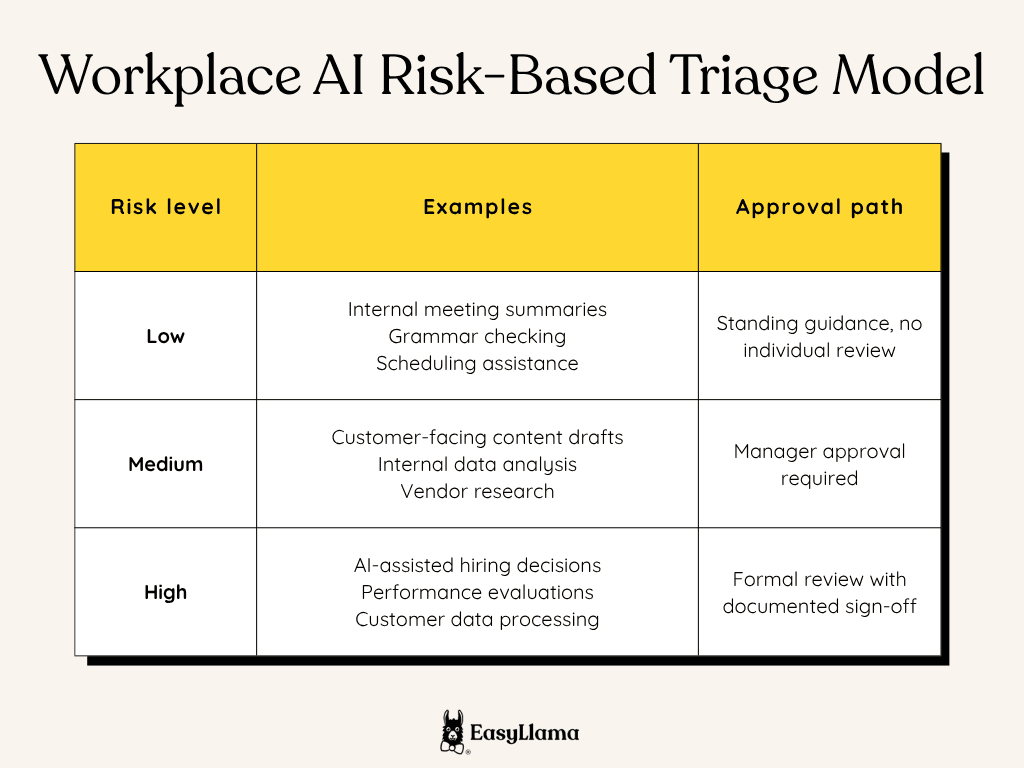
Scaling that triage model across the organization requires standardized request forms, clear approval tiers, and automated tracking. EasyLlama's HRIS integrations with tools like BambooHR, Workday, Gusto, ADP, and Paylocity automate training assignments and sync employee data daily, reducing the manual admin work that turns governance into a bottleneck.
7. Building documentation and audit trails
Most organizations can't answer basic governance questions with confidence: Who completed AI training last quarter? Which teams have acknowledged the updated AI use policy? Who approved a specific tool for production use? The silence that follows these questions during an audit is uncomfortable and expensive.
Governance that isn't documented can't be proven. Regulators expect time-stamped records that show training completion, policy acknowledgment, and approval workflows, and without centralized documentation, HR teams spend hours sifting through scattered spreadsheets, email threads, and half-forgotten shared drives every time an audit or incident lands on their desk.
Centralizing all acknowledgments, training completions, and approval records in a single system eliminates that scramble. EasyLlama's Document Management and Document Signatures tools provide 21 CFR Part 11-compliant digital acknowledgments with time-stamped e-signatures. Every policy acknowledgment, training completion, and assessment result is stored centrally and tied to the employee record, with a real-time reporting dashboard that gives you instant visibility into compliance status across the organization.
The Custom Report Builder takes that centralized data and makes it audit-ready. Filter completion records by team, location, department, or custom fields, then bulk-export certificates in the formats auditors expect. When a regulator asks for proof, you can pull it in minutes instead of days.
How HR teams can roll out AI governance in five steps
AI governance isn't just a technology challenge. It's an operational HR challenge, and HR teams are best positioned to lead it because they already own the infrastructure for training, policy acknowledgment, and compliance tracking. Here's a practical rollout framework that turns governance from a one-time project into a repeatable system.
Step 1: Draft and publish a formal AI use policy. Define approved tools, prohibited uses, data handling rules, and escalation paths. Include manager responsibilities. Use policy templates to accelerate the process rather than starting from scratch.
Step 2: Build role-specific training with recognizable scenarios. Generic training doesn't stick. Create courses tailored to how different roles actually interact with AI. The Course Authoring Tool lets you convert existing policies and PDFs into interactive, trackable training with scenario-based questions in under an hour.
Step 3: Assign policy acknowledgments with e-signatures. Every employee should confirm they've read and understood the AI use policy. Time-stamped digital signatures create the documentation trail you'll need for audits and incident response.
Step 4: Set up completion tracking and automated reminders. Those signatures only matter if you can verify who's completed them. Distributed teams and remote workers make manual tracking impractical, so automated reminders ensure no one falls through the cracks, especially during onboarding or after policy updates.
Step 5: Schedule recurring reviews. Governance isn't a one-and-done project. Set a quarterly cadence to update policies, retrain employees on changes, and reassess risk across new AI use cases. Each review cycle strengthens your posture and keeps it aligned with evolving regulations.
Start this week: draft your approved-tools list and assign baseline AI literacy training to one department as a pilot. A single cycle through these five steps gives you a working AI governance framework you can scale across the organization.
How EasyLlama helps teams operationalize AI governance
Running that five-step cycle is simpler when policy creation, training, and compliance tracking live in one platform. EasyLlama lets HR teams manage the entire AI governance lifecycle from a single dashboard instead of stitching together separate tools for each function.
Here's how each capability supports your governance rollout:
- AI Course Authoring Tool: Turn your AI policies, PDFs, and internal documents into role-specific, trackable training with scenario-based questions and interactive elements. Choose from 50+ templates or start from scratch. A working course takes under an hour to build, and you can edit it post-publish as policies evolve.
- Specialized AI Course Collection: Six expert-led courses provide structured, practical guidance on safe AI usage and data handling. Topics range from AI Fundamentals to Recognizing Deepfakes, each designed to build the shared knowledge base your governance framework depends on.
- Document Management, Document Signatures, and Real-Time Reporting Dashboard: Create an audit-ready trail with digital acknowledgments, time-stamped completions, and assessment results. Every record is centralized and accessible through a real-time dashboard, so you always know where your organization stands.
- Custom Report Builder: Filter compliance data by team, location, department, or custom fields. Bulk-export certificates when auditors come knocking. AI-powered filtering makes it fast to find exactly the records you need.
Ready to see how EasyLlama can support your AI governance rollout? Book a Demo to explore the platform with a product specialist.
Share this


Frequently
Asked
Questions

- The biggest challenges include managing shadow AI (unapproved tool use by employees), bridging uneven AI literacy across teams, and building documentation trails that satisfy auditors. Ownership confusion between HR, IT, Legal, and Compliance also slows progress. Keeping internal policies aligned with rapidly changing regulations rounds out the list.
- Start by defining which AI tools are approved, what data employees can input, and which uses are prohibited. Include escalation paths for edge cases and assign manager responsibilities for enforcement. Use policy templates to speed up drafting and pair the policy with role-specific training so employees understand both the rules and the reasoning behind them.
- Shadow AI is the use of unapproved AI tools by employees, often without IT or management awareness. Sensitive company data, customer information, or proprietary content may be entered into external AI systems with no way to retrieve or delete it. Shadow AI also makes it impossible to maintain consistent data handling standards across the organization.
- Quarterly reviews are the recommended minimum. AI regulations, tool capabilities, and organizational use cases all change quickly enough that annual reviews leave significant gaps. Assign a specific person or team to monitor regulatory changes between reviews and trigger off-cycle updates when new laws or incidents require immediate action.
- Yes. EasyLlama's AI Course Collection includes six courses co-authored with AI and compliance experts, covering topics from AI Fundamentals to Recognizing Deepfakes. Each course runs 5 to 10 minutes and can be assigned individually or as a complete Learning Journey. The Course Authoring Tool also lets HR teams create custom AI governance training tailored to their organization's specific policies and use cases.
 Articles
Read More Blogs
Explore what others in your field are learning

AI Governance Audit: What to Expect and How to Prepare
Learn what an AI governance audit is, who's responsible for it in your organization, and what documentation and processes you need to be covered for an audit.
Blaine Sanders

How to Implement an AI Governance Framework in 6 Steps
Learn six practical steps for turning AI governance from a written policy into enforceable, organization-wide practice.
Blaine Sanders

How HR Teams Build Agile Compliance Programs That Adapt and Scale
Learn about Agile Compliance, the modern compliance training approach that evolves and changes over time. Understand why traditional compliance programs are no longer sufficient.

Sarah Hamilton
Start Modernizing Workplace Compliance
It’s easy to get started with EasyLlama. Speak with one of our compliance experts and get a demo tailored to your business’s needs.