6 AI Governance Best Practices for HR and People Leaders



Most organizations are deploying AI faster than they can govern it. Here are 6 best practices HR and compliance leaders need to manage risk, ensure transparency, and stay audit-ready.

Most organizations are deploying AI faster than they can govern it. Here are 6 best practices HR and compliance leaders need to manage risk, ensure transparency, and stay audit-ready.
Test Your Compliance
Find out if your company is compliant in two minutes with our free Compliance Grader.
Get Your Free ReportAI adoption is outpacing policy development in most organizations, which can result in data leaks, algorithmic bias, regulatory penalties, and reputational damage.
Major regulatory frameworks are starting to take shape (as of 2026). The EU AI Act uses a risk-based approach with high-risk AI requirements starting August 2, 2026. NIST's AI RMF offers flexible guidance for organizations of any size, while ISO/IEC 42001 provides the first global standard for AI Management Systems. Additional OECD AI Principles also continue to shape international standards for trustworthy AI.
AI governance is often framed as a technical challenge, but the actual daily work falls to HR, People Ops, and compliance teams — writing policies, training employees, and addressing concerns as they surface.
This guide covers the best practices HR and compliance leaders need to build a governance program that scales, plus core principles for creating custom AI policies.
Responsible AI principles worth building policies around
Before you write a single rule, start with the commitments those rules should protect. These foundational principles inform every governance decision, from which tools get approved to how employees report concerns. The recurring themes for AI governance framework implementation are familiar: risk management, transparency, accountability, human oversight, bias prevention, and lifecycle monitoring.
Here are the five principles your policies should reference directly:
- Fairness. AI outputs and decisions should be actively tested for bias. That means evaluating whether hiring tools, performance systems, or communication assistants produce equitable results across demographic groups — not just assuming they do.
- Transparency. Employees, candidates, and stakeholders should know when AI is being used and how it influences decisions. Under the EU AI Act, users must know they're interacting with AI unless the context makes it obvious.
- Accountability. Every AI system needs a named owner responsible for its outcomes. Organizations are moving from shared committees to clear lines of accountability, embedding governance directly into how AI systems are designed and deployed.
- Privacy. Personal, employee, and customer data must be protected from exposure: 38% of employees have shared sensitive company data with AI tools without permission. Policies need to specify exactly what data can and can't be processed through AI tools.
- Security. AI systems should be safeguarded from misuse, unauthorized access, and malicious inputs: 61% of IT leaders say AI is increasing cybersecurity risks, and only 31% are confident in their ability to address those risks.
When employees understand why a rule exists, compliance stops being just a checkbox. Reference these principles by name in your AI governance policies so every restriction connects back to an outcome worth protecting.
6 AI governance best practices for growing teams
The following best practices move from structural foundations to day-to-day execution. They cover how to assign ownership, set employee expectations, build AI literacy, maintain documentation, and keep governance current as tools and regulations change.
1. Establish cross-functional ownership and a formal governance structure
Effective AI governance can't live in a single department. It requires shared ownership across HR, Legal, IT, Security, Compliance, and business unit leaders.
In practice, responsibilities break down across the organization:
- Data science and AI teams develop, test, and audit AI models
- Cybersecurity teams protect AI systems from threats
- Legal and compliance teams make sure AI use adheres to ethical guidelines and regulations
- Product management teams check that AI initiatives align with user requirements
- HR teams address ethical concerns and potential AI risks
- Internal control teams execute independent assessments
- Operations teams integrate approved AI governance into business workflows
A RACI-style accountability model helps define who is responsible, accountable, consulted, and informed on every AI-related decision. Without that clarity, governance becomes everyone's good intention and nobody's job.
Having a policy without assigning clear ownership is the most common place governance programs stall. This structure should be documented and revisited as the organization scales, adds new AI tools, or enters new regulatory jurisdictions. A governance committee that made sense for a 200-person company won't hold up at 2,000.
2. Conduct AI risk assessments before tools enter the workflow
Risk assessments should happen before a tool is approved, not after shadow AI has already spread across departments. While 80% of American office workers use AI in their roles, only 22% rely exclusively on employer-provided tools. The gap between what employees are using and what IT has sanctioned is where governance breaks down.
A basic AI risk assessment should evaluate:
- Data sensitivity and exposure risk. What data will the tool access, process, or store? Could employee, customer, or proprietary information be exposed?
- Output reliability and accuracy. How often does the tool produce errors, hallucinations, or misleading results?
- Regulatory and compliance exposure. Does the tool trigger obligations under the EU AI Act, state-level AI laws, HIPAA, or GDPR?
- Vendor security practices. How does the vendor handle data retention, encryption, and access controls?
- Potential for bias or discrimination. Could the tool produce outputs that disproportionately affect specific demographic groups?
Scaling teams should implement a standardized intake form so business units submit new AI tool requests through a consistent workflow. Without clear governance models, AI tools enter organizations without security assessments or compliance checks.
Shadow AI is the primary risk this practice addresses. Nearly 40% of employees say they prefer external AI solutions for "better features." A clear request process reduces the likelihood that employees bypass governance entirely.
Once a tool is approved and the governance team defines what's allowed, restricted, or prohibited, EasyLlama's AI Course Authoring Tool bridges the gap between assessment and employee action. Admins can translate those assessment outcomes into role-specific training scenarios and assign them in minutes so employees understand how to use the tool responsibly from day one.
3. Build training and AI literacy into the rollout
Publishing a policy without training employees on it creates a governance gap. In a survey by Lenovo, 31% of AI users said their employer doesn't offer training on how to use it at work.
Training should go beyond reading a policy document. Employees need to practice making decisions in realistic scenarios involving privacy, bias, and misuse so they internalize the rules.
Scaling teams face the added challenge of delivering consistent training across new hires, distributed offices, and multilingual workforces. Manual facilitation doesn't scale when you're onboarding 50 people a month across three time zones.
AI governance training doesn't start from zero. Foundational topics like Cybersecurity, Data Privacy, Phishing, and Code of Conduct & Ethics already form the literacy layer that AI-specific governance training builds on.
EasyLlama's existing course library covers these areas, so HR teams can roll out a baseline curriculum on data handling and ethical use without building everything from scratch.
EasyLlama's AI Course Authoring Tool also bridges the gap between policy and training. Admins can upload existing AI policies or PDFs and use AI prompts to draft clearer language, rewrite confusing sections, and generate role-specific scenarios that show employees what approved, restricted, and prohibited AI use looks like in their daily work. Most admins have a working course ready to assign in under an hour, moving from policy to assigned training in minutes rather than weeks.
4. Create a path for employees to flag AI-related issues
Even with strong policies and training, employees will encounter gray areas, witness misuse, or have concerns about how AI is being used. Governance only works if there's a safe, accessible channel to surface those issues before they escalate. Shadow AI, for example, often signals that employees have needs going unmet by existing tools and policies.
Employees are more likely to report concerns when the process is confidential, easy to access, and free from fear of retaliation. 74% of employees say more or better cybersecurity training on AI-related risks would reassure them that they and their organization are protected, and 70% say stricter policies on how employees can use AI would provide that same reassurance.
People want clarity, and they want a safe way to raise concerns. A formal reporting channel specifically for AI-related concerns should be separate from general HR or IT ticketing systems so issues are routed to the governance team and tracked consistently.
EasyLlama's Anonymous Reporting & Case Management provides a confidential channel where employees can flag AI misuse, policy violations, or ethical concerns without exposing their identity. Admins can gather details through two-way anonymous chat, assign cases, and track resolution without manual follow-up or scattered email threads.
5. Maintain documentation, traceability, and audit readiness
Regulators and internal auditors increasingly expect organizations to show evidence that governance is active, not aspirational. The cost of poor documentation shows up when it matters most: during an audit or after an incident.
A governance program should maintain these records:
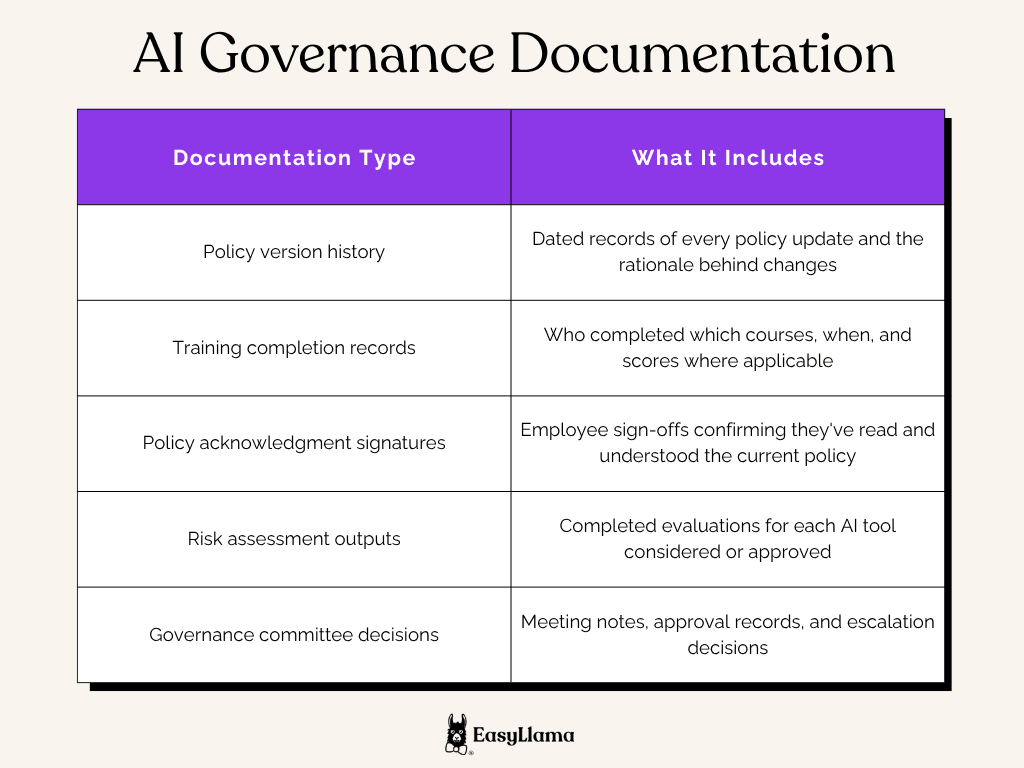
Organizations should additionally document, review, and maintain compliance on an ongoing basis, including records of transparency measures, human oversight, reliance on exemptions, and monitoring of evolving standards.
EasyLlama's acknowledgment tracking feature records employee signatures on policy documents and pairs them with centralized completion data. HR teams can show who completed training and who acknowledged the current policy version without chasing files across systems. Records are stored in one place, and automated certificates with bulk export simplify evidence gathering during audits.
6. Implement ongoing monitoring and periodic review
AI governance requires continuous attention. Tools change, regulations update, and new risks surface as AI capabilities expand. A mature AI governance program will look different in 2025 or 2026 than it did in 2024 at the same organization.
Establish a regular cadence for governance review — quarterly or semiannually — and define what gets reassessed each cycle:
- Policy relevance. Do current rules still reflect how teams actually use AI?
- Training effectiveness. Are completion rates high? Are employees passing knowledge checks?
- New tool evaluations. Have teams adopted tools that haven't gone through the intake process?
- Incident reports. What issues have been flagged, and do they reveal systemic gaps?
- Framework alignment. Have the EU AI Act, NIST AI RMF, or ISO/IEC 42001 published new guidance that requires policy updates?
Monitoring should also include tracking training completion rates and identifying teams or locations falling behind.
EasyLlama's automated reminders send email and SMS invitations and follow-up nudges to keep AI governance training on schedule for new hires and distributed teams. Access options like Magic Links and Kiosk Mode also remove login barriers for hourly or frontline workers, reducing the manual chasing that typically falls on HR.
How EasyLlama helps HR teams scale AI governance
HR teams are expected to roll out AI governance across growing, distributed organizations without adding headcount or weeks of development time. EasyLlama is built for that challenge.
Start with policy creation. EasyLlama's AI Course Authoring Tool lets admins convert existing AI policies into assigned, scenario-based training in minutes. Upload a policy PDF, generate interactive scenarios with AI prompts, customize by role or department, and publish, all without outside vendors or instructional designers.
Once training is live, employees get hands-on practice with real decisions around privacy, bias, and misuse through interactive scenarios. Training is delivered consistently in multiple languages, so global teams and multilingual workforces receive the same governance education regardless of location.
As employees complete training, acknowledgment tracking and centralized completion data give HR audit-ready records without manual reconciliation. Automated reminders keep completion rates on track across new hires, remote teams, and frontline workers who might otherwise slip through the cracks.
When issues surface, Anonymous Reporting & Case Management provides a confidential channel for employees to flag AI misuse or policy violations. Admins can gather details through two-way anonymous chat, assign cases, and track resolution — closing the loop on the full governance workflow from training through documentation, monitoring, and feedback.
Ready to see how it works for your team? Book a demo to evaluate EasyLlama firsthand.
Share this


Frequently
Asked
Questions

- AI governance is the set of frameworks, policies, and practices that guide how organizations develop, deploy, and oversee trustworthy AI systems. It helps align AI use with ethical principles, transparency requirements, and legal expectations.
- AI governance requires shared ownership across HR, Legal, IT, Security, Compliance, and business unit leaders. A cross-functional committee with clearly assigned roles using a RACI-style model ensures accountability without creating bottlenecks.
- The most widely adopted frameworks include the EU AI Act, NIST AI Risk Management Framework, ISO/IEC 42001, and the OECD AI Principles. The NIST AI RMF stands out as the most recognized framework, particularly among U.S. technical leaders, due to NIST's strong track record with cybersecurity standards. Organizations operating in or serving EU markets should treat the EU AI Act as mandatory.
- AI governance policies should be reviewed at least quarterly or semiannually. Treat responsible AI as a living system rather than a static framework. Reassess regularly as technologies and risks evolve to keep your governance fit for purpose.
- Track training completion rates by department and location, policy acknowledgment percentages, time-to-resolution for reported AI incidents, risk assessment coverage for approved tools, and audit readiness scores.
 Articles
Read More Blogs
Explore what others in your field are learning

AI Governance Audit: What to Expect and How to Prepare
Learn what an AI governance audit is, who's responsible for it in your organization, and what documentation and processes you need to be covered for an audit.

Blaine Sanders

12 Email Security Best Practices for a Compliant Team
A checklist of 12 email security best practices to prevent phishing, meet compliance, and train employees with an incident response plan.
Michael Devyver
![8 Best Mobile-Friendly Learning Management Systems (LMS) Compared [2026]](/_next/image?url=https%3A%2F%2Fd230yvp9l0f4m2.cloudfront.net%2FGroup_81042796_1a3767beae.png&w=1200&q=75)
8 Best Mobile-Friendly Learning Management Systems (LMS) Compared [2026]
Discover the best mobile LMS platforms for compliance training. Compare mobile-friendly features, pricing, and tools built for on-the-go teams.
Blaine Sanders
Start Modernizing Workplace Compliance
It’s easy to get started with EasyLlama. Speak with one of our compliance experts and get a demo tailored to your business’s needs.