How HR Teams Build Agile Compliance Programs That Adapt and Scale



Learn about Agile Compliance, the modern compliance training approach that evolves and changes over time. Understand why traditional compliance programs are no longer sufficient.

Learn about Agile Compliance, the modern compliance training approach that evolves and changes over time. Understand why traditional compliance programs are no longer sufficient.
- What agile compliance means for HR and compliance teams
- Why traditional, calendar-driven compliance falls short
- 6 building blocks of an agile compliance program
- How to implement an agile compliance program step-by-step
- 2. Identify regulatory requirements by jurisdiction and role
- Build a compliance program that keeps pace with your business
Test Your Compliance
Find out if your company is compliant in two minutes with our free Compliance Grader.
Get Your Free ReportMost HR and compliance teams only think about training once a year. They scramble before audits, chase employees for completions, and pull together records from scattered spreadsheets. Then the cycle resets.
Agile compliance management offers a way out of that cycle. Instead of treating training as an annual checkbox, it builds a continuous process that adapts whenever a regulation changes or an employee switches roles. The payoff gets you shorter audit prep, fewer compliance gaps, and a program that actually keeps pace with your business.
This article breaks down what agile compliance means, why traditional models fall short, the six building blocks you need, and a step-by-step framework for putting it all into practice.
What agile compliance means for HR and compliance teams
Agile compliance is a model where policies, training, and documentation are updated continuously rather than sitting static until the next audit cycle. When a regulation changes or an employee switches locations, an agile program treats that as an immediate trigger for action — not something to address at the next annual review.
From our perspective at EasyLlama, we define agile compliance using a three-part framework:
- Identify: Compliance requirements, security risks, training and policies.
- Automate: Training assignments, tracking and reporting, reminders and follow-ups.
- Monitor: Behavior change, risk levels, regulatory changes.
Compare that to the traditional approach: annual training cycles, manual spreadsheet tracking, and static policies that only surface during audits. Most organizations still rely on generic courses designed for "everyone" that actually fit no one.
For HR managers, that translates to fewer last-minute scrambles before audits. Compliance officers see shorter gaps between when a regulation changes and when employees are actually trained on it. Employees, meanwhile, get training that reflects their real roles — which makes them far more likely to retain it.
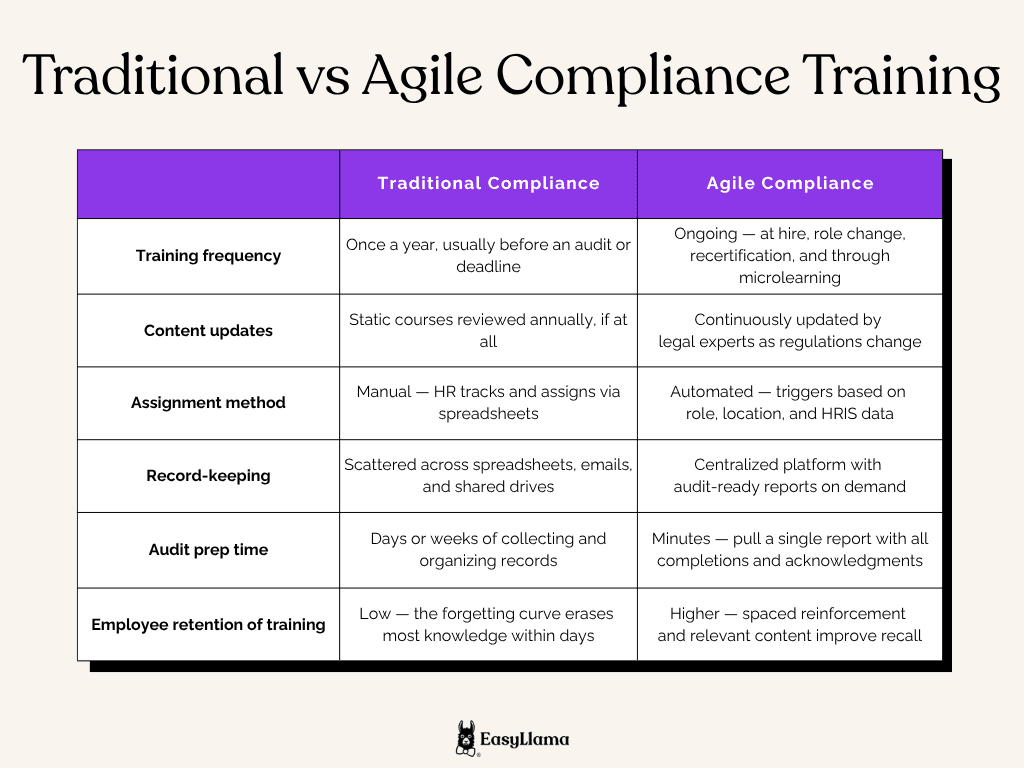
Why traditional, calendar-driven compliance falls short
Three forces make the annual compliance model unsustainable, and each one creates compounding risk that grows the longer an organization waits to address it.
Regulations change faster than annual cycles can keep up
State and local employment laws update throughout the year, not on a predictable schedule. Harassment prevention requirements, workplace safety mandates, and pay transparency rules can shift with little notice as a result.
Beyond employment law, data privacy regulations like CPRA and GDPR amendments add another layer of training needs that can't wait 12 months.
The risk is easy to see—if training happens once a year, employees may operate under outdated rules for months after a law changes. Organizations with employees in multiple states also face this issue at scale. For example, what's compliant in California may already be non-compliant in New York.
Distributed teams create assignment gaps
Remote work, multi-location operations, and frequent role changes mean employee rosters shift constantly. New hires, transfers, and promotions all require different training.
A reactive model relies on someone in HR noticing each change and manually updating assignments. That process does not scale. When one person is responsible for reassigning training every time an employee moves, gaps are inevitable — and those gaps become audit findings.
Annual training produces compliance on paper, not in practice
A once-a-year training event checks a regulatory box. It does not build lasting knowledge.
Ebbinghaus’ forgetting curve is well documented, and in the workplace context, employees are likely to lose a significant portion of what they learned within days if there is no reinforcement. If employees cannot recall their training during an incident or audit, the organization carries the same liability as if the training never happened.
6 building blocks of an agile compliance program
The following six components address the specific failure modes of the traditional model. Each one replaces a reactive, manual process with a proactive, automated one.
- Customized, role-specific training. Programs tailored to your organization's industry, policies, and risk profile. Content personalized to each learner's role, location, and experience level, so training is relevant from day one.
- Continuously updated training. Content that reflects current regulations, with legal experts verifying accuracy. Assignments adjust by location, role, and industry, so employees are never trained on outdated rules.
- Automated, lifecycle-based assignments. Training that triggers automatically when employees are hired, change roles, transfer locations, or reach recertification deadlines. No manual handoffs required.
- Centralized, audit-ready records. A single source of truth for completions, policy acknowledgments, and certifications. Replaces scattered spreadsheets and shortens audit prep from a multi-day project to a single report pull.
- Ongoing reinforcement. Microlearning, automated reminders, and recertification alerts that maintain knowledge between formal training cycles. Retention improves when learning is spaced over time rather than concentrated in a single session.
- Engaging, interactive content. Quizzes, knowledge checks, and real-world scenarios that improve retention and completion rates compared to passive slide decks or video-only formats.
Knowing these building blocks is the first step; now, let's walk through how to put them into practice.
How to implement an agile compliance program step-by-step
This framework moves agile compliance from concept to action. Each step builds on the previous one, creating a system that runs continuously with minimal manual oversight.
1. Audit your current compliance process
Start by mapping what you have. Document your existing training schedules, assignment workflows, and record-keeping systems.
Ask yourself:
- Where do you rely on manual steps?
- Where are you dependent on annual timelines?
- Which tools are disconnected from each other?
This baseline matters because you cannot measure improvement without understanding your starting point.
Most teams discover that their current process depends on one or two people manually tracking everything in spreadsheets.
2. Identify regulatory requirements by jurisdiction and role
The first operational step is mapping which regulations apply to which employees. Factor in location, role, and industry. A warehouse worker in California has different training requirements than a remote software engineer in Texas.
This mapping needs to be dynamic, not a static document that becomes outdated the moment a new law passes or an employee transfers. That's the kind of mapping EasyLlama is built around — automatically determining required training based on employee location, industry, and role. Its compliance courses are continuously updated by legal experts to reflect current state and local laws, reducing the time teams spend interpreting regulatory changes.
3. Connect training assignments to employee data
Integrating compliance training with HRIS and payroll systems removes the manual handoff between HR and compliance. When employee data syncs automatically, training assignments trigger based on predefined rules for role, location, and department.
EasyLlama also integrates with over 100 HRIS and payroll systems, including BambooHR, Workday, Gusto, and ADP. This means that new hires, promotions, and location changes automatically trigger the right training workflows, and most customers complete implementation in less than one day.
Assignment gaps shrink, onboarding speeds up, and no single person is responsible for remembering to update a spreadsheet.
4. Customize and personalize training content
Once assignments are connected to employee data, the next step is making sure the content itself is relevant. Generic, one-size-fits-all training reduces engagement and retention. Employees disengage when courses do not reflect their actual work environment.
Tailor training by industry, department, and role. When existing courses don't match a specific need, EasyLlama's Course Authoring Tool lets teams build custom courses from a single prompt. Turn internal policies, SOPs, or emerging risk topics into interactive, role-specific training without waiting on external vendors or design tools.
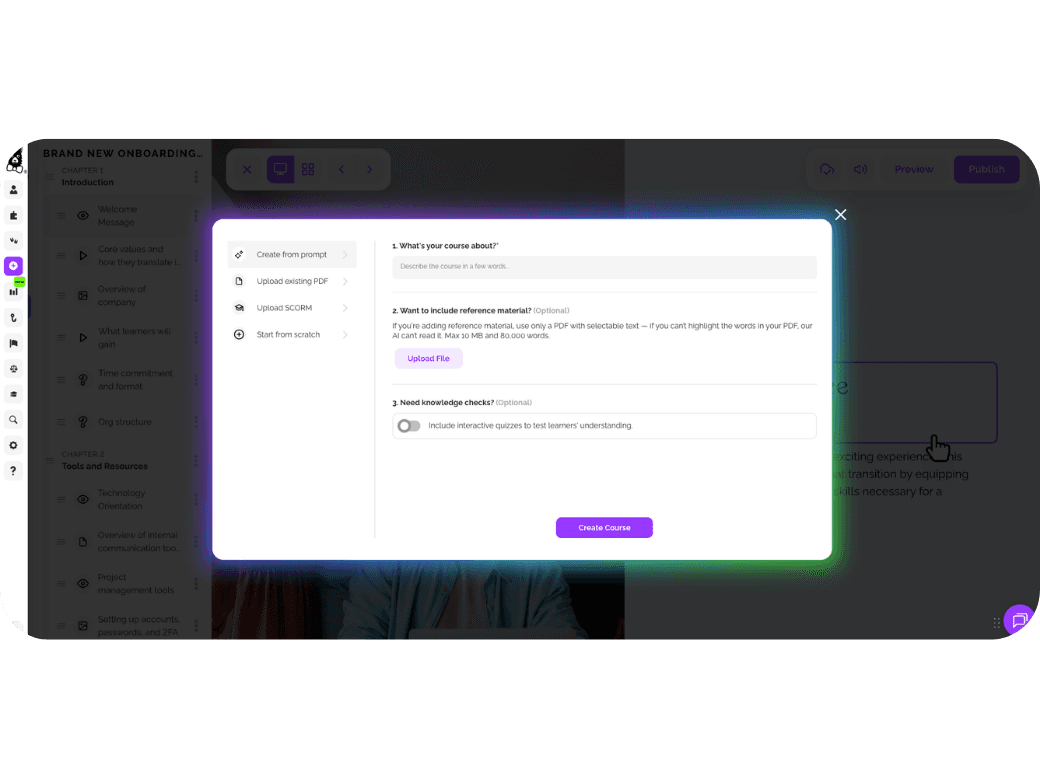
Personalization also means format flexibility. Some topics work best as short microlearning modules, while onboarding may call for a longer course and high-risk scenarios benefit from interactive exercises.
When training feels relevant, employees engage more—a Harvard Business School study found that goal achievement among frontline workers increased by roughly 10% after relevant training.
5. Build a continuous monitoring and reporting cadence
Agile compliance requires regular visibility into compliance status, not just an annual snapshot. Set up dashboards that surface gaps, overdue completions, and upcoming deadlines in real time.
That kind of visibility is exactly what EasyLlama's Custom Report Builder delivers – real-time dashboards filterable by department, state, and role. Training completions, signature records, and acknowledgment data are available in an audit-ready format. Instead of manually collecting records before an audit, teams pull a single report.
Schedule compliance reviews monthly or quarterly using automated reports. Do not wait for an external audit to expose problems.
6. Set up automated reminders and recertification workflows
The final step is automating follow-up so compliance becomes self-sustaining. Configure reminders for initial deadlines and recurring recertifications across multiple channels.
Multi-channel follow-up is what makes this work in practice — EasyLlama sends automated reminders through email, SMS, and Slack. Consistent follow-up across three channels means admins do not have to chase completions manually throughout the year.
For ongoing reinforcement between full training cycles, EasyLlama's microlearning modules take just 5 to 10 minutes each, fitting into even the busiest schedules, which means admins shift from chasing completions to monitoring compliance health. For example, Pipl saved 100 working hours per 100 learners after moving to location-specific training with EasyLlama.
Build a compliance program that keeps pace with your business
Traditional, calendar-driven compliance creates gaps that widen every time a regulation shifts or an employee changes roles. Agile compliance closes those gaps by making the entire program — from training content to reporting — continuous rather than periodic.
The shift does not require a massive overhaul. Start by auditing your current process and connecting training to employee data, then focus on making content relevant to each role. The same Course Authoring Tool that powers role-specific training also makes it possible to respond to emerging compliance needs in minutes, not weeks, as new policies or risks surface. Build custom courses from a single prompt, no matter your company size.
EasyLlama also offers a Learning Management System (LMS) built for busy teams who need to quickly create, assign, and track custom training, in one place and without sacrificing quality. With 8,000+ organizations already on the platform, a G2 #1 rating, and setup in as little as 5 minutes, the barrier to getting started is lower than you think.
Take a look at where your current compliance program falls short, then take the first step toward an always-on approach.
Book a Demo to see how EasyLlama helps HR and compliance teams build agile compliance programs that adapt as fast as your business does.
Share this


Frequently
Asked
Questions

- Traditional compliance relies on fixed annual training cycles, manual tracking, and static policies reviewed only during audits. Agile compliance is a continuous model where training, assignments, and documentation update automatically as regulations change, employees move roles, or new risks emerge. The result is fewer gaps, faster audit prep, and training that stays current year-round.
- There is no single schedule that fits every organization, but agile compliance moves away from a once-a-year model. Best practice includes onboarding training at hire, role-specific refreshers after transfers or promotions, recertification at required intervals, and short microlearning reinforcement on an ongoing basis.
- Automation is what makes agile compliance sustainable at scale. It handles training assignments triggered by HRIS data changes, sends multi-channel reminders for deadlines, generates real-time compliance reports, and manages recertification workflows. Without automation, continuous compliance depends on manual effort that does not scale.
- With centralized, real-time records, audit preparation becomes a report pull instead of a multi-day data collection project. Every completion, policy acknowledgment, and certification is documented automatically. When auditors ask for evidence, it is already organized and exportable.
- Yes. Agile compliance is not limited to enterprise teams with large budgets. Platforms like EasyLlama are designed for organizations of all sizes, with setup in as little as 5 minutes and most HRIS integrations completing in less than one day. The key is choosing a platform that automates the manual work so a small team can manage compliance without adding headcount.
 Articles
Read More Blogs
Explore what others in your field are learning

The Agile Compliance Checklist: 7 Steps To Reduce Risk
Use this 7-step agile compliance checklist to assess your program, identify gaps, and build a system that keeps pace with changing regulations.

Katrine Reddin

How to Implement an AI Governance Framework in 6 Steps
Learn six practical steps for turning AI governance from a written policy into enforceable, organization-wide practice.

Blaine Sanders
EasyLlama + California Chamber of Commerce: Upskilling California Employers
We’re excited to announce a new partnership between EasyLlama and the California Chamber of Commerce (CalChamber). Together, we'll help California employers go beyond baseline compliance requirements and invest in meaningful workforce development through modern, high-impact training.
Katrine Reddin
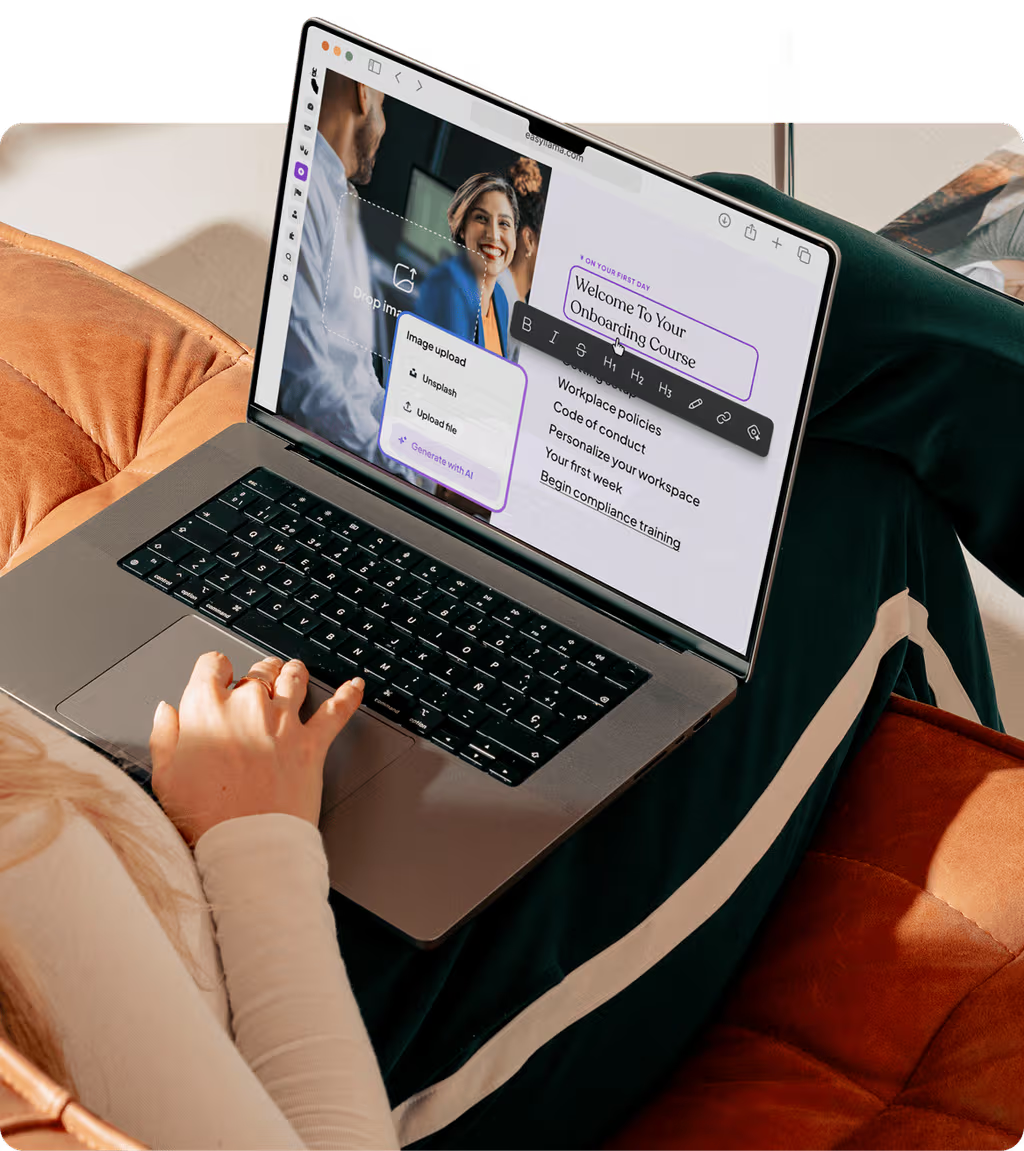
Start Modernizing Workplace Compliance
It’s easy to get started with EasyLlama. Speak with one of our compliance experts and get a demo tailored to your business’s needs.