LMS Competency: How To Support Skill-Based Digital Learning



Learn what LMS competency means, how it supports skill-based learning, and how EasyLlama helps track and build workforce readiness.

This article covers everything you need to know for supporting skill-based digital learning. Learn what LMS competency means, how exactly it supports skill-based learning, and how EasyLlama helps track and build workforce readiness.
Test Your Compliance
Find out if your company is compliant in two minutes with our free Compliance Grader.
Get Your Free ReportTraditional training often stops at course completion. But just because someone finished a training, doesn’t mean they can apply what they’ve learned. That’s where LMS competency comes in. Instead of focusing on course time or checking boxes, competency-based learning tracks whether employees can actually demonstrate the skills needed for their roles.
This approach is gaining traction because businesses value progress over mere participation.
For HR, learning, and compliance teams, that means shifting from “Did they take the course?” to “Can they do the job well and safely?”
In this guide, we’ll break down what LMS competency really means, how it works, and why it’s such a powerful tool for building a more capable, confident workforce.
You’ll learn how a competency-based LMS like EasyLlama helps you create skill-based learning paths, track progress in real time, and close gaps that matter most to your business. If you care about readiness, retention, or compliance, this is a smarter way to train.
What is LMS competency?
LMS competency is all about measuring what people can do, not just what they’ve watched or completed. Instead of only checking a box when a course is done, a competency-based LMS tracks whether employees can apply what they’ve learned in real-world situations.
With competency-based learning, your LMS helps you build and track job-ready skills. These platforms make it possible to define the exact competencies required for each role and then map training to those goals.
Common examples of competencies you might track:
- Handling sensitive data securely
- Communicating effectively with customers
- Responding appropriately to harassment or bias
- Following safety procedures on-site
- Completing required steps during onboarding
Each learning activity is tied to a specific outcome or skill. This helps HR and compliance teams ensure training isn’t wasted time. Instead, it supports job performance, reduces risk, and gives managers real insights into who’s ready for more responsibility and who might need extra support.
How competency-based LMS differs from traditional approaches
Most learning platforms focus on ticking boxes. Watch a video, take a quiz, and the course is “complete.” But completing a course doesn’t always mean someone has learned the skill.
A competency-based LMS takes a different approach. What a learner can do matters more than how much time they spent in training. Instead of just content quizzes, employees show what they know through real tasks and skill checks. Learners need to demonstrate that they know how to respond to a difficult situation at work, for example.
This kind of learning is more useful for everyone. Teams get the training they actually need, based on their roles and gaps. And companies get peace of mind knowing people are building real skills that matter.
3 benefits of competency-based LMS for organizations
Competency-based learning isn’t just good for employees. It helps organizations work smarter, reduce risk, and plan for growth.
Here are three key ways a competency-based LMS can make a real difference.
1. Improved compliance and risk management
When it comes to compliance, checking a box isn’t enough. In highly regulated industries like healthcare and financial services, you need to prove that employees understand the material and can apply it on the job. That’s where competency-based learning changes the game.
Instead of relying on course completions, EasyLlama helps organizations track real skills. You can see who’s actually competent in areas like harassment prevention, HIPAA, or cybersecurity, and who needs more support. This creates stronger documentation if you’re ever audited or need to prove compliance.
By focusing on what people can do, not just what they’ve watched, your team stays safer and more prepared. And when the stakes are high, that kind of assurance matters.
2. Enhanced employee development and retention
Competency-based learning helps employees grow. When people clearly see how their skills connect to their roles and future goals, they feel more motivated and supported. That’s a big win for retention.
With EasyLlama’s skill tracking, managers can easily spot who’s excelling and where additional training may help. This makes it easier to create development plans that feel personal and purposeful.
Common ways competency-based learning supports development include:
- Personalized learning tied to role-specific goals
- Visibility into each employee’s strengths and gaps
- Progress tracking that informs growth conversations
- Training paths that align with promotions or new responsibilities
When people feel seen, challenged, and supported, they’re more likely to stay. By using an LMS that builds on real skills, you turn compliance into an opportunity for long-term growth.
3. Data-driven decision making
When training data is tied to real skills, it becomes a powerful tool for smarter decision-making. Competency-based LMS platforms like EasyLlama help leaders spot trends, uncover skill gaps, and make more informed choices about how to grow their teams.
With built-in reporting and analytics, L&D teams can quickly see which competencies are strong across the organization and where more support is needed. This allows companies to invest in the right training at the right time, rather than guessing.
For example, if data shows that customer-facing teams are struggling with communication skills, leaders can roll out targeted training and even use those insights to inform future hiring. Competency tracking moves training from a check-the-box task to a strategic part of workforce planning.
Core components of a competency-based LMS
To support real skill-building, your LMS needs more than courses and quizzes. A competency-based LMS includes tools that help define, deliver, and measure learning based on the skills that matter most to your organization.
Skill mapping and competency frameworks
Skill mapping is the foundation of any competency-based learning strategy. Start by identifying the specific skills, knowledge, or behaviors employees need to succeed in their roles. From there, you can organize these into a structured framework that ties each competency to a learning path and measurable outcomes. For example, a healthcare company might define a competency around patient confidentiality, with supporting skills like HIPAA awareness, data handling, and ethical decision-making.
With EasyLlama, you can easily create custom frameworks tailored to your industry, from healthcare to hospitality.
The platform makes it simple to:
- Define role-specific skills
- Align competencies with training modules
- Build clear learning paths
- Track mastery through assessments
This structure keeps training focused, relevant, and aligned with both compliance goals and employee growth.
Personalized learning paths
Personalized learning paths are one of the biggest advantages of a competency-based LMS. Instead of assigning the same courses to every employee, the system adapts based on what each person needs to learn. If someone already has a strong foundation in a certain area, they can move on. If they need extra support, they get it.
EasyLlama makes this process simple by helping teams build custom learning journeys tied to specific skills or roles. Whether it’s compliance basics or advanced leadership training, employees follow paths that reflect their goals and current knowledge.
This kind of personalization keeps learners more engaged because the content feels relevant. It also helps managers spot progress quickly and support employees more effectively, leading to better results and stronger retention.
Assessment and progress tracking
Competency-based LMS platforms don’t stop at course completion. They measure whether employees have actually mastered the skills they need. This happens through a mix of assessment types that go beyond simple quizzes. EasyLlama makes it easy to evaluate learners in ways that reflect real-world performance.
Common assessment methods include:
- Scenario-based questions
- Interactive knowledge checks
- Skill demonstration tasks
- Self-assessments and peer reviews
- Manager evaluations
EasyLlama’s real-time analytics dashboard brings all this data together, showing how individuals and teams are progressing.
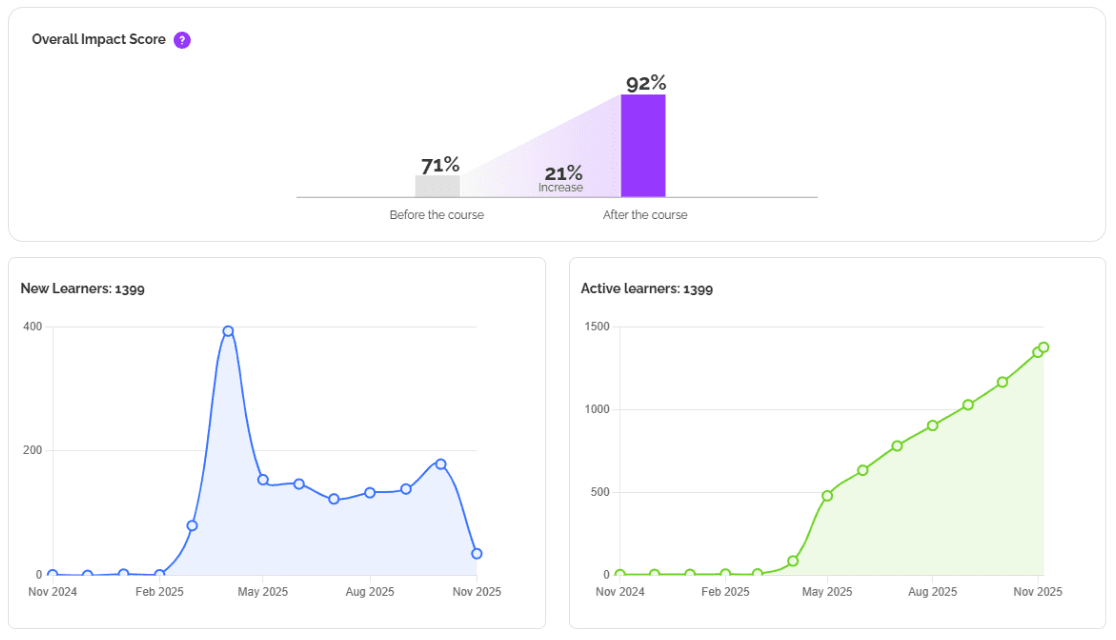
HR and L&D leaders can see who’s meeting skill benchmarks, where support is needed, and which areas are ready for the next level of development. With these insights, training becomes a continuous feedback loop instead of a one-time event.
Top competency-based LMS platforms compared
When you’re evaluating competency‑based LMS options, it helps to see how different platforms approach skill tracking, reporting, and learner support. Below is a comparison of some of the top tools to consider.
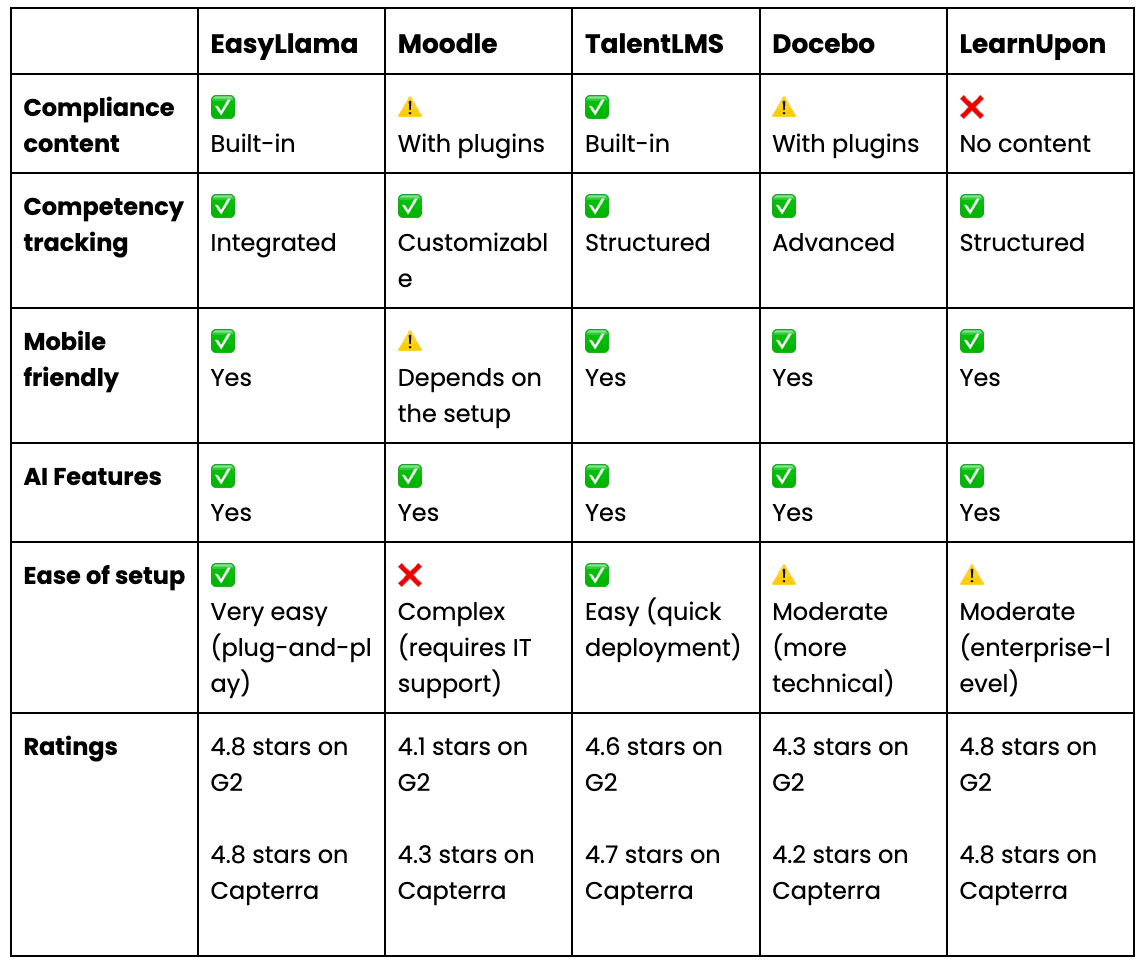
1. EasyLlama: Compliance-focused competency tracking
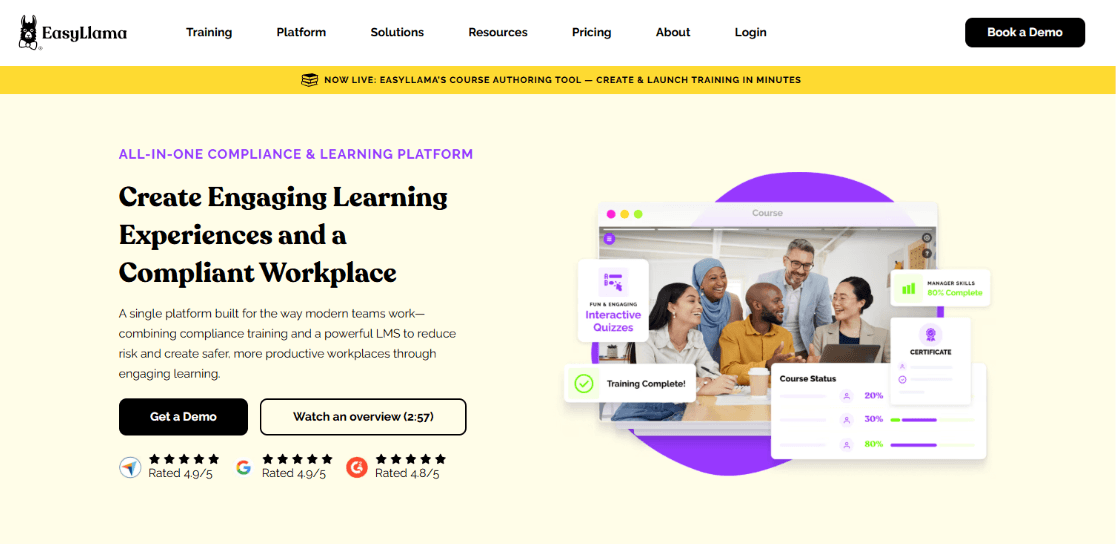
EasyLlama is built for modern teams that need training to do more than check a box. It blends compliance accuracy with personalized skill development, helping HR, L&D, and compliance leaders train smarter. With EasyLlama, you can build custom courses, automate training assignments, and track real progress. It’s especially well-suited for teams managing compliance across industries like healthcare, retail, and finance, where accuracy, flexibility, and engagement really matter.
Key features
- Custom course authoring
- Multilingual content support
- Mobile-friendly learner experience
- Real-time analytics and dashboards
- Guided learning journeys
- SCORM and xAPI compatibility
- HRIS and payroll system integrations
- AI-powered compliance hub with legal updates
Differentiator
EasyLlama combines legal-grade compliance content with a consumer-style experience, making training both effective and enjoyable. It’s one of the few LMS platforms built for compliance-first organizations that also supports custom skills training and microlearning.
Limitation
While EasyLlama is great for compliance and core competencies, organizations with highly technical or niche role-based training may need to supplement with industry-specific platforms or build out advanced learning paths with internal content. But for that, you can use our Course Authoring Tool to generate engaging, accurate courses in minutes.
Ratings
- 4.8 stars on G2
- 4.8 stars on Capterra
2. Moodle: Open-source mastery-based progression
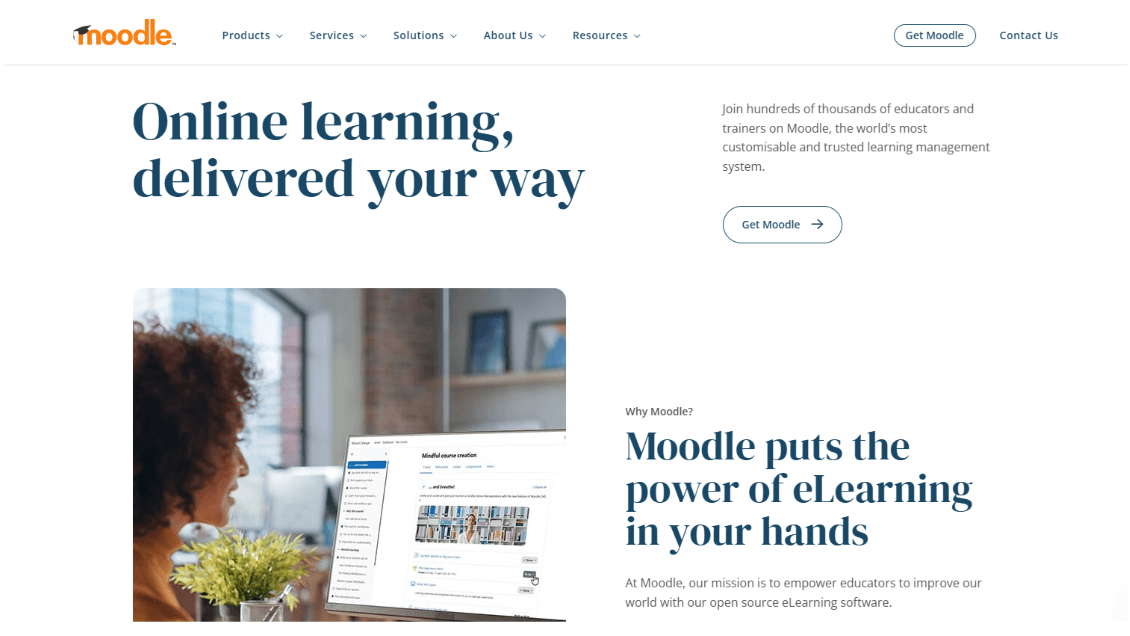
Moodle is a flexible, open-source LMS built for educators and organizations that want full control over how learning happens. It supports competency-based training by allowing users to define, assign, and track competencies across personalized learning plans. Through its wide plugin ecosystem, Moodle enables progress tracking, outcome-based assessments, and performance monitoring, making it a good fit for academic institutions or companies with in-house technical resources.
Key features
- Custom grading scales
- Learning plans linked to roles or goals
- Competency breakdowns and progress tracking
- Outcome-based assessments
- Plugin ecosystem for advanced reporting
- Full SCORM and xAPI support
Differentiator
Moodle offers unmatched flexibility with a robust set of tools for creating custom learning environments and competency frameworks, especially for organizations that want to tailor every part of the training experience.
Limitation
Moodle’s setup and customization require significant technical expertise and ongoing maintenance, unlike EasyLlama, which offers plug-and-play simplicity and built-in compliance tools ready out of the box.
Ratings
- 4.1 stars on G2
- 4.3 stars on Capterra
3. TalentLMS: Skills-driven microlearning with certification
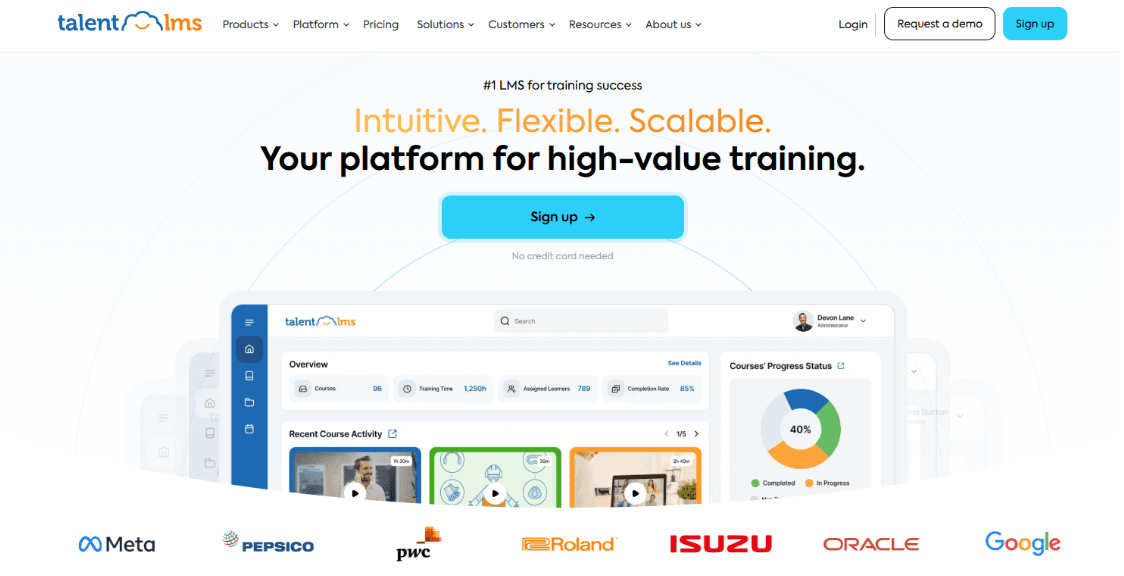
TalentLMS is built for fast, flexible training, especially for growing teams that need to build real-world skills without a long setup. Its approach to competency-based learning centers on short, goal-oriented lessons that are easy to assign, track, and scale. Competency is measured through course completion, quizzes, and skills tagged to specific roles or learning objectives. It’s a solid choice for teams looking to quickly roll out engaging, skills-based training with built-in certification.
Key features
- Kill-based learning paths
- Quiz and test builder
- Role-specific training matrices
- Automated certification
- Mobile-friendly access and offline learning
- Rich integrations with HR systems
Differentiator
TalentLMS excels at rapid deployment of microlearning with intuitive skill tagging and certifications. It’s great for small to midsize teams who want to scale training quickly without added complexity.
Limitation
On the other hand, TalentLMS lacks a strong focus on compliance and doesn’t offer the industry-specific content libraries that EasyLlama provides out of the box, making it less ideal for teams with strict regulatory requirements.
Ratings
- 4.6 stars on G2
- 4.7 stars on Capterra
4. Docebo: AI-powered competency alignment
With Docebo, you get a high-tech approach to competency-based learning that places AI at the center. The platform automatically recommends content, analyzes skill gaps, and aligns competencies with learning materials. That means learners get personalized paths that adjust as they go, making it a good fit for large teams with diverse training needs. With flexible frameworks and powerful dashboards, Docebo helps organizations deliver adaptive learning journeys that scale alongside growth.
Key features
- AI-based skills tagging
- Custom learning plans
- Automated skill gap analysis
- Advanced reporting and dashboards
- Social learning capabilities
- Mobile-first delivery
Differentiator
Docebo’s AI-driven personalization and skill-gap analytics make it easy to scale adaptive competency development across teams, offering deep insights and flexible learning pathways for all kinds of learners.
Limitation
On the flip side, Docebo is more complex and costly to implement than EasyLlama, especially for small teams that want fast, straightforward compliance training without needing a dedicated admin or technical setup.
Ratings
4.3 stars on G2
4.2 stars on Capterra
5. LearnUpon: Streamlined competency tracking for enterprise teams
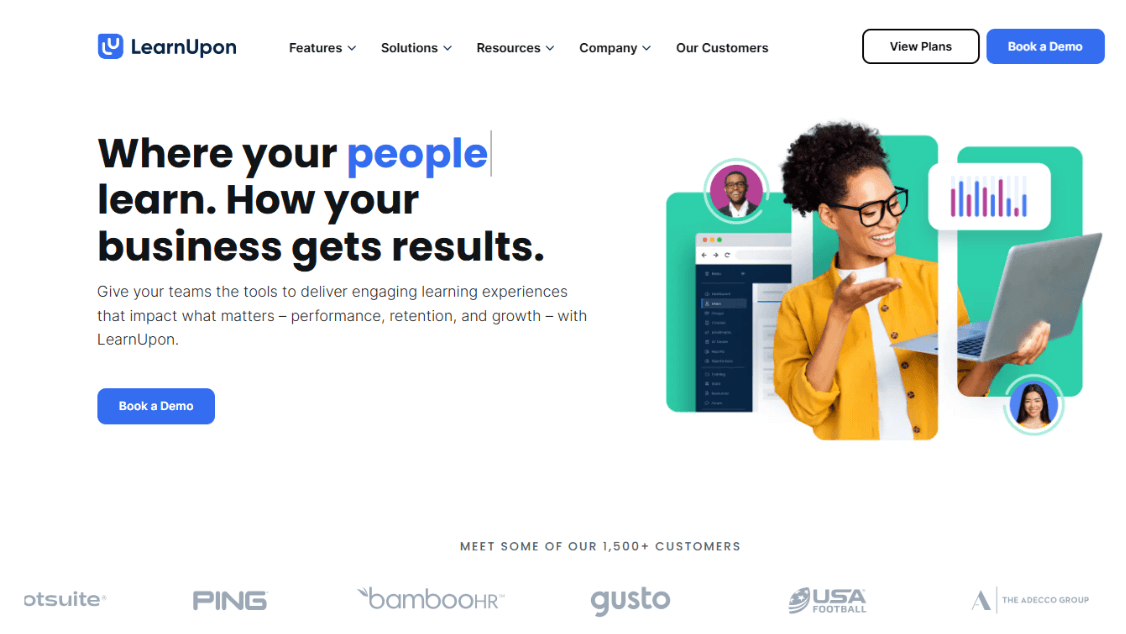
Built for large-scale organizations, LearnUpon offers a centralized, flexible platform to manage training across multiple audiences. It supports competency tracking by tying skills to specific roles, departments, or individuals, then measuring progress through course completions and assessments. With strong integrations and branded learning portals, LearnUpon helps enterprise teams deliver consistent learning experiences across divisions and geographies.
Key features
- Branded learning portals
- Automated enrollments
- Certification management
- Learning paths
- Advanced reporting and analytics
- Salesforce integration
Differentiator
LearnUpon is designed for enterprise training at scale, offering deep system integrations and the ability to manage multiple learning portals under one roof.
Limitation
While powerful, LearnUpon is not specialized in compliance training content, so teams may need to spend more time building or sourcing materials that EasyLlama already offers out of the box.
Ratings
- 4.8 stars on G2
- 4.8 stars on Capterra
Competency-based learning is easier, smarter, and more impactful with the right tools. Book a demo with EasyLlama to see how to improve learning for your team.
Share this


Frequently
Asked
Questions

- LMS competency means using your learning platform to build real skills rather than just tracking course completions. It focuses on helping employees master the abilities they need to succeed in their roles, not just check training boxes.
- A competency-based LMS helps ensure employees actually understand and apply critical policies. Instead of tracking who clicked “complete,” it shows who has mastered the skills needed to stay compliant and reduce risk.
- A competency-based LMS personalizes learning by identifying what each employee already knows and where they need support. From there, it delivers the right training content based on skill level, making learning more relevant, effective, and engaging.
- Start by aligning competencies with real job responsibilities and business goals. Use clear, measurable language and involve managers in the process. Keep it simple, relevant, and focused on the skills employees need to succeed in their roles.
 Articles
Read More Blogs
Explore what others in your field are learning
LMS for Microlearning: What Is It & How To Choose The Right One
Discover how a microlearning LMS boosts retention, simplifies compliance, and helps teams train faster with short, focused learning modules.
Blaine Sanders

LMS Implementation Strategy: 6-Step Guide for HR and L&D Teams
Learn how to implement your new LMS with ease. This 6-step LMS implementation guide helps HR & L&D teams plan, launch, and measure success.

Sarah Hamilton
![12 Best Security Awareness Training Providers [2026]](/_next/image?url=https%3A%2F%2Fd230yvp9l0f4m2.cloudfront.net%2FCybersecurity_654735261c.jpg&w=1200&q=75)
12 Best Security Awareness Training Providers [2026]
Discover the 12 best Security Awareness Training providers that drive real behavior change—not just compliance checkboxes.

Michael Devyver
Start Modernizing Workplace Compliance
It’s easy to get started with EasyLlama. Speak with one of our compliance experts and get a demo tailored to your business’s needs.