AI Governance Audit: What to Expect and How to Prepare



Learn what an AI governance audit is, who's responsible for it in your organization, and what documentation and processes you need to be covered for an audit.
Learn what an AI governance audit is, who's responsible for it in your organization, and what documentation and processes you need to be covered for an audit.
Test Your Compliance
Find out if your company is compliant in two minutes with our free Compliance Grader.
Get Your Free ReportIt’s not hard to imagine scenarios like these: a manager runs performance review notes through an AI tool to "clean up the tone." A benefits coordinator uses a chatbot to draft responses to employee questions about medical leave. But none of this is in any policy document, and none of it is tracked.
And in half of organizations using AI, this kind of quiet, uncoordinated use has already produced a negative consequence—a data leak, a compliance issue, a decision nobody can explain. HR teams are increasingly the ones expected to get ahead of it.
Getting ahead of it starts with knowing where you actually stand, which is what an AI governance audit is for. It evaluates whether your organization has the policies, training, and documentation to prove responsible AI use. And because so much of that evidence lives in employee behavior, HR is central to making it defensible.
This guide walks through what auditors expect, how to prepare step by step, and a practical checklist for internal readiness reviews.
What AI governance controls auditors expect from HR
At a high level, an AI governance audit examines your governance structure, risk controls, AI governance audit documentation, and alignment with recognized frameworks like the NIST AI RMF, ISO 42001, or EU AI Act requirements. But auditors also zero in on the employee-facing controls that HR owns.
AI use policy attestations and training records
Auditors expect documented proof that employees have been trained on your organization's AI use policies. Having a policy on file isn't enough. They want evidence that employees acknowledged and understood it.
That means role-based training assignments, completion timestamps, knowledge check scores, and signed attestations. Relying on email confirmations or scattered spreadsheets creates audit risk, so centralized, exportable records should be standard.
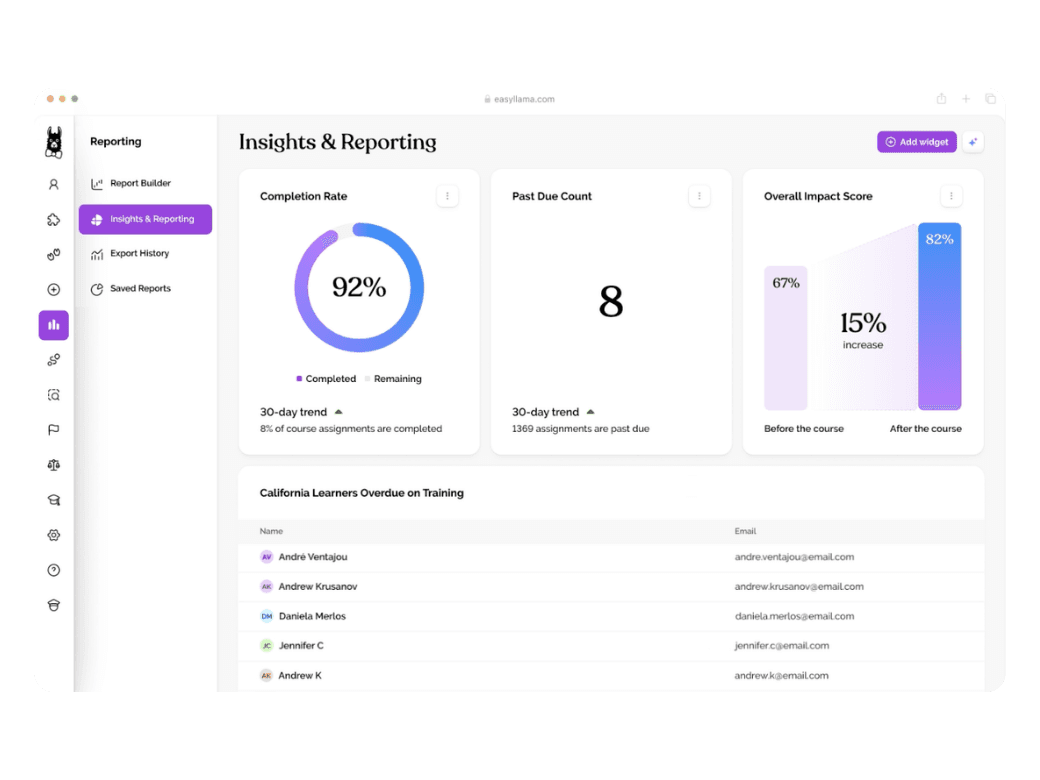
That’s what EasyLlama's AI-powered Custom Report Builder was designed for. With bulk certificate exports, it centralizes completion data, refresher status, knowledge gaps, and policy attestations into one real-time dashboard. When auditors ask for proof across the workforce, admins can bulk-export certificates in minutes rather than spending days pulling records from disconnected systems.
Cross-functional accountability and access controls
AI governance audits should also assess whether accountability is clearly distributed across functions. HR assigns training while Legal and Compliance monitor status, IT and Security oversee sensitive workflows, and managers follow up with their teams.
As a result, auditors will look for role-based permissions that prevent data overexposure while enabling each function to own its responsibilities. If one person holds all the keys, or if access controls are undefined, that becomes a finding.
That’s the structure EasyLlama’s built around – role-based admin access with permission controls so each function can manage its own scope without compromising data boundaries.
Automated rollout, reminders, and refresher schedules
Auditors check whether training is assigned consistently to new hires, whether overdue learners receive follow-up, and whether refresher schedules are documented and enforced. Manual follow-up is a common audit finding since organizations that rely on individual reminders often have gaps in their training records.
Automation closes that gap. EasyLlama syncs employee records from 100+ HRIS and payroll systems, so new hires are automatically enrolled when added. Scheduled reminders go out by email, SMS, and Slack, keeping overdue learners visible without adding to HR's workload.
Documented channels for surfacing AI concerns
Auditors increasingly expect evidence that your organization has a working channel for employees to flag AI misuse, biased outputs, or policy violations. A written policy encouraging reporting isn't enough. They want timestamped case records, documented escalation paths, and evidence of resolution.
Informal reporting leaves no audit trail and also creates the appearance that no concerns are being raised, which itself becomes a finding. A dedicated reporting channel solves both problems. EasyLlama's Anonymous Reporting and Case Management provides a confidential intake channel with two-way anonymous chat, case assignment, and resolution tracking. Incident response becomes documented audit evidence.
How to get audit-ready for AI governance in 6 steps
An AI governance audit is not a one-and-done exercise. Auditors expect evidence of continuous governance, ongoing monitoring, and periodic reassessment. The following six steps build a repeatable process for AI governance audit-readiness.
Step 1: Scope your AI governance audit
Effective scoping starts with building a formal AI inventory. Catalog every AI system, tool, vendor, data flow, and use case across the organization. HR should collaborate with IT and Compliance teams to identify which AI tools employees interact with daily.
Scoping also means identifying which employee groups need AI governance training based on their AI exposure. A recruiter using AI for resume screening carries different risks than someone using a grammar checker—so categorize use cases by risk level to focus audit attention where it matters most.
Here’s an example of what that might look like:
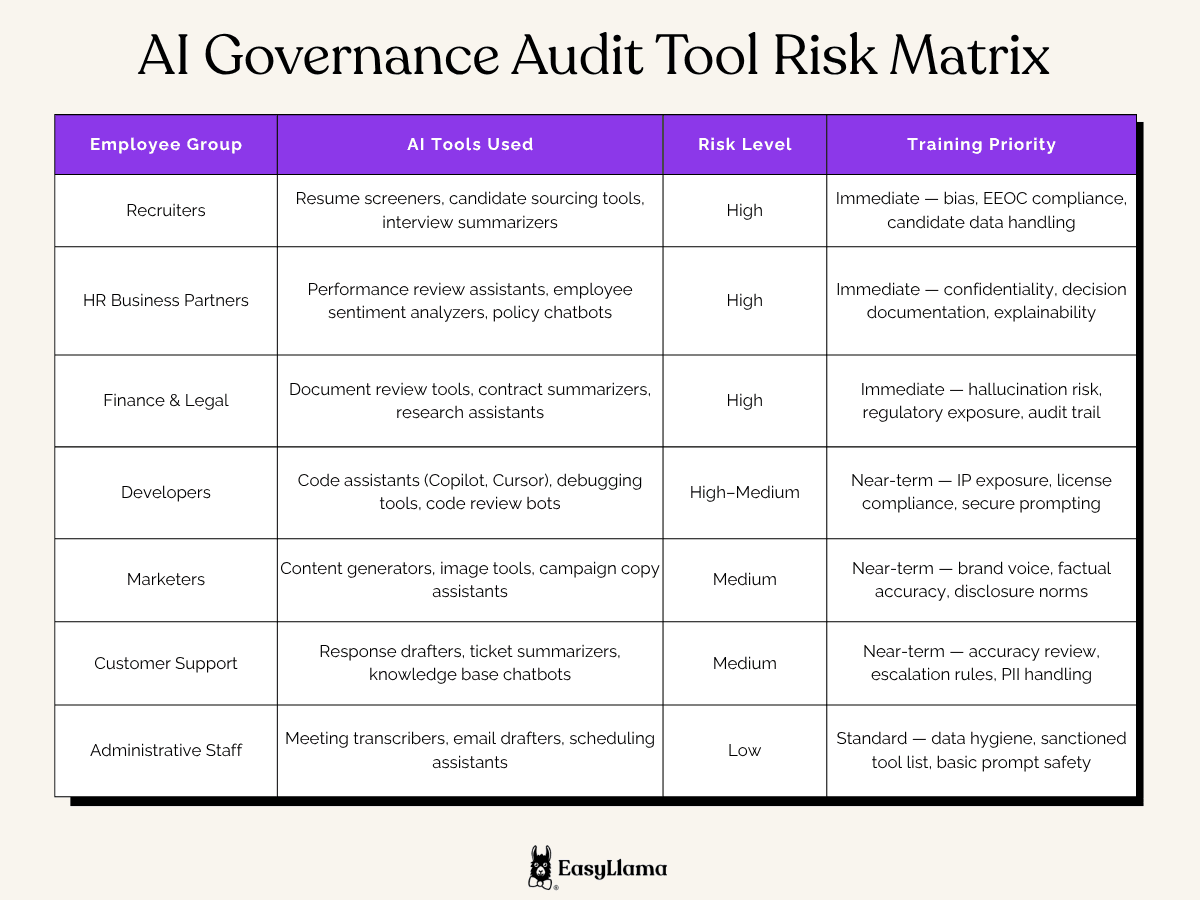
You can use this example as a baseline to work from, but consult your legal team for any nuances specific to your organization.
Step 2: Baseline your current workforce
Once the scope is defined, assign foundational AI training to all current employees with a clear completion deadline. Building that foundation from scratch isn't necessary — EasyLlama's AI course collection covers AI fundamentals, productivity, data privacy, security risks, scam awareness, and deepfake detection across six expert-led courses. HR can assign a ready-made training foundation without building courses from scratch.
After the initial rollout, review completion rates and assessment scores to identify knowledge gaps. Flag departments or roles that need targeted follow-up based on those results.
Step 3: Automate onboarding and role-based assignments
Training enrollment should be integrated with your HRIS so new hires are automatically assigned AI governance courses on day one. Set role-based assignment rules so developers, recruiters, managers, and other groups receive content matched to their exposure level.
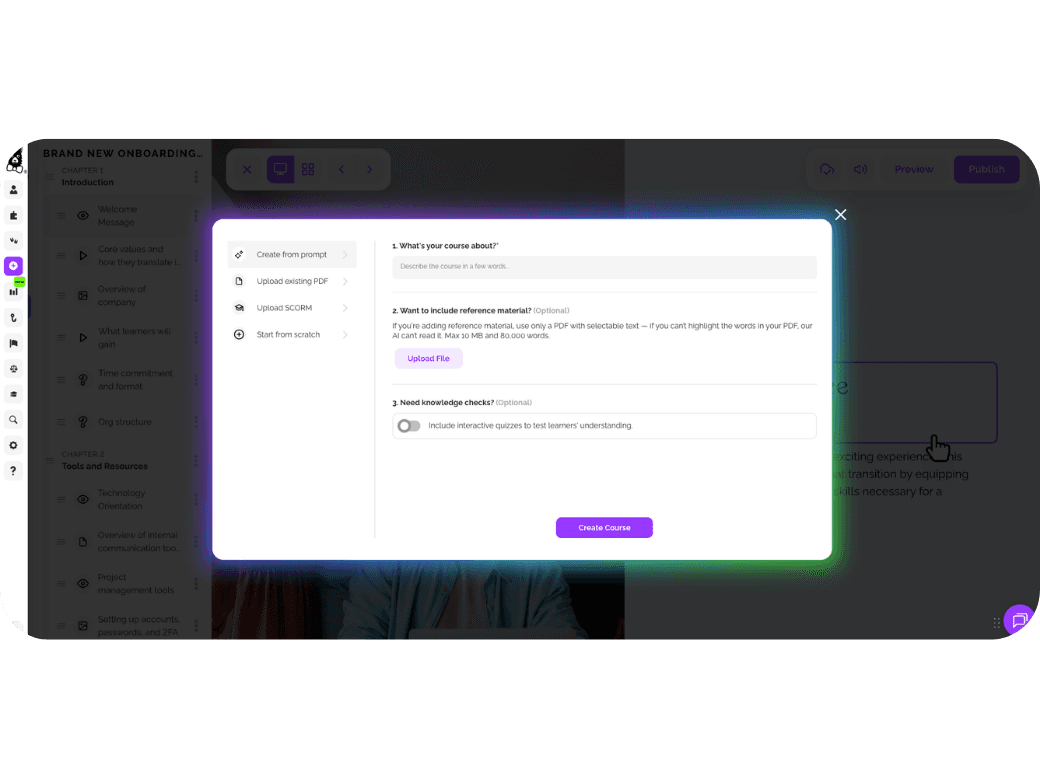
But role-based assignments only work if you have role-specific content to assign. EasyLlama's Course Authoring Tool lets HR teams build custom AI policy training from a single prompt, so organizations can create role-specific courses as AI use cases evolve — no instructional designers needed.
Every assignment should generate a trackable record from the start. If there's no record, there's no evidence. Auditors treat missing evidence the same as noncompliance.
Step 4: Schedule recurring refreshers and policy updates
You should establish a refresher cadence tied to your policy review cycle—annual recertification is the minimum. Increase frequency when regulations or internal AI use policies change, and automate recertification assignments and multi-channel reminders so nothing falls through the cracks.
Training content should also be updated promptly when AI use policies are revised. EasyLlama's 5-10 minute microlearning modules let HR push targeted refreshers when AI policies update mid-year, without pulling employees through a full re-training cycle.
Step 5: Respond to audit findings with targeted remediation
When an audit surfaces gaps, targeted training should reach the affected employee groups within days. Use a compliance reporting tool to monitor remediation progress in real time.
Document the remediation timeline and completion evidence so the next audit cycle shows a closed loop. Auditors want to see that findings led to concrete action, not just acknowledgment.
Step 6: Review, report, and refine
Conduct quarterly reviews of AI governance metrics: training completion rates, overdue learner counts, policy attestation coverage, and assessment scores. Share a summary report with leadership to maintain board-level confidence.
Adjust training content, assignment rules, and refresher cadences based on what each review cycle reveals. Pulling those metrics quarterly shouldn't mean rebuilding a report from scratch each time. EasyLlama's Custom Report Builder turns quarterly reviews into a repeatable leadership update – HR can filter governance metrics by team, location, or department and export the summary as audit-ready evidence without rebuilding the report each cycle.
A practical AI governance audit preparation checklist
Before your next AI governance risk audit, use this checklist to assess readiness across the controls auditors evaluate most closely:
- Confirm a formal AI inventory exists and is current
- Verify that AI use policies are documented, distributed, and acknowledged by employees
- Ensure role-based AI governance training is assigned and completion records are centralized
- Check that refresher schedules are automated and overdue learners are tracked
- Confirm cross-functional accountability is documented — who owns what across HR, Legal, IT, Compliance, and Security
- Validate that audit evidence is exportable: completion certificates, attestation records, and training reports
- Review alignment with at least one recognized framework — NIST AI RMF, ISO 42001, or EU AI Act
Share this checklist with your compliance or audit team as a starting point. If your current tools make it difficult to check every box, it may be time to centralize your AI governance audit documentation in one platform.
Ready to see how EasyLlama handles your AI governance requirements? Book a Demo to evaluate it firsthand.
Share this


Frequently
Asked
Questions

- An AI governance audit is a structured review of how an organization manages the risks and responsibilities of AI use. It evaluates policies, training records, risk controls, and documentation to determine whether governance practices are defensible and aligned with recognized standards.
- AI governance is a shared responsibility. HR typically owns training assignments, policy attestations, and employee-facing controls. Legal and Compliance monitor regulatory alignment, while IT and Security manage technical safeguards. Effective governance requires documented accountability across all functions.
- Auditors expect timestamped training completion records, signed policy attestations, role-based assignment logs, refresher schedules, incident reports, and exportable evidence that ties everything together. AI governance audit documentation should be centralized, searchable, and ready to share on short notice.
- Most organizations should conduct a formal AI governance risk audit at least annually, with quarterly internal reviews of key metrics. Organizations in highly regulated industries or those with rapidly evolving AI use cases may need to audit more frequently.
- Start by completing the checklist above: build an AI inventory, assign and track training, automate enrollment and reminders, document cross-functional accountability, and centralize exportable evidence. The goal is to demonstrate continuous governance, not just point-in-time compliance.
 Articles
Read More Blogs
Explore what others in your field are learning
Top 7 AI Governance Challenges (And How HR Teams Solve Them)
This article covers the top challenges HR teams are experiencing with AI Governance and how to solve them.
Blaine Sanders

6 AI Governance Best Practices for HR and People Leaders
Most organizations are deploying AI faster than they can govern it. Here are 6 best practices HR and compliance leaders need to manage risk, ensure transparency, and stay audit-ready.

Michael Devyver

How to Implement an AI Governance Framework in 6 Steps
Learn six practical steps for turning AI governance from a written policy into enforceable, organization-wide practice.
Blaine Sanders
Start Modernizing Workplace Compliance
It’s easy to get started with EasyLlama. Speak with one of our compliance experts and get a demo tailored to your business’s needs.