How to Implement an AI Governance Framework in 6 Steps



Learn six practical steps for turning AI governance from a written policy into enforceable, organization-wide practice.

Learn six practical steps for turning AI governance from a written policy into enforceable, organization-wide practice. Know how to establish audit-ready documentation and ongoing monitoring so the framework stays current as regulations continue to evolve.
- Step 1: Map your organization's AI tools and risk levels
- Step 2: Build your AI acceptable use policy
- Step 3: Assign cross-functional ownership
- Step 4: Turn policy into role-based training
- Step 5: Establish documentation and audit trails
- Step 6: Monitor, measure, and keep governance current
- Make AI governance actionable with EasyLlama
Test Your Compliance
Find out if your company is compliant in two minutes with our free Compliance Grader.
Get Your Free ReportThis scenario might sound familiar: an employee pastes a confidential contract into ChatGPT to "quickly summarize the key terms." Within seconds, proprietary data sits on a third-party server, with no audit trail, no approval, and no way to pull it back. Multiply that moment across every department in your organization, and you start to feel the weight of what unmanaged AI adoption actually looks like.
Regulators feel it too. The EU AI Act now requires organizations to classify AI systems by risk level and maintain documented compliance, while the NIST AI Risk Management Framework (AI RMF) gives teams a structured way to identify and mitigate AI-related risks.
AI governance framework implementation turns high-level principles into enforceable policy, targeted training, and the oversight that sustains both over time. This article walks through six practical steps to make that governance operational across your entire workforce.
Step 1: Map your organization's AI tools and risk levels
Before writing a single policy, you need a clear picture of how AI is already being used across your organization.
Start by inventorying every AI tool and use case across departments. This includes generative AI platforms like ChatGPT and decision-support systems used in hiring, as well as automated workflows employees have adopted in operations or finance.
Pay special attention to shadow AI — tools employees use without official approval or IT oversight. According to research from the National Cybersecurity Alliance, 38% of employees have shared sensitive company data with AI tools without permission.
From there, evaluate each tool for data privacy exposure, bias potential, regulatory applicability, and business-critical dependencies. The NIST AI RMF's "Map" function provides a structured method for this evaluation, and the EU AI Act's risk classification tiers — unacceptable, high, limited, and minimal — offer a practical way to categorize and prioritize.
HR and Legal should co-lead this assessment rather than deferring entirely to IT. Both functions own workforce-facing risk, and HR teams are best positioned to identify which AI tools employees actually use day to day.
Step 2: Build your AI acceptable use policy
With your risk assessment complete, the next step is converting governance principles into a clear, enforceable policy document.
Core policy components
Your AI acceptable use policy should define approved AI tools, prohibited uses, data handling rules, and escalation procedures. Write each section in plain language so any employee can apply it without a legal background.
Generative AI deserves particular attention. Address intellectual property ownership for AI-generated content, confidentiality rules for data entered into AI tools, and output verification requirements so employees know how to validate what these systems produce.
Minimum viable controls before employees use AI tools
Before rolling out AI access broadly, certain baseline controls should already be in place — especially in regulated or higher-risk environments. These align with the EU AI Act's risk classification approach and protect your organization while full governance matures.
At a minimum, your organization should establish:
- Data classification rules that define what information can and cannot be shared with AI tools
- An approved-tool list that employees can reference before adopting new AI products
- Manager sign-off requirements for high-risk use cases, such as using AI in hiring decisions
- Mandatory acknowledgment forms confirming each employee has read and understood the policy
These controls provide immediate protection during the rollout period.
Step 3: Assign cross-functional ownership
AI governance cannot live in a single department. It requires coordinated ownership across HR, Legal, IT, Security, and business leadership. Without clearly defined responsibilities, enforcement gaps emerge and accountability becomes unclear.
Form a governance committee or steering group with defined decision-making authority and escalation paths. Each function should own a specific domain:
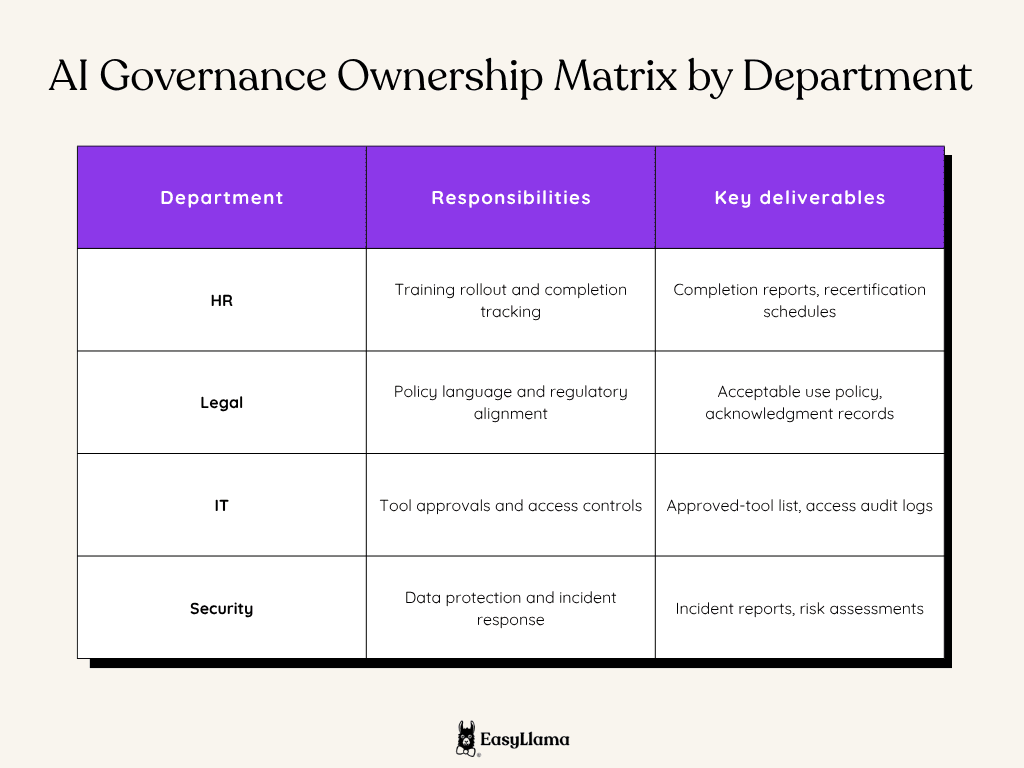
The tools you use have to match that structure. Each stakeholder gets a defined scope of visibility through EasyLlama's organizational hierarchy and segmented dashboards. HR leaders see training completion and compliance gaps, while Legal teams access policy acknowledgment records. That clarity keeps accountability tight and prevents enforcement gaps.
Step 4: Turn policy into role-based training
This is the step where most governance programs stall. A written policy sitting in a shared drive does not change employee behavior. Training is the bridge between policy and practice, and it needs to be targeted, accessible, and scalable.
Employees also need a reliable way to find approved information when questions arise, which is why many organizations maintain an AI knowledge base that makes policies, procedures, and guidance easier to access and search.
Design training by role and risk level
Different employees interact with AI in different ways, and your training should reflect that reality. Executives require strategic risk awareness covering regulatory liability and reputation, while frontline staff need practical guidance on approved tools and data-sharing boundaries. Technical teams need a separate track focused on development guardrails and safe data handling practices.
Generic, one-size-fits-all training leads to low engagement and poor knowledge retention. Pairing AI literacy fundamentals with governance-specific rules helps employees understand both what the policy requires and why it matters, which makes them far more likely to follow it.
Deploy training at scale without heavy admin lift
Turning a written policy into assigned training shouldn't require an instructional designer or a multi-week project. HR teams can upload internal AI policies, PDFs, or slide decks and convert them into trackable, interactive training using EasyLlama's Course Authoring Tool. The tool auto-generates a course outline and quiz questions from your source materials, with scenario-based exercises built in. Admins can go from an existing policy document to an assigned course in a single session, without IT involvement or external vendors.
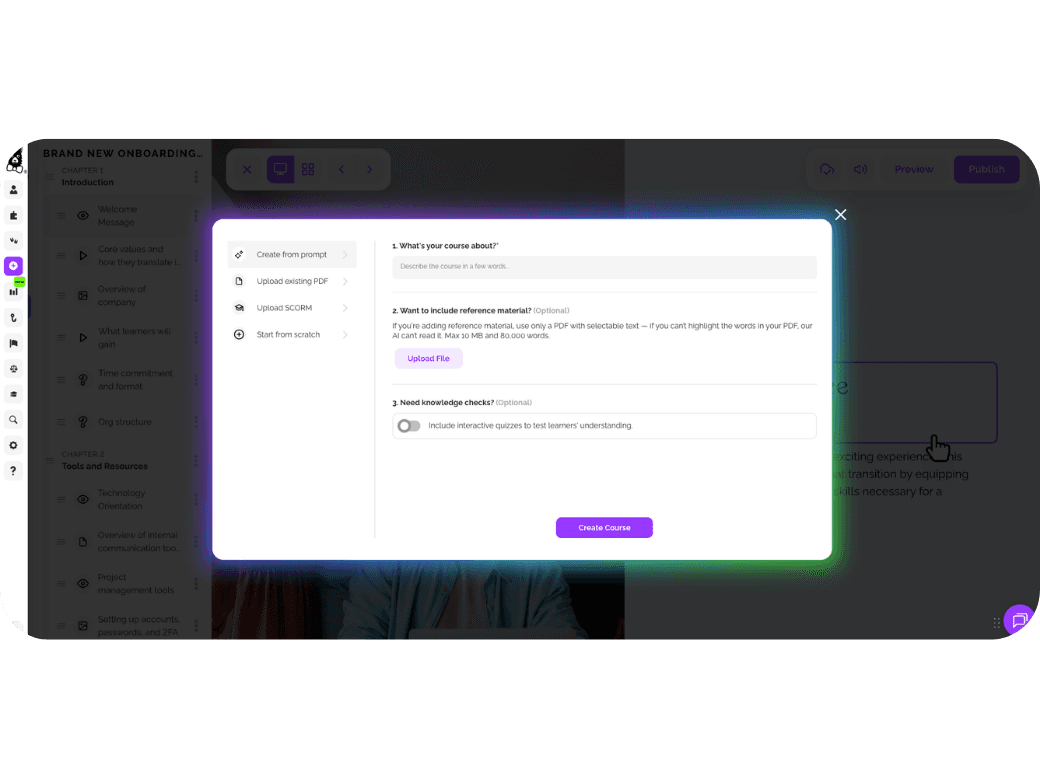
For organizations that need foundational AI training immediately, EasyLlama's AI Course Collection provides a ready-made baseline covering AI literacy and data privacy, including security risks relevant to everyday employee behavior. These expert-led, bite-sized courses can be deployed right away, and custom-authored governance courses can then layer organization-specific policies on top.
Employee data also stays in sync, and AI governance training gets assigned by role or department automatically through EasyLlama's HRIS integrations with Workday, BambooHR, Gusto, and ADP. Multi-channel reminders through email and Slack drive completion without manual follow-up, enabling rapid AI governance framework enterprise implementation while substantially reducing admin work.
Be sure to build in refresher cycles and recertification schedules from the start. Training that was accurate six months ago may already be outdated.
Step 5: Establish documentation and audit trails
Documentation is a regulatory requirement, not an administrative extra. The EU AI Act mandates technical documentation and record-keeping for high-risk AI systems. Auditors, therefore, increasingly expect evidence of employee training and policy acknowledgment as proof that governance is operational.
The essential records include:
- Policy acknowledgment signatures
- Training completion certificates
- Employee attestations
- Version-controlled policy documents
- Decision traceability showing who approved each AI tool and the conditions and risk assessment behind each decision
Pulling these records from disconnected systems is where audit prep gets painful. HR and Legal teams get a single source of truth for training records and policy acknowledgments through EasyLlama's compliance dashboard and document signature capabilities—bulk certificate exports and timestamped records mean you're never scrambling when an auditor calls.
Step 6: Monitor, measure, and keep governance current
AI governance is a continuous program. This final step covers both ongoing performance tracking and the change management process that keeps your framework aligned with evolving regulations and tools.
Track KPIs and audit regularly
Ongoing monitoring is essential to catch bias, drift, model risk, and compliance gaps before they escalate. Define specific metrics to track your governance program's health:
- Training completion rates
- Policy acknowledgment percentages
- Incident report volume
- Audit findings
- Time-to-compliance for new regulations
- Employee confidence scores
Schedule governance audits quarterly or biannually to review your AI tool inventory, training accuracy, and any policy updates triggered by regulatory changes.
These audits should also watch for model drift — the gradual degradation of an AI system's accuracy or reliability over time. When bias incidents or emerging risks surface, a defined escalation and review process ensures they are addressed promptly.
Adapt as regulations and tools evolve
AI regulations are actively evolving. The EU AI Act has staggered compliance deadlines through 2027, and frameworks like the NIST AI RMF and ISO/IEC 42001 continue to shift alongside them. The OECD AI Principles are shaping international standards as well, which means your governance framework must keep pace with multiple moving targets.
Training content is one place where that pace becomes manageable. AI governance training stays current automatically — courses update when relevant regulations or risk guidance changes, built into EasyLlama's platform by default. This helps organizations avoid stale training across active assignments, including jurisdiction-specific requirements for multi-region teams. Organizations also receive proactive notifications when regulations affecting their industry change.
Establish a change management process that defines who monitors regulatory developments, how policy updates get approved, and how updated training reaches employees. AI literacy is an ongoing investment, and building a culture of responsible AI use requires consistent reinforcement as the technology and rules around it continue to develop.
Make AI governance actionable with EasyLlama
An AI governance framework only matters when it reaches every employee as clear policy, relevant training, and documented compliance. The six steps outlined here form a repeatable cycle, not a linear checklist. Governance matures with each iteration as your organization's AI use, regulatory environment, and workforce needs evolve.
EasyLlama gives HR and compliance teams the infrastructure to move from policy draft to company-wide, auditable compliance without heavy IT lift or months of lead time. HR teams can convert policies into training immediately and automate assignments through HRIS integrations — all while keeping documentation audit-ready in one place with EasyLlama's Course Authoring Tool.
Book a Demo to see how EasyLlama can help your organization implement AI governance training at scale.
Share this


Frequently
Asked
Questions

- The EU AI Act requires organizations to classify AI systems by risk level and maintain documented compliance for high-risk applications. This includes mandatory technical documentation and human oversight requirements, as well as evidence of employee training. Any company operating in or serving the EU market needs a structured governance framework to meet these obligations.
- AI governance requires cross-functional ownership. HR typically leads training rollout and completion tracking, while Legal owns policy language and regulatory alignment. IT manages tool approvals and access controls. A steering committee with representatives from each function ensures coordinated decision-making.
- Every employee needs training tailored to their level of AI exposure. Executives should focus on strategic risk awareness, while technical teams need development guardrails. All employees need to understand the organization's acceptable use policy and know where to find it.
- Review your framework at least quarterly. AI regulations like the EU AI Act have staggered compliance deadlines through 2027, and tools evolve continuously. Each review should assess your AI tool inventory, policy relevance, training accuracy, and compliance metrics.
- Start by inventorying all AI tools currently in use across your organization, including unofficial ones. Then draft a clear acceptable use policy and assign cross-functional ownership. From there, deploy targeted training across the organization. Platforms like EasyLlama help mid-size teams move from policy to training quickly without requiring large IT or compliance budgets.
 Articles
Read More Blogs
Explore what others in your field are learning

AI Governance Audit: What to Expect and How to Prepare
Learn what an AI governance audit is, who's responsible for it in your organization, and what documentation and processes you need to be covered for an audit.
Blaine Sanders

The Agile Compliance Checklist: 7 Steps To Reduce Risk
Use this 7-step agile compliance checklist to assess your program, identify gaps, and build a system that keeps pace with changing regulations.

Katrine Reddin
![12 Best Security Awareness Training Providers [2026]](/_next/image?url=https%3A%2F%2Fd230yvp9l0f4m2.cloudfront.net%2FCybersecurity_654735261c.jpg&w=1200&q=75)
12 Best Security Awareness Training Providers [2026]
Discover the 12 best Security Awareness Training providers that drive real behavior change—not just compliance checkboxes.

Michael Devyver
Start Modernizing Workplace Compliance
It’s easy to get started with EasyLlama. Speak with one of our compliance experts and get a demo tailored to your business’s needs.