Required California Compliance Training



There are three required compliance trainings in California—most employers only know about two. Learn about the third and stay protected.

Ask a California employer about mandatory workplace training and you'll usually hear about harassment prevention training. What gets discussed less often is that many employers may also have training obligations related to workplace violence prevention and injury and illness prevention.
These are distinct requirements with different legal foundations and different compliance obligations. Understanding one does not necessarily mean you've covered the others.
In working with employers, I've found that compliance gaps often arise not because an organization is ignoring its obligations, but because it's focused on one requirement without realizing there are additional training mandates that may also apply.
My goal in this article is simple: provide a straightforward overview of the three major workplace training requirements California employers should know about and explain how they fit into a broader compliance program.
Training #1: Injury & Illness Prevention Program (IIPP) Training
This is the one most employers don't know about. And that surprises me, because it's actually one of the foundational workplace safety obligations in California and has been around the longest of all the requirements - since 1991! — required under California Code of Regulations, Title 8, Section 3203.
The IIPP isn't just paperwork. Under California Code of Regulations Title 8, Section 3203, California employers are required to establish, implement, and maintain a written safety program — and to train employees on it. The training requirement is an explicit regulatory mandate, not merely an implied safeguard.
Who it applies to: Nearly all California employers, including office environments, remote work, outdoor work, manufacturing facilities, and construction sites.
What's required:
- A written plan that addresses hazard identification, correction procedures, incident investigation, and safety communication.
- Training at hire, when job assignments change, when new hazards are introduced, or when previously unknown hazards are identified.
- Employees must understand how to recognize hazards, follow safe work practices, and report unsafe conditions.
- Supervisors must be trained to enforce safe work practices.
- Ongoing recordkeeping that supports IIPP implementation and training efforts.
Common misconception I see: "We're an office — IIPP doesn't really apply to us."
All California employers need an IIPP, including offices. Hazard profiles vary, but even office environments have ergonomic risks, emergency response procedures, and reporting obligations that must be addressed. The IIPP is designed to function as a living operational safety system, not a one-time document.
Another one: "Generic safety orientation is enough."
Training must address workplace-specific hazards and actual job duties. IIPP citations frequently come down to this — employers using boilerplate content disconnected from what their employees actually do.
Why it matters: Cal/OSHA routinely uses the IIPP as a gateway enforcement mechanism. During inspections, regulators ask for the written IIPP, training documentation, and hazard correction records. In serious injury or fatality investigations, they examine whether employees were trained on the specific hazard that caused the incident. A weak IIPP also tends to compound liability under other Cal/OSHA standards, because it signals a broader systemic problem with how the employer approaches safety.
Training #2: Harassment Prevention Training
California's harassment prevention training requirement lives inside the Fair Employment and Housing Act (FEHA), and it's more expansive than most people expect.
Who it applies to: Employers with five or more employees.
What's required:
- Supervisors must receive at least 2 hours of training every two years.
- Non-supervisory employees must receive at least 1 hour every two years.
- Training must be provided within a reasonable period after hire or promotion.
What the training must cover: This is where I see a lot of employers fall short. California's law is not just about sexual harassment. Your training must address discrimination, retaliation, abusive conduct, gender identity and expression, protected classifications under FEHA, complaint reporting procedures, and — critically for managers — how to handle and escalate complaints appropriately.
Common misconception I see: "We have a generic anti-harassment video, so we're covered."
Generic content is a real compliance risk here. California expects training to be interactive, include practical examples, and satisfy specific content standards set by the California Civil Rights Department. A one-size-fits-all presentation that doesn't address California-specific obligations, complaint handling, or supervisory duties may not meet the bar.
Why it matters beyond the checkbox: Failure to provide compliant training doesn't create a standalone lawsuit, but in litigation, the absence of training becomes evidence that the employer didn't take "reasonable steps" to prevent harassment under FEHA. That's especially damaging when a supervisor is involved. Poorly trained managers who delay escalating complaints, minimize concerns, or inadvertently retaliate after a report often cause more harm — and more liability — than the original conduct itself.
Training #3: Workplace Violence Prevention Training
This is California’s newest training requirement. California Labor Code section 6401. 9 took effect in 2024, and requires most California employers to establish, implement, and maintain a written Workplace Violence Prevention Plan (WVPP) — and to train employees on it.
But many assume workplace violence training is only a concern for healthcare facilities, security companies, or other high-risk industries. It isn't. In the year before, Labor Code section 6401.9 took effect, nearly two million American workers spread over every industry and type of worksite were impacted by workplace violence.
What's required:
- A written WVPP in place.
- Training for all employees at hire.
- Annual retraining.
- Additional training whenever the WVPP materially changes, workplace hazards change, job duties expose employees to new risks, or a significant workplace violence incident occurs.
What training must cover: Employees need to understand how to recognize workplace violence hazards, what the reporting procedures are, how to respond in an emergency, and that they're protected from retaliation for reporting. The training must be interactive and allow for employee questions.
Common misconceptions I see:
"We already have harassment training — doesn't that count?" No. Workplace violence prevention training and harassment prevention training are entirely separate legal obligations with different content requirements, timelines, and governing authorities.
"Workplace violence only means physical assault." This is a significant misread of the law. SB 553 covers threats, intimidation, verbal escalation, and behavioral warning signs. Employers who focus exclusively on active assailant scenarios frequently undertrain employees on the early intervention and reporting obligations that California actually cares about.
"A written WVPP policy in our handbook satisfies the requirement." A policy sitting unread in a handbook is not compliance. Cal/OSHA expects employees to understand their workplace-specific risks, know the reporting channels, and understand what to do in an emergency.
Why it matters: Cal/OSHA can and does cite employers for missing WVPP requirements. The most serious exposure, though, comes after an incident. If a violent event occurs and it emerges that employees didn't know how to report escalating behavior, or that the employer had never updated training after prior incidents, those gaps become central evidence in Cal/OSHA investigations and civil litigation.
The Bigger Picture: Three Requirements, One Compliance Strategy
The reason I'm writing this is that California compliance isn't a single-lane road. Employers who focus exclusively on harassment prevention training are leaving real exposure on the table — not because they're careless, but because the other two requirements don't get nearly the same level of attention in the HR world.
Here's a quick summary of all three:
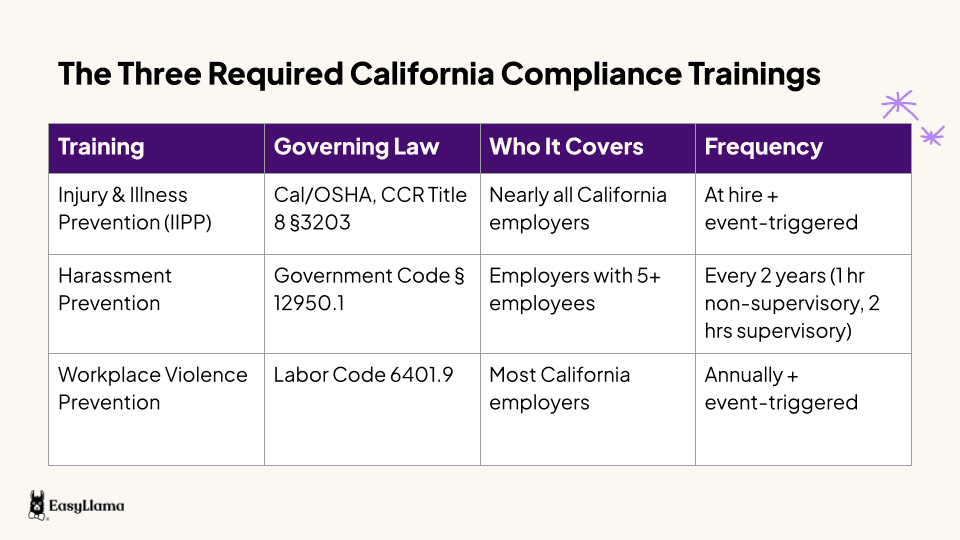
Getting all three right requires more than a good policy document. It requires training that employees actually understand, records that demonstrate completion, and systems that can keep pace with changes — new hires, new roles, updated plans, or incidents that trigger retraining obligations.
That's exactly what EasyLlama is built to help with. Our course library includes California-compliant courses for all three of these requirements, designed to meet the specific content standards California regulators expect — not generic content repurposed from other states. And because compliance doesn't stand still, our platform makes it straightforward to assign, track, and document training as your workforce and your obligations evolve.
If you have questions about what California requires for your organization, I'd recommend consulting your employment counsel — what I've shared here is an overview, not legal advice tailored to your specific situation. But if you're looking to make sure your training program actually covers what California law requires, I'd encourage you to take a closer look at what you have in place for all three.
Ready to see how EasyLlama handles all three California training requirements in one place? See EasyLlama in Action →
Written by Doug Johnston, General Counsel at EasyLlama
Share this


 Articles
Read More Blogs
Explore what others in your field are learning

California Harassment Training Online Free Resources Versus EasyLlama: Which One Should You Choose?
Free California harassment training might save money but lacks quality. Learn why EasyLlama is worth the investment, preventing future headaches and legal issues.

Saphira Ensley

California AB 2053 Sexual Harassment Training Requirements Online
EasyLlama offers online sexual harassment training that meet California AB 2053 training requirements - sign up now on EasyLlama.com

Alicia Falcon

SB 240 and Workplace Violence in Texas Healthcare

Start Modernizing Workplace Compliance
It’s easy to get started with EasyLlama. Speak with one of our compliance experts and get a demo tailored to your business’s needs.