Beyond Sexual Harassment Training: Illinois and Chicago's Industry-and Role-Based Requirements



Get a breakdown of Illinois and Chicago's sexual harassment training requirements, plus the industry- and role-specific compliance trainings employers often miss.

Most Illinois employers know they need sexual harassment prevention training, but that's only the baseline. This article breaks down the state and Chicago-specific harassment requirements, then walks through the industry- and role-specific training obligations layered on top, covering restaurants, healthcare, education, government, retail, construction, and private security. Readers will come away with a clear framework for figuring out what training applies to each employee based on jurisdiction, industry, and role.
Test Your Compliance
Find out if your company is compliant in two minutes with our free Compliance Grader.
Get Your Free ReportAsk an Illinois employer about mandatory workplace training and you'll usually hear about sexual harassment prevention. That's a fair place to start. Some version of it is required of every employer in the state, and if you have people working in Chicago, the city adds its own version on top of the state's.
What gets discussed a lot less is that harassment prevention is only the training every employer shares. Depending on your industry, and depending on the specific role a given employee holds, Illinois also requires an entirely separate set of trainings: food handler certification, human trafficking recognition, hospital infection control, underground storage tank operator certification, and dozens more. These aren't extensions of the harassment requirement. They're their own distinct compliance domains, triggered by industry and by role rather than by anything related to harassment.
In working with employers, I've found this is where the real complexity lives, not in the baseline, which is well understood, but in the layer underneath it. It isn't one law to track. It's three separate questions stacked on top of each other: what does the jurisdiction require, what does your industry require, and what does this specific person's job require? The answer can change for nearly every employee on your roster.
My goal in this article is to walk through both pieces: the baseline every Illinois and Chicago employer shares, and the industry- and role-specific layer underneath it, plus where each one tends to catch employers off guard.
Training #1: Illinois Sexual Harassment Prevention Training
This is the one most employers already know about, but the details trip people up. It's required under the Illinois Human Rights Act, 775 ILCS 5/2-109, as amended by the Workplace Transparency Act.
Who it applies to: Every employer in Illinois, regardless of size. There is no employee-count threshold.
What's required:
- Annual training for every employee, completed shortly after hire and refreshed every 12 months.
- Content covering the definition of sexual harassment, examples of prohibited conduct, a summary of relevant state and federal law, and the internal complaint process.
- Illinois doesn't set a specific minimum number of hours in the statute itself. The Department of Human Rights publishes a free model program, but employers can also build their own as long as it meets the content requirements.
Common misconception I see: "We're too small for this to apply to us." Illinois drew no line here. A two-person company and a two-thousand-person company owe their employees the exact same training obligation.
Why it matters: A documented training record is one of the first things examined if a complaint escalates to the Illinois Department of Human Rights. Employers who can't produce one are starting from a weaker position, regardless of how the underlying complaint plays out.
Training #2: Chicago Sexual Harassment Prevention & Bystander Intervention Training
This is where I see the most confusion, because employers often assume the Illinois training already covers it. It doesn't. Not entirely. Chicago's requirement lives in Municipal Code § 6-10-040 and sits on top of the state law, not in place of it.
**Who it applies to: **Any employer with even one employee performing work in Chicago. It also reaches supervisors who manage a Chicago-based employee, even if that supervisor is located somewhere else entirely.
What's required:
- One hour of sexual harassment prevention training annually for non-supervisory employees.
- Two hours annually for supervisors and managers, including out-of-city supervisors of Chicago employees.
- One additional hour of bystander intervention training annually, for everyone.
- The training runs on its own annual cycle, July 1 to June 30, with a five-year recordkeeping requirement and its own notice and posting obligations that the state law doesn't have.
The mistake I see most often: "We already do the Illinois training, so we're covered in Chicago too." Chicago's own guidance says the state's one-hour employee training can count toward part of this, but it doesn't cover the additional supervisor hour or the bystander intervention hour, both of which are Chicago-only requirements. And the manager living in Indiana who oversees three Chicago employees still needs that two-hour supervisor training, even though they've never set foot in the city.
**What's actually at stake: **Chicago's ordinance carries its own notice and recordkeeping requirements with real penalties attached, independent of anything Illinois requires. An employer can be fully compliant with state law and still be exposed under the city ordinance.
Beyond the Baseline: Where Industry and Role Take Over
Everything above applies no matter what your company does. Everything below depends entirely on it, and on the specific role each employee holds. I've grouped every requirement two ways, because the distinction changes how you administer it:
- Applies to your whole team in that industry: if you're in this industry, this training goes to essentially everyone, not just a subset.
- Applies to specific roles only: regardless of your industry, if you have an employee doing this specific job, this training follows that person, not your org chart.
One more thing worth knowing before you read through these: Chicago hasn't built its own version of any of this. The city ordinance covers harassment and bystander training only. Everything below is Illinois state law, and it applies the same way whether or not your Chicago location is also covered by the city ordinance. The two obligations run on separate tracks.
Restaurants & Bars
Whole team:
- Human Trafficking Recognition Training (820 ILCS 95/10): every employee of a restaurant, lodging establishment, or truck stop.
- Food Handler Training (410 ILCS 625/3.06(b)): every food handler, unless already certified as a sanitation manager.
- Restaurant/Bar Supplemental Harassment Training (775 ILCS 5/2-110): on top of the statewide harassment course above.
Specific roles only:
- Dram Shop Liability Training (235 ILCS 5/6-27.1): alcohol servers and anyone who checks ID or pours drinks.
Healthcare
Illinois' healthcare rules mostly key off "is this a hospital" or "is this a long-term/dementia care facility" rather than healthcare broadly, so it's worth reading the fine print before assuming coverage either way.
Whole team (hospitals):
- Patient Abuse Detection & Reporting Training (77 Ill. Adm. Code § 250.260(c)(12))
- Health Care Workplace Violence Prevention Training (405 ILCS 90/20)
- Hospital Infection Control & Hand Hygiene Training (77 Ill. Adm. Code 250.1100)
Specific roles only:
- Alzheimer's Services Supervisor Training (77 Ill. Adm. Code 973.140): supervisors in assisted living, nursing homes, and developmental disability residential care.
- Dementia Services Staff Training (77 Ill. Adm. Code 973.140(c)): staff with direct resident access in dementia care settings.
Education (K-12)
Whole team:
- School Personnel Professional Conduct & Reporting Training (105 ILCS 5/10-23.13)
- Seizure Recognition & First Aid Training (105 ILCS 150/25): teachers, administrators, and support staff.
Specific roles only:
- Mandated Reporter Training (325 ILCS 5/4): designated reporters in direct contact with children.
- Child Care Center In-Service Training (89 Ill. Adm. Code 407.100): licensed day-care staff.
- Student Data Privacy & Vendor Compliance Training (105 ILCS 85/15(1)): employees handling student data or ed-tech vendor relationships.
- Campus Security Enhancement Act and Preventing Sexual Violence in Higher Education Act trainings (110 ILCS 12/20; 110 ILCS 155): specific higher-ed emergency management, trauma-response, and complaint-resolution roles.
- Youth Sports Concussion Training (105 ILCS 5/22-80(h)(1)): coaches and game officials.
Government & Public Administration
Whole team:
- Local Government Cybersecurity Training (20 ILCS 1375/5-30): every county and municipal employee.
- State Employee Harassment & Discrimination Prevention Training (5 ILCS 430/5-10.5): state workforce.
Specific roles only:
- Underground Storage Tank Operator Training, Classes A/B/C (41 Ill. Adm. Code § 176.615): designated tank operators.
Retail
Specific roles only:
- Cannabis Dispensary Agent Training (410 ILCS 705/15-65(a)): licensed dispensary staff.
- Underground Storage Tank Operator Training (41 Ill. Adm. Code § 176.615): designated tank operators.
Retail is a good example of how lopsided this can get: there's no whole-team requirement here, only two narrow, role-specific ones. It's easy for a retailer to assume they have nothing beyond the state harassment training and be wrong the moment they open a gas station convenience counter or a dispensary.
Construction
Whole team (public works contractors):
- Public Works Reasonable Suspicion Observation Training (820 ILCS 265/15(2))
- Private Security
Whole team (security industry):
- Private Security Guard Basic Training, initial and annual refresher (225 ILCS 447/25-20)
The Bigger Picture: Three Questions, Not One
The one I hear across every industry above: "We checked the state harassment requirement, so we're covered." That's the baseline. Necessary, but rarely sufficient. The real compliance question for any given employee is three questions stacked on top of each other: What does Illinois require of every employer? What does Chicago add if this person works there? And what does this person's specific industry, and specific role, add on top of that?
What's actually at stake: none of the industry- and role-specific requirements above are optional add-ons or best practices. They're independent legal requirements with their own citations, their own enforcement bodies, and in several cases, their own penalties. A restaurant that's excellent on state and city harassment training but has never touched food handler certification hasn't avoided a compliance gap. It has one it doesn't know about yet.
A quick summary of the three layers, side by side:
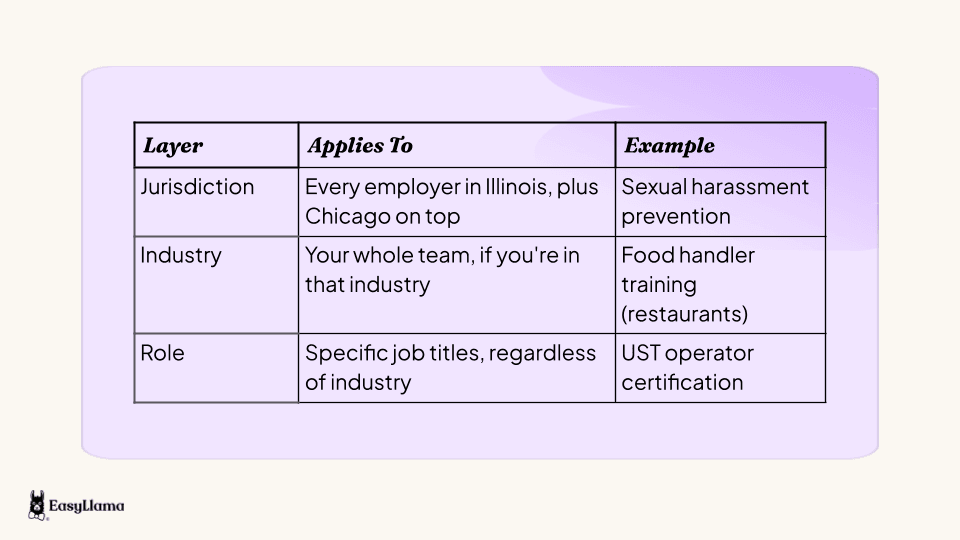
Keeping track of all three, for every employee, as roles change and new hires come on, is exactly the kind of research most HR teams don't have hours in the week for. That's exactly what EasyLlama's Compliance Advisor is built to help with: tell it about your business (your locations, your industry, your roles) and it maps that to what's actually required, explains why, and flags gaps before an audit does.
Talk to our team about Compliance Advisor
Share this


Frequently
Asked
Questions

- Only partially. Chicago allows the state's one-hour employee training to count toward part of its requirement, but it doesn't cover the additional hour of supervisor training or the hour of bystander intervention training, both of which are Chicago-only obligations.
- Yes. Chicago's ordinance reaches any supervisor who manages a Chicago employee, regardless of where that supervisor is physically located. A manager based in another state still needs the two-hour supervisor training if they oversee even one Chicago-based employee.
- No. The Illinois Human Rights Act sets no minimum company size. A two-person business and a two-thousand-person company have the identical training obligation.
- No. The two run on separate tracks with their own notice, posting, and recordkeeping requirements. An employer can be fully compliant with state law and still be exposed under the Chicago ordinance if the supervisor and bystander intervention hours haven't been completed.
- It depends on both your industry and each employee's specific role, so the answer can differ across your own roster. Restaurants, healthcare, education, government, retail, construction, and private security each carry their own requirements, some applying to an entire team and others to a single job title.
- No. Chicago's ordinance only covers harassment prevention and bystander intervention. Every industry- and role-specific requirement discussed in this article comes from Illinois state law and applies the same way regardless of whether a location is also covered by the city ordinance.
 Articles
Read More Blogs
Explore what others in your field are learning
From #MeToo to the Retail Worker Safety Act: The Real History Behind New York's Training Requirements
Learn about the history behind each of New York's compliance training requirements and understand how it impacts your organization.
Doug Johnston

Illinois Harassment Laws Workplace Requirements: Effective in 2020
![Illinois Sexual Harassment Training Requirements & Laws [2022 Informative Guide]](/_next/image?url=https%3A%2F%2Fd230yvp9l0f4m2.cloudfront.net%2Fworkplace_bullying_depression_and_gossip_of_busin_2022_12_15_04_22_57_utc_52427fc627.jpg&w=1200&q=75)
Illinois Sexual Harassment Training Requirements & Laws [2022 Informative Guide]
Start Modernizing Workplace Compliance
It’s easy to get started with EasyLlama. Speak with one of our compliance experts and get a demo tailored to your business’s needs.