How to Customize Cybersecurity Training by Role, Policy & Risk



How HR teams can replace one-size-fits-all cybersecurity training with modules tailored to each employee’s role, company policies, and each team’s actual level of risk.

Learn the three ways to customize cybersecurity training (by role, by policy, and by risk) and the core modules every program should cover, from phishing and data privacy to AI security. Get a practical way to turn existing policy documents into training they can assign and track, plus a quarterly review schedule and a short list of metrics for keeping the program current without an in-house instructional design team.
Test Your Compliance
Find out if your company is compliant in two minutes with our free Compliance Grader.
Get Your Free ReportEvery cybersecurity course I've ever built starts the same way: with a subject matter expert explaining a threat to me in far more detail than any employee will ever need.
My job is to figure out what actually matters to the person sitting through the training, and cut the rest. That's the real work of instructional design, and it's also the exact problem most off-the-shelf cybersecurity training fails to solve.
Generic training treats every employee like they face the same risk. They don't. A finance team member and a frontline retail associate are not defending against the same attacks, and training that ignores that difference wastes their time and misses the threats that actually matter to their job.
Customizable cybersecurity training modules solve for that: training that adapts to your company's policies, your threat profile, and the actual structure of your workforce, instead of a generic course everyone sits through the same way. For HR teams without a dedicated security content function, and without hours to spend building this from scratch, that customization has to be achievable without an instructional design background. This piece walks through what that customization looks like in practice, which modules to prioritize, how to turn your own policies into assignable training, and how to keep the content current as threats change faster than most training calendars do.
##What customizable cybersecurity training modules actually look like
Before getting into specific modules, it's worth defining what "customized" means here, since the word gets used loosely. There are three ways to customize cybersecurity training, and the strongest programs use all three together.
Role-based customization
Role-based customization assigns different modules based on what someone's job actually exposes them to. A finance team member needs training on invoice fraud and wire transfer scams; a remote employee needs training on VPN usage and the risks of public Wi-Fi. Neither needs the other's course.
A few pairings worth building around: HR staff need data handling and personally identifiable information (PII) training, since they handle sensitive employee records daily. IT admins need insider threat awareness, given their access to systems most employees never touch. Frontline and field workers need mobile device security, since their work often runs entirely on a phone. Finance and accounting teams need training specific to invoice fraud and wire transfer scams, the attack category that costs companies the most per incident.
Role-based paths cut the time employees spend sitting through content that doesn't apply to them, and that time savings is also an engagement lever. Nobody pays attention to a scenario they know doesn't describe their job.
Policy-based customization
Policy-based customization means embedding your company's actual cybersecurity policies, acceptable-use rules, and AI-use guidelines directly into the training content, rather than teaching generic best practices and hoping employees connect the dots to your specific rules on their own.
This is the piece I care most about as an instructional designer, because it's where training stops being abstract. A course that says "use strong passwords" teaches nothing an employee can act on. A course that says "use the password manager IT issued you, and here's how to set it up" teaches a behavior. Done well, policy-based modules also double as documentation: employees acknowledge that they've read and understood the policy, which gives HR a record beyond a generic completion certificate.
Risk-based customization
Risk-based customization means adjusting training intensity and focus according to a team's actual assessed risk level, rather than assigning the same frequency and depth to everyone. Phishing simulation data is useful here specifically because it's behavioral, not self-reported: if one department consistently clicks simulated phishing emails at a higher rate, that's the group that needs more frequent or more targeted training, not a company-wide refresher.
This is also the most efficient way to spend a limited training budget. Concentrating additional training where the data shows the actual risk sits does more to reduce breach likelihood than spreading the same generic content evenly across a workforce that doesn't share the same exposure.
Core modules every cybersecurity training program should cover
Customization shapes how training gets delivered, but a handful of threat categories form the foundation every organization needs to address, regardless of industry.
Phishing and social engineering
Phishing remains the most common attack vector by a wide margin, and coverage should extend past email to include SMS phishing, voice phishing (vishing), and QR code scams, since attackers have moved into all four channels. EasyLlama's library of 500+ courses includes an entire Security Awareness topic with 25+ courses covering phishing, social engineering, vishing, QR code scams, and other evolving security threats.
Coursework builds awareness, but employees also need opportunities to put what they’ve learned into practice. EasyLlama’s customizable Phishing Simulations send realistic test emails so employees can identify and respond to threats in a safe environment, followed by short, targeted courses that reinforce awareness in the moment and help drive behavior change that lasts. To customize this piece specifically, tailor simulation templates to mimic the actual tools and vendors your company uses, like your internal HR portal or payroll provider, and adjust simulation frequency by department based on the risk levels your earlier campaigns surfaced.
Natural Retreats, a hospitality company with employees across more than 20 states, built this into a standard practice regardless of role or location. As the company described it: with employees spread across the country, they made the call that every employee, regardless of where they live, takes cybersecurity and phishing courses — a policy decision independent of what any single state requires by law.
Data handling and privacy
This category covers sensitive data classification, proper storage, encryption basics, and alignment with regulations like HIPAA and GDPR. EasyLlama's library includes Data Classification and Handling, Preventing Data Leaks, and Understanding Personally Identifiable Information (PII) as dedicated modules here.
Data handling training only works when it reflects your company's actual data policies and the specific types of information employees handle day to day. To customize it, embed your organization's data classification tiers, approved storage tools, and incident reporting procedures directly into the course, so employees learn your rules instead of a generic best-practice framework they then have to translate into their actual job.
Sarah Donovan, who leads onboarding and employee growth at Showpad, described what that clarity does for a global organization managing sensitive data across teams: "The training itself is so robust, I don't have to worry about compliance." That's the outcome policy-based data privacy training is supposed to produce — confidence that the training reflects the actual rules, not just general awareness.
Password security and device protection
This category covers password hygiene, multi-factor authentication (MFA), and secure device practices across both company-issued and personal devices. Relevant modules include Password Managers & Multi-Factor Authentication, Mobile Device Security, and Personal Device Safety.
Remote and hybrid work setups make this category harder than it used to be, since employees are connecting from home networks and personal devices that IT doesn't control directly. To customize this training, reference the specific password manager and MFA tools your company has actually deployed, and tailor device security guidance depending on whether employees use company-issued laptops, bring their own devices, or share a kiosk on a warehouse floor.
AI security and emerging threats
This is the category I update most often, because the threat landscape underneath it moves faster than almost anything else I build training for. It covers safe AI tool usage, deepfake awareness, and AI-generated phishing attacks, and it needs training content built specifically for it: Safeguarding Sensitive Data from AI Misuse, How to Write Secure AI Prompts, and AI Hallucinations and Misinformation Risks.
To customize this training well, add your company's approved AI tools list and acceptable-use policy directly into the course, along with examples specific to your industry. A professional services firm needs a scenario about client data entered into a public LLM. A manufacturing company needs one about proprietary designs uploaded to an image generator. The underlying risk is the same category; the example that actually lands with an employee is not.
How to turn company policies into assignable training fast
Most HR teams I talk to already have the raw material for this training. It's just sitting in a PDF or a wiki page, not in a format anyone can assign, track, or hold employees accountable to.
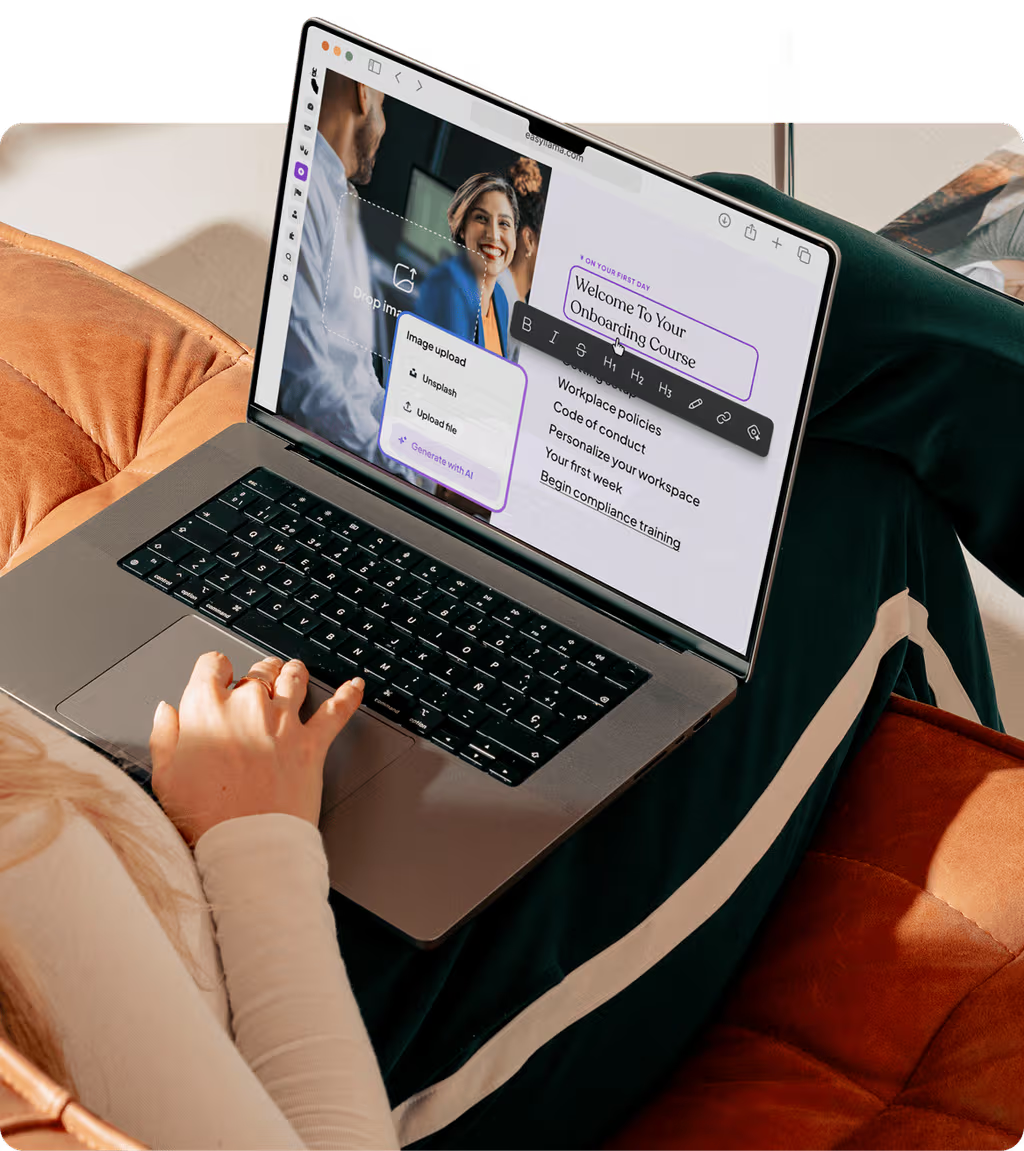
This is where the AI Course Authoring Toolearns its keep. It generates a ready-to-assign course from a single prompt in minutes, and it can work directly from policy documents you upload, adding quizzes and acknowledgments without requiring instructional design expertise on your team. AI-powered editing tools then let you update that course later when policies or threats change, without rebuilding it from the ground up.
Once individual courses exist, admins can bring them together into structured Learning Journeys, so a finance team's Journey can cover phishing and insider threats while a new hire's Journey covers cybersecurity basics and company policy acknowledgment. Admins can put courses in the right sequence and assign the full Journey by role, team, department, or location. HRIS integrations and EasyLlama workflow automations can take that a step further, using changes like new hires, promotions, or location moves to trigger the right training without admins having to manually manage every assignment.
Keep your cybersecurity training program effective over time
Customization isn't a setup task you finish once. The value comes from sustaining it, measuring what's working, and adjusting as both threats and teams change.
A practical cadence looks like this: review modules quarterly against new threat intelligence, whether that's emerging AI-driven attacks or a new phishing tactic making the rounds. Use the AI Course Authoring Tool's editing capability to update scenarios and examples as needed without rebuilding the course from scratch. Set annual renewals for foundational modules, so employees revisit the core topics with content that's actually current rather than a stale repeat of last year's version.
On the measurement side, a few metrics tell you most of what you need to know: completion rates overall and by department, phishing simulation click rates over time, time-to-report for simulated incidents, and completion trends that flag a lagging department before its gap turns into an actual risk. EasyLlama’s AI-powered Reporting Assistant makes it easy to pull exactly this kind of insight, letting admins ask questions about their training data in plain language and get answers as charts, tables, or summaries without reconstructing the data in a spreadsheet.
Samantha Sherman, HR Manager at Zenetec, described what it's like to finally have that kind of control over content that used to require an outside vendor every time something changed: "We wanted training that actually reflected how we work at Zenetec, and now with EasyLlama, we can build and update that internally as the company continues growing." That's the real test of a sustainable program: not whether it launched well, but whether your team can keep it current without starting over every time.
Customized cybersecurity training reduces risk, increases engagement, and simplifies the compliance side of the job all at once, and none of that requires adding headcount or a separate content function. The right platform makes the customization itself the easy part. If you want to see what that looks like for your team, book a demo.
Share this


Frequently
Asked
Questions

- Customize cybersecurity training by matching content to the threats, responsibilities, and systems each role encounters. For example, finance teams may need more emphasis on invoice fraud and phishing, while IT teams may need deeper training on access controls and data security. Admins can also bring relevant courses together into structured learning paths so employees receive training that reflects what they actually encounter in their work.
- Customize cybersecurity training by incorporating the specific policies, procedures, and security practices employees are expected to follow. This might include requirements for passwords, acceptable use, data handling, remote work, or incident reporting. Connecting training to your actual policies helps employees understand not only general security best practices, but exactly what your organization expects them to do.
- Customize cybersecurity training based on factors like job responsibilities, access to sensitive information, phishing simulation performance, and previous training results. Employees or teams with greater exposure or repeated risky behaviors may need more targeted training, reinforcement, or realistic practice. Using these signals helps organizations focus additional training where risk is highest instead of giving every employee the same experience.
- Customized cybersecurity training can be more relevant and actionable because employees receive education tied to the risks they are most likely to encounter. A finance employee handling payment requests faces different threats than an IT administrator with elevated system access, so identical training may leave important gaps for both. Tailoring training by role, policy, and risk helps organizations focus employees’ attention on the behaviors that matter most while still providing a consistent foundation in security awareness.
- EasyLlama gives organizations several ways to tailor cybersecurity training to their workforce, policies, and risks. Admins can customize courses, create company-specific training with the AI Course Authoring Tool, and bring relevant courses together into structured Learning Journeys that can be assigned by role, team, department, or location. EasyLlama also supports customizable Phishing Simulations and reporting tools that help organizations identify areas of risk and determine where additional training or reinforcement may be needed.
 Articles
Read More Blogs
Explore what others in your field are learning

Navigating Cybersecurity for Protecting Data in the Cloud

Secure Your Remote Workforce with Cybersecurity Best Practices
![7 Best Online Compliance Training Providers [2026]](/_next/image?url=https%3A%2F%2Fd230yvp9l0f4m2.cloudfront.net%2Fbusiness_people_meeting_and_computer_in_group_pla_2023_11_27_05_22_36_utc_7a8a1249a6.jpg&w=1200&q=75)
7 Best Online Compliance Training Providers [2026]
Discover the 7 top online compliance training providers, and which is the best fit for you.

Sarah Hamilton
Start Modernizing Workplace Compliance
It’s easy to get started with EasyLlama. Speak with one of our compliance experts and get a demo tailored to your business’s needs.